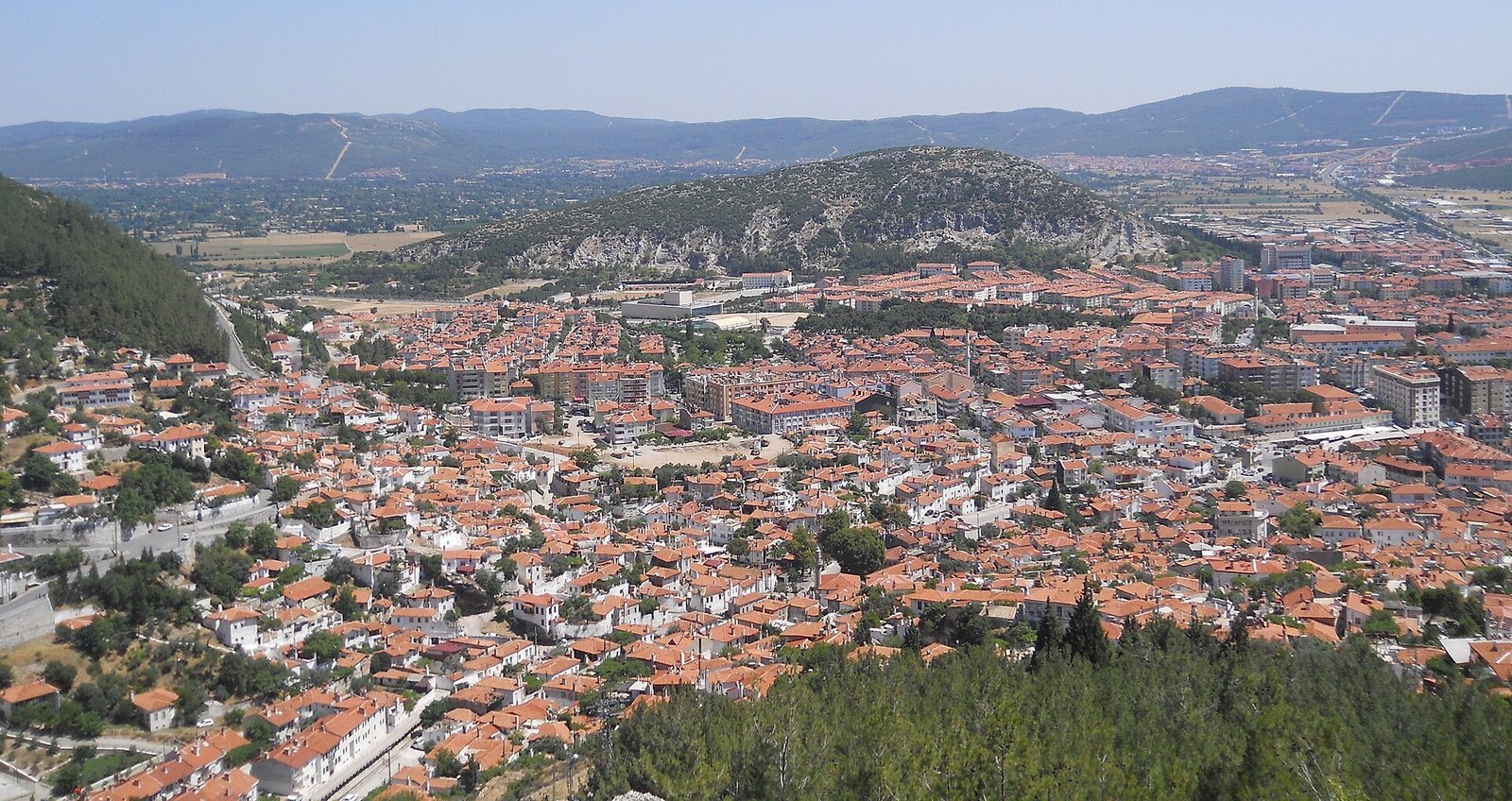
If you plan a trip to southwestern Türkiye, you will probably pass through Muğla. Most visitors treat it as a gateway to the coast. The city itself has a longer story than the beaches suggest, and its name is part of it. This guide follows that name and the history behind it.
Where Is Muğla, and Why Does the Setting Matter?
Muğla stands in the ancient region of Caria, on the slopes of Asartepe. It sits roughly 650 metres above the sea. That height explains a lot. The old town grew on a hillside, not on a harbour, so its character is different from the coastal towns in the same province.
When you walk the narrow lanes, you are walking on the slopes of a hill that people settled long before the Turks arrived. The next section shows how we know that.
The Origin of the Name Muğla
The best-supported explanation is simple. The name comes from the ancient name Mobolla. Over time, Mobolla turned into the form Mogola. The TDV Encyclopedia of Islam explains Muğla this way.
Two written records back it up:
- An inscription found in Muğla and dated to the 2nd century BC records the name of the town as Mobolla.
- In the 10th century, the Byzantine Emperor Constantine VII mentions the settlement as Mogola in his work De Thematibus.
So the name was not invented in the Turkish period. It was already in use in the 2nd century BC. It was still in use, in a slightly changed form, more than a thousand years later. From Mogola to Muğla is a short step.
The Muğlı Bey Story: A Legend, Not a Record
You may come across another explanation. It says the city took its name from a conqueror called Muğlı Bey. This claim comes from Evliya Çelebi, who passed it on. It has never been verified.
The two explanations are not equal. One rests on an inscription and a Byzantine text. The other is an unconfirmed story. If you need to cite a source in an essay, use Mobolla.
What Was Mobolla Like?
The ancient town stood on a rocky hill called Masa Dağı or Asar. Researchers have identified the following there:
- Fortress walls
- Rock-cut tombs
- Cisterns
- The remains of three open-air temples
The cisterns are a practical clue. A hilltop town needs to store water, and the people of Mobolla built for that. The rock tombs and temples show a community that had both a defensive base and religious life.
From Rome to Byzantium
In 395, the Roman Empire was divided. Caria remained within the borders of the Eastern Roman Empire. That is why a 10th-century emperor in Constantinople could write about Mogola as part of his own world. The settlement belonged to the Byzantine sphere for the centuries that followed.
Menteşe Beylik and the Ottomans
The Menteşe Beylik shaped the Turkish history of the region. Its rule in Muğla is visible today in the Great Mosque in the Tabakhane quarter. According to the Menteşe District Governorate, the builder was İbrahim Bey, son of Orhan, from the Menteşeoğulları family. Sources disagree on the date. A thesis made available by Istanbul University gives 1344. The Menteşe District Governorate page says 1334. Treat the date as uncertain.
The political story moves fast after that:
- In Bayezid I’s campaign of 1389–1390, the Muğla branch of the Menteşe Beylik fell to the Ottomans.
- In 1402, the Ottomans lost the Battle of Ankara. The Menteşe Beylik became independent again.
- The TDV Encyclopedia of Islam dates the final Ottoman rule over the Menteşe lands, Muğla included, to 827 in the Islamic calendar, which is 1424.
Nearby in Milas, the Firuz Bey Mosque has a door inscription. It says that Hoca Firuz Bey, governor of Menteşe, had it built in 1394 by the architect Hasan bin Abdullah. That date falls between the first Ottoman conquest and the return of independence, so it shows how mixed those years were.
Muğla Under Ottoman Rule
In 1493, Hacı Muslihuddin had a complex built. It included a mosque, a madrasa, a teachers’ building and a fountain. A complex like this gave a town its social centre.
Trade followed. In the 16th century, the Muğla bazaar between the Great Mosque and the Hacı Muslihuddin Mosque held 250 to 300 shops. That is a big market for a hill town. You can still feel the logic of the layout: the two mosques acted as anchors, and the shops filled the street between them.
The Clock Tower and the Old Houses
The Clock Tower in the Arasta dates to 1895. Hacı Kadızade Süleyman Efendi and his wife Pembe Ana had it built by a Greek master named Filvarus. It is made of cut stone and brick. It has a square plan that narrows upward in five levels.
The houses tell a similar story of mixed communities. Traditional Turkish houses in Muğla are organised around a courtyard and a central living space. The Greek houses in Konakaltı and Saburhane look different. They have cut-stone fronts and open straight onto the street. If you stand in one of those districts, you can read the difference from the facades alone.
Timeline
- 4th century BC: The rock tombs of Kaunos, visible from Dalyan, are built.
- 337 BC: The trilingual inscription at Letoon is dated.
- 2nd century BC: An inscription in Muğla records the name Mobolla.
- 395: Caria stays within the borders of the Eastern Roman Empire.
- 10th century: Constantine VII uses the name Mogola.
- 1389–1390: The Muğla branch of the Menteşe Beylik falls to the Ottomans.
- 1394: The Firuz Bey Mosque in Milas is built.
- 1402: After the Battle of Ankara, the Menteşe Beylik becomes independent again.
- 1424: Muğla enters firm Ottoman rule, according to the TDV Encyclopedia of Islam.
- 1493: The Hacı Muslihuddin Complex is built.
- 1895: The Clock Tower in the Arasta is built.
- 1988: Xanthos-Letoon enters the UNESCO World Heritage List.
- 1994: The Muğla Museum opens to visitors.
Beyond the City: Kaunos, Knidos and Letoon
The province holds sites older than the city’s written name.
Kaunos. It lies in Çandır village in Köyceğiz district. It was a port town. The Dalyan Delta formed over time and left the town away from the sea. The rock tombs of Kaunos can be seen from Dalyan. They were made in the 4th century BC and were still used in the Roman period.
Knidos. It lies at Tekir Burnu on the Datça Peninsula. The city grew in two parts: on the mainland and on an island called Kap Krio. The gap between island and mainland was filled in, and two harbours formed. The northern one served military use. The southern one was for merchant ships.
Letoon. It is in Muğla province. It was listed by UNESCO in 1988 together with Xanthos, which is in Antalya. Three temples stand there, dedicated to Leto, Artemis and Apollo.
Details You Won’t Find in Guidebooks
- In the 17th century, the stream running through the Muğla bazaar had 13 bridges. Seven were wooden and six were stone.
- The traditional Muğla chimney is built with 28 traditional alaturka tiles. All four sides are left open. This stops the chimney from clogging and keeps stoves from smoking. If you look at rooftops in the old town, you are looking at a practical answer to a daily problem.
- The Muğla Museum opened in 1994 after excavations at Özlüce in 1993 produced fossils. It shows fossils of creatures that lived 5 to 9 million years ago. A section on gladiators sits in the same museum.
- The Letoon inscription of 337 BC is in Lycian and Greek. It also carries a summary in Aramaic.
- In 2016, a news report said that a looting investigation near Knidos turned up 14 bronze coins, 24 small bronze statues and six bronze earrings in the vehicle of two suspects. The ancient sites still need protection.
FAQ
Where does the name Muğla come from?
The name goes back to the ancient Mobolla, which later became Mogola. A 2nd-century BC inscription found in Muğla records Mobolla, and a 10th-century Byzantine work uses Mogola.
Who was Muğlı Bey?
Muğlı Bey is a conqueror in a story that Evliya Çelebi passed on. The story is unverified. The competing explanation, the one from ancient Mobolla, rests on written records.
When did Muğla become Ottoman?
The Menteşe branch at Muğla fell to the Ottomans in Bayezid I’s campaign of 1389–1390. The beylik regained independence after the Battle of Ankara in 1402. The TDV Encyclopedia of Islam dates final Ottoman control of the Menteşe lands, Muğla included, to 1424.
Which ancient sites belong to Muğla province?
Kaunos near Dalyan, Knidos on the Datça Peninsula and the Letoon sanctuary are all in the province. Letoon was listed by UNESCO in 1988 together with Xanthos.
Sources
- TDV İslâm Ansiklopedisi — Muğla islamansiklopedisi.org.tr
- Muğla İl Kültür ve Turizm Müdürlüğü — Mobolla mugla.ktb.gov.tr
- Türkçe Vikipedi — Muğla tr.wikipedia.org
- İstanbul Üniversitesi açık erişim tezi — Muğla Ulu Camii bölümü nek.istanbul.edu.tr
- Menteşe Kaymakamlığı — Muğla Ulu Camii mentese.gov.tr
- Menteşe Kaymakamlığı — Saatli Kule mentese.gov.tr
- Muğla İl Kültür ve Turizm Müdürlüğü — Neyi Meşhur? mugla.ktb.gov.tr
- Muğla İl Kültür ve Turizm Müdürlüğü — Muğla Bacası mugla.ktb.gov.tr
- Kültür ve Turizm Bakanlığı DÖSİMM — Muğla dosim.ktb.gov.tr
- Muğla İl Kültür ve Turizm Müdürlüğü — Kaunos mugla.ktb.gov.tr
- Ortaca Kaymakamlığı — Kaunos Antik Kenti ortaca.gov.tr
- Kültür ve Turizm Bakanlığı — Muğla Knidos Örenyeri muze.gov.tr
- Muğla İl Kültür ve Turizm Müdürlüğü — Dini Yapılar mugla.ktb.gov.tr
Image: Muğla 9932 (cropped).JPG — Perencal, CC BY-SA 3.0