Picture a wall of granite blocks, stacked with no cement, standing for centuries in the hills of southern Africa. In the 19th century, some Europeans looked at it and refused to believe Africans had made it. The evidence says otherwise. This article explains who built Great Zimbabwe, what the ruins contain, and how a colonial myth was built and then taken apart.
Who built Great Zimbabwe?
The ancestors of the Shona peoples built Great Zimbabwe. The Shona live in present-day Zimbabwe and the lands around it. Monumental building began in the 11th century and continued into the 15th. From the 13th century the city served as the capital of the Great Zimbabwe Kingdom.
The National Museums and Monuments of Zimbabwe (NMMZ) describes the site as the largest pre-colonial settlement in the southern African region. The modern state of Zimbabwe takes its name from it. So the question “who built it?” has a plain answer. The harder question is why anyone argued about it.
Where is Great Zimbabwe located? A map in words
If you are looking for Great Zimbabwe on a map, find the city of Masvingo in the south of Zimbabwe. The ruins sit about 30 kilometres from that city. The site stands at roughly 1,100 metres above sea level.
This is not a place you pass by chance. You travel to it. Plan the visit as a day trip from Masvingo, and expect to climb, because one of the three main groups of ruins sits on a hill.
The ruins: three groups of buildings
The site has three main groups of structures:
- the Hill Ruins,
- the Great Enclosure,
- the Valley Ruins.
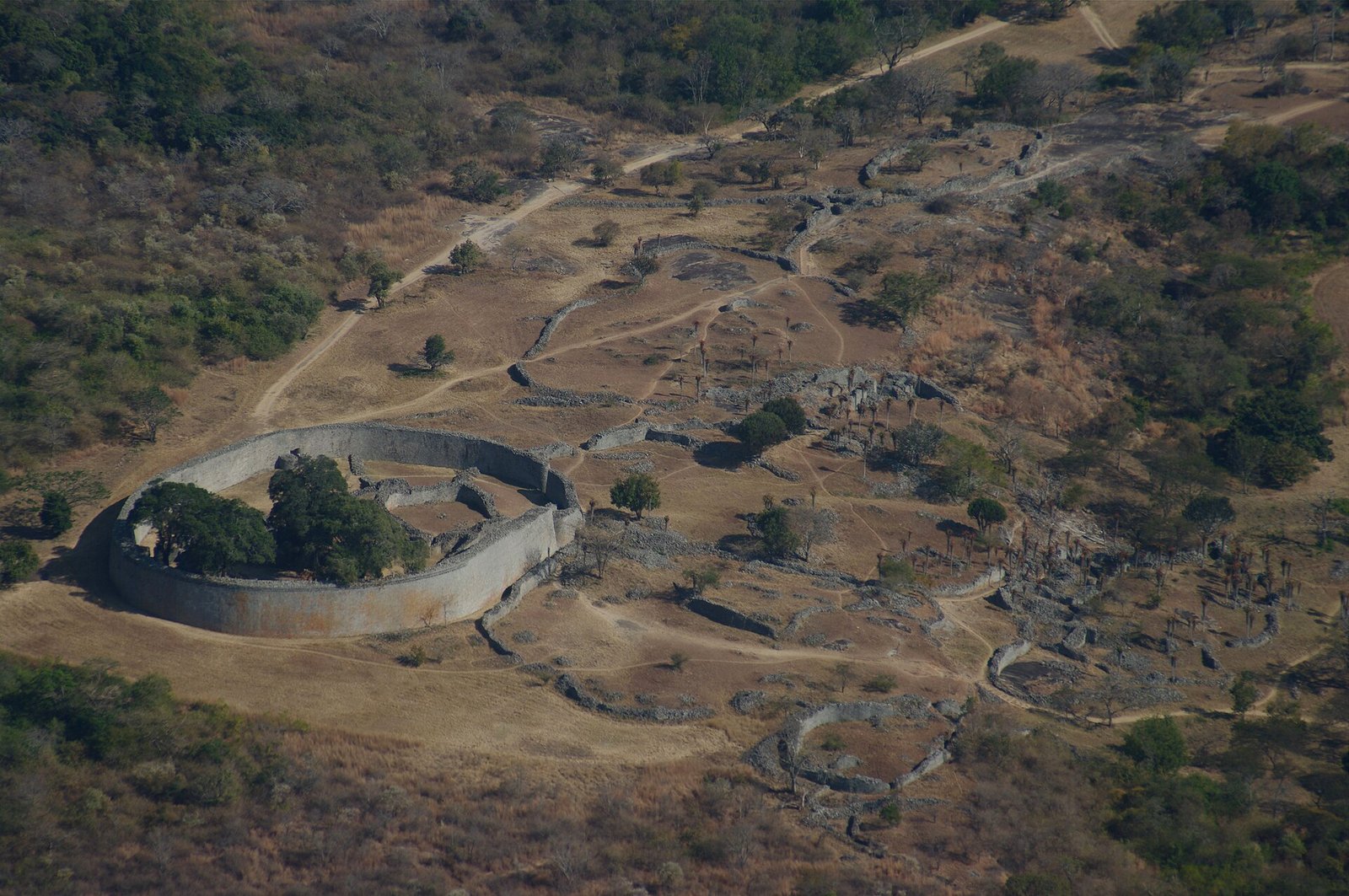
The Great Enclosure lies south of the hills. It is oval in shape, and UNESCO dates it to the 14th century. Between two of its walls stands a conical tower about 9 metres high and 5.5 metres across.
How the walls stand without mortar
The stone walls were made by laying granite blocks on top of one another. The builders used no mortar and no other binding material.
Think of stacking books on a shelf. Each one sits on the one below, and only careful placement keeps the pile upright. Now do it with granite and on the scale of a city.
Inside the stone enclosures, people lived in houses made of daga. Daga is a mixture of granite sand and clay. So the city combined two materials: stone for the great walls and daga for homes.
The Great Zimbabwe empire: trade and cattle
People often search for the “Great Zimbabwe empire”. The site’s own record speaks of a kingdom, the Great Zimbabwe Kingdom, with Great Zimbabwe as its capital from the 13th century. That is the term to use.
The city was not isolated. Archaeologists found Chinese and Iranian ceramics, glass beads and Kilwa coins at the site. These finds show that the city took part in long-distance trade networks.
Imported goods are only part of the story. Archaeologist Shadreck Chirikure published an assessment in 2019. He argued against models that explain the economy through imported luxury goods alone. His approach puts the seasonal production and circulation activities of households in the foreground.
Cattle also mattered. The site has yielded a large number of cattle bones. They show how important herding was in the economic and political life of the settlement. If you think of wealth only as gold and glass beads, this is a useful correction.
How many people lived there?
A common estimate puts the population at 18,000 to 20,000 people. In 2017 Chirikure and colleagues published a modelling study. It proposed much lower estimates. The figure is therefore open to debate, and you should treat any single number with care.
The same 2017 study questions another familiar story. UNESCO describes the site as abandoned around 1450. The study instead identifies a phase of occupation running from 1700 to 1890. It does not support the idea that the whole settlement emptied on a single date.
There is a smaller detail too. The part of the site used today as a car park was settled from about 1450 to 1660. That is later than the main occupation of the Hill Complex.
Water: what the clay pits were for
Researchers once read the dhaka pits as places where people dug clay. A 2022 study concluded they were also used to collect and store water. The pits are not just a by-product of building.
In 2023 the University of Pretoria announced related work. Researchers examined the pits with LiDAR and calculated that together they could store at least 18,000 cubic metres of water at one time.
Here is the everyday link. Many households keep a rain barrel or a water tank for dry weeks. Great Zimbabwe’s residents managed the same problem at the scale of a city. The study describes it as climate-smart water management.
How the myth of a foreign builder began
Karl Mauch introduced Great Zimbabwe to the Western world in 1871. But the place was never lost. Local people had always known about it.
Then came the claim. Cecil Rhodes linked the city to an ancient Mediterranean or Phoenician civilization. The claim rested on a prejudice: that Africans could not have built such structures. Later excavations disproved it.
Damage made the question harder to settle. Archaeologist Roger Summers recorded that unauthorised gold-seeking at the site, which went on until 1902, destroyed acres of archaeological deposit. Those layers might have answered questions that remain open today.
Two investigations then settled the main point:
- In 1905 David Randall-MacIver excavated at the site. He concluded that the structures were built in the Middle Ages by Shona ancestors.
- In 1929 Gertrude Caton-Thompson carried out her own research. It confirmed the African origin of Great Zimbabwe. That supported Randall-MacIver’s conclusion from 24 years earlier.
The argument did not end with the science. Under Ian Smith, the Rhodesian Front ordered its employees not to state definitively, in official publications, that Great Zimbabwe was built by Africans. So an official body told its staff to avoid a conclusion that excavations had already reached.
Great Zimbabwe National Monument: what to look for
Great Zimbabwe National Monument joined the UNESCO World Heritage List in 1986. UNESCO records the area of the World Heritage property as 722 hectares.
If you search for pictures of the monument, you will mostly meet two images. One is the curved stone wall of the Great Enclosure. The other is a bird carved in soapstone. In the eastern part of the Hill Ruins, six soapstone pillars were found, each topped with a bird figure. The Zimbabwe Bird, inspired by these soapstone birds, became the national emblem of the country.
Timeline
- 11th century: Monumental building begins at Great Zimbabwe.
- 13th century: The city becomes the capital of the Great Zimbabwe Kingdom.
- 14th century: According to UNESCO, the Great Enclosure is built.
- 1450–1660: Settlement continues in the area now used as a car park.
- 1700–1890: The 2017 study classifies this as a later phase of occupation.
- 1871: Karl Mauch’s visit brings the ruins, long known to local people, to Western attention.
- 1905: David Randall-MacIver’s excavations support a local African origin.
- 1929: Gertrude Caton-Thompson’s research confirms the African origin.
- 1986: Great Zimbabwe National Monument joins the UNESCO World Heritage List.
- 2022: A study shows the dhaka pits were also used to collect and store water.
Details you won’t find in guidebooks
- A symbol with a twist. The copper dome of Rhodes House in Oxford carries the Zimbabwe Bird symbol. Cecil Rhodes adopted it, even though he did not credit Africans with the origin of the place.
- Pits with two lives. The dhaka pits were first read as clay quarries. The 2022 study showed they also held water.
- A car park with a date. The area now used for parking was settled between about 1450 and 1660, after the main occupation of the Hill Complex.
- Six birds, six pillars. The eastern part of the Hill Ruins produced six soapstone pillars with bird figures on top. That is the origin of the national bird emblem.
- A map hidden in the name. The country of Zimbabwe is named after this city, not the other way around.
Practical notes for visitors
The ruins lie about 30 kilometres from Masvingo, so base yourself there. Wear shoes for climbing, since the Hill Ruins stand on high ground. Walk the three groups in order: the hill, the Great Enclosure, then the valley. You will see how the city spread across the landscape. Look closely at the wall faces. You will find no mortar, only stone resting on stone.
FAQ
Who built Great Zimbabwe?
The ancestors of the Shona peoples, who live in and around present-day Zimbabwe, built it. Excavations in 1905 and an investigation in 1929 both reached this conclusion.
Where is Great Zimbabwe located?
It lies in southern Zimbabwe, about 30 kilometres from the city of Masvingo, at roughly 1,100 metres above sea level.
Why did Europeans deny that Africans built it?
Colonial figures such as Cecil Rhodes linked the city to an ancient Mediterranean or Phoenician civilization. The claim rested on the prejudice that Africans could not have built such structures, and later excavations disproved it.
When was Great Zimbabwe built?
Monumental building began in the 11th century and continued into the 15th century. From the 13th century the city served as the capital of the Great Zimbabwe Kingdom.
Is Great Zimbabwe a World Heritage Site?
Yes. Great Zimbabwe National Monument joined the UNESCO World Heritage List in 1986. UNESCO records the site’s area as 722 hectares.
Sources
- Wikipedia — Great Zimbabwe en.wikipedia.org
- UNESCO — Great Zimbabwe National Monument whc.unesco.org
- NMMZ — Southern Region, Masvingo nmmz.co.zw
- Journal of Archaeological Research — New Perspectives on the Political Economy of Great Zimbabwe link.springer.com
- PLOS ONE — What was the population of Great Zimbabwe (CE1000–1800)? journals.plos.org
- Oxford School of Archaeology — Climate-smart harvesting and storing of water arch.ox.ac.uk
- University of Pretoria — UP-linked study reveals climate-smart water storage strategies up.ac.za
- Nature — Zimbabwe, 19 October 1929 nature.com
- Antiquity — The dating of the Zimbabwe Ruins cambridge.org
- Vikipedi — Büyük Zimbabve tr.wikipedia.org
Image: Great-zim-aerial-looking-West.JPG — Janice Bell, CC BY-SA 4.0