Ayutthaya Kingdom history: the short version
The Ayutthaya Kingdom was a Siamese state centred in what is now Thailand. It lasted from 1351 to 1767. Its capital carried the same name. In 1767 a Burmese army broke into that capital, burned it and forced its people to leave.
That is the event most people mean when they ask how Ayutthaya fell. This article walks through it step by step. It also covers where the city stood, what people believed there and what came afterward.
When was the kingdom founded?
Sources do not agree on one year. UNESCO dates the city to 1350. The Thai Ministry of Foreign Affairs dates the founding of the kingdom to 1351. Its chronology names the founder as Ramathibodi I, also called Uthong.
So you will see both years in print. Neither is a mistake. They simply count different things.
Ayutthaya kingdom location and capital
The capital stood on an island in present-day Thailand. Three rivers surround it: the Chao Phraya, the Lopburi and the Pa Sak.
The spot was chosen with defence in mind. UNESCO notes that the city sits in the upper reach of the tidal influence. That position protected it from attacks by seagoing warships.
If you look at the historic maps, you see an orderly plan. Roads, canals and moats were laid out across the island. This was a planned city, not a random cluster of villages.
Ayutthaya kingdom map, flag and religion
Map. Think of an island city cut by waterways. The rivers form the outer ring, and canals and moats divide the inside.
Flag. In the Thai government’s history of its flag, Ayutthaya-era Siamese ships used a plain red flag to identify themselves. That is the only flag fact we can pin down for this period.
Religion. The main religion was Theravada Buddhism. Hindu, Muslim and Catholic communities lived in the kingdom as well.
Foreign contact. Ayutthaya first made contact with Portugal in 1511–1512. It signed a treaty with Portugal in 1516. This was a kingdom that dealt with outsiders early.
The first fall: 1569
The disaster of 1767 was not the first time Burmese armies took the city. Ayutthaya had already fallen to Burmese forces in 1569.
The kingdom survived that blow. The second time, it did not.
Ayutthaya kingdom king: Ekkathat
The last king was Ekkathat. He ruled from 1758 to 1767. His whole reign ended with the siege.
On the other side stood King Hsinbyushin of Burma. He ordered a two-pronged attack on Ayutthaya. Maha Nawrahta advanced from the south. Nemyo Thihapate advanced from the north.
Ayutthaya kingdom fall: how the siege worked
The defenders had a plan. They expected the Burmese to withdraw when the rainy season came. The Burmese did not. Their forces held their ground on higher land and on boats.
Then came the wall. In April 1767, Nemyo Thihapate’s soldiers dug tunnels under the walls. They lit fires beneath the foundations. This opened a breach in the northeastern section.
A Thai chronicle, quoted by the KMUTT Library, gives a precise account of 7 April 1767:
- Fire was set at the base of the wall near Mahachai Fort, close to Hua Ro.
- Artillery fired from the siege camps while the wall burned.
- The wall collapsed in the evening dark.
- At 8 p.m. a signal was given, and Burmese troops launched a general assault.
Historians generally accept 7 April 1767 as the date of the fall. Be aware of one catch. The Thai and Burmese chronicles that KMUTT compares give different days and hours for the moment the attackers entered the city. The date is a convention, not a stopwatch reading.
What happened after the walls fell
UNESCO states that the Burmese army burned and destroyed Ayutthaya and forced its people to leave the city.
The damage did not stop in one night. A letter by the French missionary Brigot, as reported by KMUTT, says the burning of houses and destruction of property went on for 15 days after the capture.
Palaces and temples burned. Prisoners were taken to Burma. They included Uthumphon and members of the court.
Details you won’t find in guidebooks
- A witness with a certificate. The Armenian Anthony Goyaton described the attack. He said the attackers came close by boat and threw earthen pots filled with gunpowder over the walls. His account of the destruction was confirmed on 26 April 1768 by P. van der Voort, a port official in Palembang.
- A theory that rejects simple decline. Chris Baker and Pasuk Phongpaichit argued in 2017 that the core problem was not a collapsing dynasty or internal strife. In their view, Ayutthaya failed to manage the social and political effects of its own prosperity.
- A rich city, not a poor one. Baker’s 2011 article pushes back on the picture of a declining kingdom. The economic evidence for late Ayutthaya shows a productive, commercial city whose population was probably growing.
- Survivors built Bangkok. Architects and craftsmen who lived through the destruction were put to work building the new capital.
- The name lives on. The long official Thai name of Bangkok still contains the name Ayutthaya.
- Scanned in 2017. From 19 to 26 June 2017, CyArk documented Wat Phra Si Sanphet with LiDAR and photogrammetry. The work helped map how the ground has settled under the monuments.
Timeline
- 1350–1351: UNESCO gives 1350 for the city. The Thai chronology gives 1351 for the kingdom.
- 1511–1512: First contact with Portugal.
- 1516: Treaty with Portugal.
- 1569: Ayutthaya falls to Burmese forces for the first time.
- 1758: Ekkathat becomes the last king.
- 1767: Burma’s final campaign under Hsinbyushin and the siege of Ayutthaya.
- 7 April 1767: The generally accepted date of the fall. The walls are breached and the city is burned.
- 1767–1782: Taksin rules from Thonburi and reunifies Siam.
- 1782: Rama I takes the throne. The Chakri dynasty and the Bangkok-based Rattanakosin period begin.
- 1991: The historic area joins the UNESCO World Heritage List.
- 19–26 June 2017: CyArk documents Wat Phra Si Sanphet.
What came next: Thonburi, then Bangkok
After the destruction, Taksin chose Thonburi as his administrative centre. From 1767 to 1782 he reunified the country.
In 1782 Rama I took the throne. That began the Chakri dynasty and the Rattanakosin period, centred on Bangkok.
Here is an everyday link. Next time you see “Bangkok” on a flight board or a booking page, remember the full Thai name behind it. That name still carries Ayutthaya inside it.
What is Ayutthaya famous for today?
Ayutthaya is famous for two things. One is its role as the capital of a kingdom that lasted from 1351 to 1767. The other is its destruction in 1767.
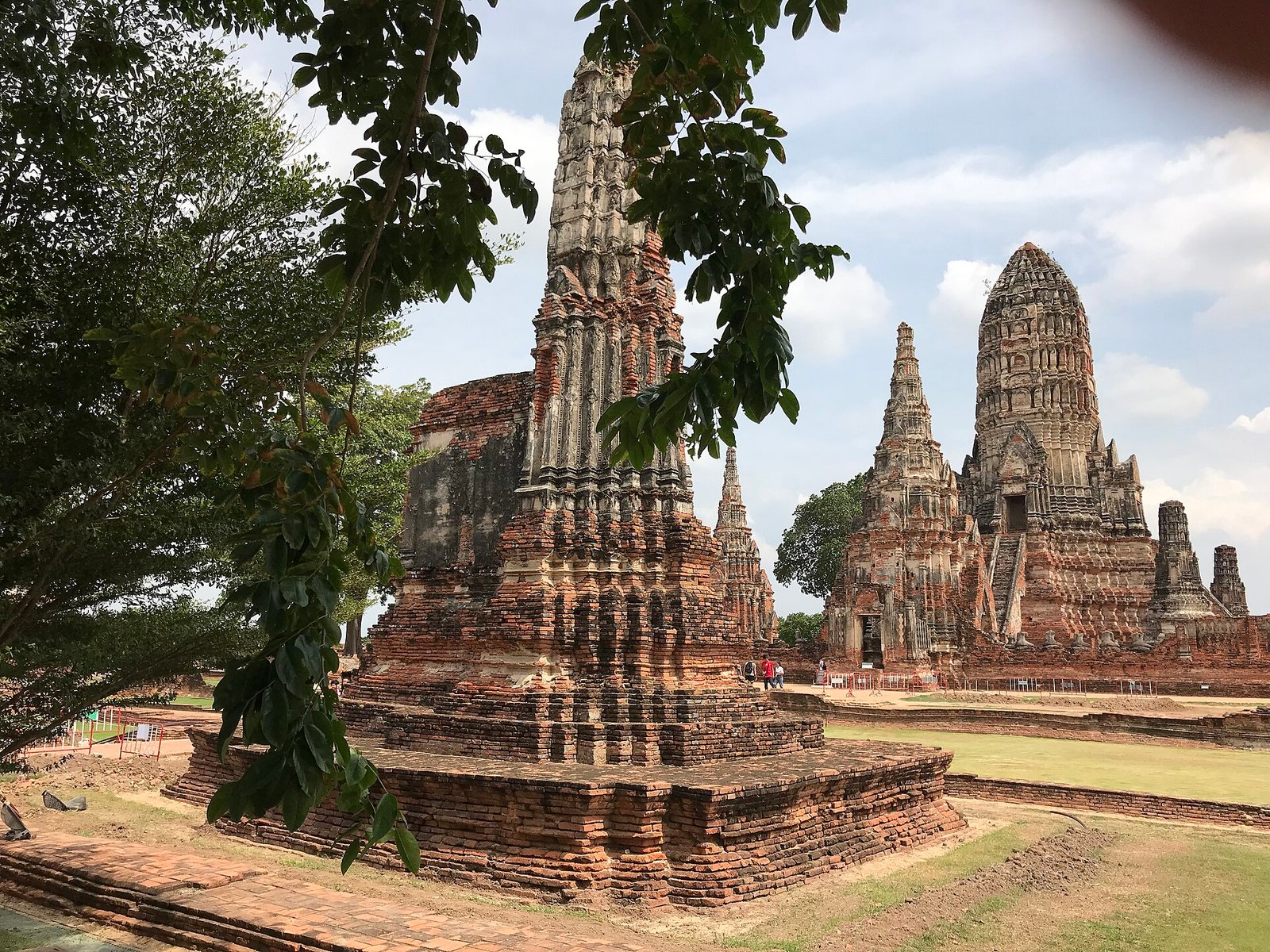
Today its 289-hectare historic area is a UNESCO World Heritage Site, listed since 1991. If you visit, you walk through the ruins of a planned island city. The rivers that once guarded it still wrap around it.
Ayutthaya kingdom pictures
The best visual record of the original layout is the set of historical maps. They show roads, canals and moats arranged across the island. For the monuments as they stand today, CyArk’s 2017 LiDAR and photogrammetry survey of Wat Phra Si Sanphet is a public 3D record. It is hosted on Open Heritage 3D.
FAQ
When did the Ayutthaya Kingdom fall?
The fall is generally dated to 7 April 1767. Thai and Burmese chronicles differ on the exact day and hour the attackers entered the city.
Who was the last king of Ayutthaya?
Ekkathat, who reigned from 1758 to 1767.
Why did Thailand move its capital to Bangkok?
After 1767, Taksin made Thonburi his administrative centre and reunified the country until 1782. That year Rama I took the throne, founding the Chakri dynasty and the Bangkok-based Rattanakosin period.
Is Ayutthaya a UNESCO World Heritage Site?
Yes. The 289-hectare historic area was added to the World Heritage List in 1991.
Sources
- Turkish Wikipedia — Ayutthaya Krallığı tr.wikipedia.org
- UNESCO — Historic City of Ayutthaya whc.unesco.org
- Thai Ministry of Foreign Affairs — Ayutthaya and the World (chronology) image.mfa.go.th
- English Wikipedia — Ayutthaya Kingdom en.wikipedia.org
- English Wikipedia — Phra Nakhon Si Ayutthaya (city) en.wikipedia.org
- Thai Government — The flag of Thailand thailand.go.th
- KMUTT Library — Events Following the Fall of Ayutthaya lib.kmutt.ac.th
- Cambridge University Press — A History of Ayutthaya cambridge.org
- The Journal of the Siam Society — Markets and production in the city of Ayutthaya before 1767 so06.tci-thaijo.org
- Open Heritage 3D / CyArk — Ayutthaya, Wat Phra Si Sanphet openheritage3d.org
Image: Born to be.jpg — Jiranooch, CC BY-SA 4.0