The Borgias were a noble family of Spanish origin who rose to power in Renaissance Italy. They produced two popes, placed relatives in military and religious offices, and used marriages to build political alliances. Their family history connects Xàtiva, Rome, France, and Romagna.
If you know the Borgias through television dramas, the historical starting points are their papacies, marriages, military campaigns, and documented acts of violence. The evidence needs careful handling. Giovanni Borgia’s murder is a fact; the accusation that his brother Cesare killed him remains unproven. Lucrezia’s marriages are documented, while the poisoning stories attached to her lack historical support.
What was the House of Borgia?
The family came from around Xàtiva in Spain’s Kingdom of Valencia. Its Spanish surname was Borja, derived from the town of Borja in Aragon. Borgia was the Italianized form. These names belong to the same family history, so you may encounter either spelling when following its Spanish and Italian connections.
The family’s rise involved trained lawyers as well as ambitious relatives. Alfons de Borja taught law at the University of Lleida and served as a diplomat for the rulers of Aragon. Rodrigo Borgia later studied law in Bologna. Both men reached the papacy, placing their legal backgrounds alongside their family connections.
An everyday comparison helps explain one route to Borgia power: relatives receiving jobs in a family business. Callistus III made his nephew Rodrigo a cardinal. Rodrigo, as Alexander VI, later appointed his son Giovanni commander-in-chief of the papal army. Here, family appointments carried religious and military authority.
Which House of Borgia members became pope?
Alfons de Borja became Pope Callistus III in 1455. His papacy lasted until 1458. Before his election, his career had combined university teaching with diplomatic service. His appointment of Rodrigo as a cardinal helped advance another member of the family within the Church.
Rodrigo became Pope Alexander VI in 1492 and remained pope until 1503. He was Callistus III’s nephew. Keeping those relationships clear matters: the two Borgia popes were uncle and nephew, while Cesare and Lucrezia were children of Alexander VI.
Alexander also commissioned the decoration of the Borgia Apartment in the Vatican. Pinturicchio and his team completed the work between autumn 1492 and early 1494. The commission places artistic patronage near the beginning of his papacy, alongside the family appointments and alliances associated with his rule.
What does the House of Borgia family tree look like?
A useful starting point is Callistus III and his nephew Rodrigo. Rodrigo Borgia and Vannozza dei Cattanei had four children: Giovanni, Cesare, Lucrezia, and Gioffre. This group connects the papacy to the military careers and political marriages at the center of the family’s Renaissance history.
Giovanni Borgia received command of the papal army from his father. Cesare became a cardinal before pursuing a military and ducal career. Lucrezia’s marriages connected her to the Sforza, d’Aragona, and d’Este families. These were different routes through which the children of Alexander VI became involved in dynastic politics.
Two similar names can make this family tree confusing. Giovanni Borgia was Lucrezia’s brother. Giovanni Sforza was her first husband. Both appear in the events of 1497: Giovanni Borgia was murdered, and Lucrezia’s marriage to Giovanni Sforza was annulled.
How did Cesare Borgia gain and lose power?
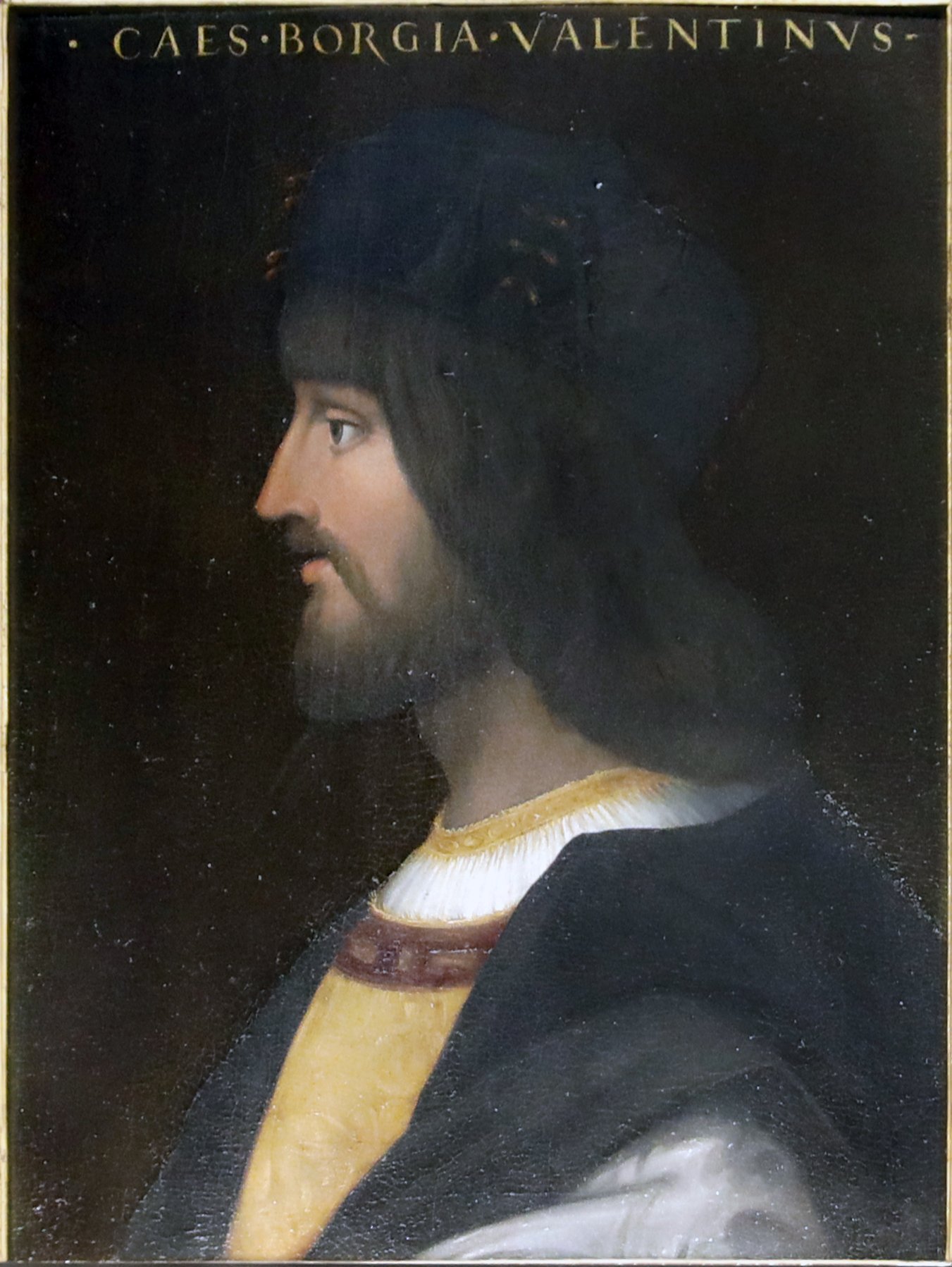
Cesare became a cardinal in 1493, during his father’s papacy. In 1498, he left the cardinalate. That same year, negotiations involving King Louis XII of France led to his becoming Duke of Valentinois. His career moved from a senior Church office toward military command and territorial power.
In 1499, Cesare married Charlotte d’Albret, strengthening his French connection through a dynastic marriage. With a French-supported papal army, he captured Imola and Forlì in 1500. He became Duke of Romagna in 1501. Marriage, foreign support, and conquest all contributed to his position.
His father’s death in August 1503 was followed by the collapse of his political power. Cesare died fighting near Viana in Navarre in 1507. His political and military career also inspired Niccolò Machiavelli’s assessments of rulers in The Prince, giving it a place in political writing as well as family history.
What happened to Lucrezia Borgia?
Lucrezia married Giovanni Sforza on 12 June 1493, when she was thirteen. The marriage was intended to strengthen a political alliance with the Sforza family. After that alliance broke down, the marriage was annulled in 1497 on the grounds that it had not been consummated.
Her second husband, Alfonso d’Aragona, survived an attack in 1500. He was then killed by Cesare’s men in the room where he was recovering. This murder is part of the documented violence surrounding the family. It should be distinguished from accusations against Lucrezia for which historical support has not been found.
Lucrezia’s third husband was Alfonso d’Este, who later became Duke of Ferrara. She died on 24 June 1519 after a difficult childbirth. Her marriages therefore connect her biography to several ruling families, while her death belongs to a different, personal part of that history.
Which Borgia accusations are supported?
Giovanni Borgia was murdered in 1497. Cesare was accused of killing his brother, but clear evidence confirming that charge is lacking. If you are weighing the accusation, keep the established death separate from the disputed identity of the killer.
Giovanni Sforza was among those who spread accusations that Lucrezia had incestuous relationships with her father and brother. No historical basis has been found for those accusations. National Geographic’s historical account finds no historical support for the familiar portrayal of Lucrezia as a woman who poisoned people.
Alexander VI’s death requires similar caution. One account claims that he died through accidental poisoning in August 1503. Malaria is presented as a more likely explanation, although the cause remains uncertain. Neither the poison story nor the alternative should be turned into a settled diagnosis.
Timeline
- 1455: Alfons de Borja becomes Pope Callistus III.
- 1458: Callistus III’s papacy ends.
- 1492: Rodrigo Borgia becomes Pope Alexander VI.
- 1493: Cesare becomes a cardinal; Lucrezia marries Giovanni Sforza.
- 1497: Giovanni Borgia is murdered; Lucrezia’s Sforza marriage is annulled.
- 1498: Cesare leaves the cardinalate and becomes Duke of Valentinois.
- 1499: Cesare marries Charlotte d’Albret.
- 1500: Lucrezia’s second husband, Alfonso d’Aragona, is murdered; Cesare captures Imola and Forlì.
- 1501: Cesare becomes Duke of Romagna.
- 18 August 1502: Cesare grants Leonardo da Vinci access to fortifications for inspection.
- August 1503: Alexander VI dies; Cesare begins losing political power.
- 1507: Cesare dies fighting near Viana in Navarre.
- 24 June 1519: Lucrezia dies after a difficult childbirth.
- 1748: The Gandía title passes by inheritance from Borja to Pimentel.
Details you won’t find in guidebooks
Cesare held religious offices long before becoming a cardinal. According to Spain’s Ministry of Culture, he received the offices of apostolic protonotary, archdeacon of Xàtiva, and rector of Gandía at just seven years old. The appointments show how early his institutional career began.
On 18 August 1502, Cesare issued Leonardo da Vinci a pass allowing entry to castles and fortified places in Romagna. Leonardo had been assigned to inspect fortifications. The document connects Cesare’s territorial ambitions with the practical task of examining defenses.
The Borgia Apartment consists of six monumental rooms in the Vatican. Today, it houses part of the Collection of Modern and Contemporary Art, which opened in 1973. If you visit, Alexander VI’s rooms bring Renaissance patronage into contact with a later museum collection.
The archive of the Dukes of Gandía contains more than a thousand bundles of documents, according to Spain’s Ministry of Culture. It is a substantial documentary resource for Borgia history. Alongside the painted rooms and Leonardo’s pass, it offers another concrete trace of the family’s activities.
What remains of the House of Borgia today?
The Vatican’s Borgia Apartment preserves a visible connection to Alexander VI’s patronage. The Gandía archive preserves documents used to study the family. These surviving rooms and records give you specific places and materials through which to approach Borgia history.
The Gandía title also requires attention to inheritance. After María Ana de Borja died in 1748, it passed to her nephew Francisco Alonso Pimentel. Later holders therefore did not bear the Borja surname. Following that title means following inheritance beyond the family name itself.
FAQ
Who were the Borgias?
The Borgias were a noble family from around Xàtiva in the Kingdom of Valencia, Spain. They rose to prominence in Renaissance Italy and produced two popes, Callistus III and Alexander VI.
Which members of the Borgia family became pope?
Alfons de Borja ruled as Callistus III from 1455 to 1458. His nephew Rodrigo Borgia ruled as Alexander VI from 1492 to 1503.
Was Lucrezia Borgia a poisoner?
National Geographic’s historical account finds no historical basis for the accusations that Lucrezia poisoned people. The incest accusations against her also lack historical support.
Did Cesare Borgia kill his brother Giovanni?
Giovanni Borgia was murdered in 1497. Cesare was accused of responsibility, but clear evidence confirming that accusation is lacking.
What happened to the Borgia title of Duke of Gandía?
After María Ana de Borja died in 1748, the title passed to her nephew Francisco Alonso Pimentel. Subsequent holders therefore did not carry the Borja surname.
Sources
- Wikipedia — House of Borgia en.wikipedia.org
- Vikipedi — Borgia ailesi tr.wikipedia.org
- British Museum — Cesare Borgia, Duke of Valentinois britishmuseum.org
- National Geographic History — Lucrezia Borgia, Predator or Pawn? nationalgeographic.com
- National Geographic History — The real history of the Borgia family and their cursed ‘black legend’ nationalgeographic.com
- Oxford Bibliographies — Lucrezia Borgia academic.oup.com
- Larousse — Borgia larousse.fr
- Spain’s Ministry of Culture — El archivo de los duques de Gandía y los Borgia cultura.gob.es
- Imola Municipal Library — In Romagna con Leonardo bim.comune.imola.bo.it
- Vatican Museums — Borgia Apartment museivaticani.va
Image: Cesare Borgia il Valentino, di Cristofano dell’Altissimo, 1552-68 -FG.jpg — Fabrizio Garrisi, CC0