Abbasid Caliphate definition: who were the Abbasids?
The Abbasids were the dynasty that ruled the third major Islamic caliphate. Their name came from Abbas ibn Abd al-Muttalib, an uncle of the Prophet Muhammad, from whom they descended. They established their state in 750 after overthrowing the Umayyads’ central government. Their rise shifted the caliphate’s centre of power from Syria to Iraq.
Baghdad became the city most closely associated with their rule. Yet Abbasid history also includes Kufa, Samarra and Cairo. If you follow those changing centres, you can trace a transformation in the caliphate itself. A dynasty that once governed extensive provinces later supplied religious legitimacy to rulers who held military and political power.
Abbasid Caliphate founder: how did the dynasty take power?
Abu al-Abbas al-Saffah founded the Abbasid state and became its first caliph. The conventional foundation date is 750, corresponding to 132 in the Islamic calendar. The movement had already reached an important stage on 28 November 749, when allegiance was pledged to al-Saffah in Kufa’s mosque. These dates describe different moments in the establishment of Abbasid rule.
Open rebellion began earlier. On 15 June 747, Abu Muslim’s movement raised a black banner at Sifazanj in Khurasan. In early 750, the Abbasid army defeated Marwan II near the Great Zab. That victory ended the Umayyads’ central power and opened the way for the new dynasty’s government.
Abbasid Caliphate flag: why did black matter?
Black banners were a visible feature of the Abbasid movement. The banner raised in Khurasan in 747 marked its passage into open revolt. Black also appeared in Abbasid court life. Ceremonial clothing and official document cases used the colour, extending its presence beyond the army and into the presentation of government.
Abbasid Caliphate map: where was the empire at its peak?
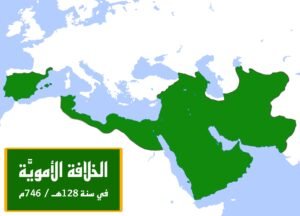
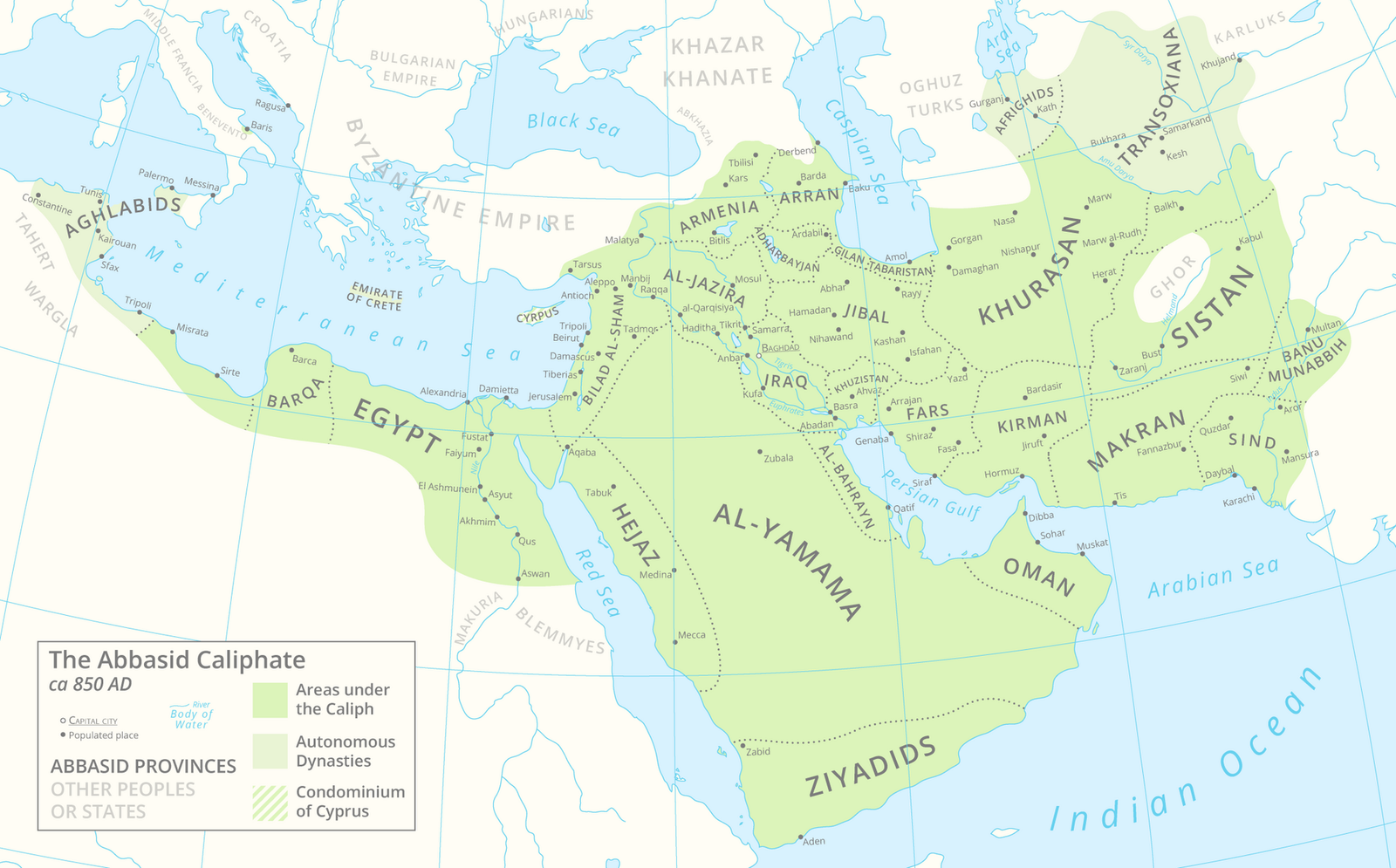
UNESCO describes the empire during its powerful period as a collection of provinces stretching from Tunisia to Central Asia. Iraq became its political centre. The move east from Syria also brought the government geographically closer to its Iranian mawali supporters. The dynasty’s geography therefore reflected the support behind its rise.
When you picture an Abbasid Caliphate map, the date matters. Regional dynasties emerged well before the fall of Baghdad in 1258. The Aghlabids, Tahirids, Samanids, Saffarids and Tulunids belonged to this process of separation from central control, especially during the ninth century. A map of the empire’s powerful period cannot represent every later stage of Abbasid authority.
Abbasid Caliphate capital: why was Baghdad chosen?
Kufa, in present-day Iraq, was the first Abbasid administrative centre. The second caliph, al-Mansur, sought a new capital after governing from Hashimiyya near Kufa. He feared the influence of Kufa’s strong supporters of Ali over his army. Moving the court was therefore a decision about political security as well as location.
Baghdad offered practical advantages. The Khurasan road intersected with caravan routes nearby. Irrigation canals and fertile agricultural land helped support the city. Its position could also meet the army’s food requirements. The choice connected the demands of government with transport, farming and military supply.
You can relate this to everyday shopping: access to routes and food supplies matters when choosing where people gather. Al-Mansur’s decision involved those same practical concerns on the scale of a capital. Baghdad needed to sustain a court, an administration and an army.
Construction began in 762. Al-Mansur moved there in 763, when the palace and administrative buildings were usable. The circular city was completed in 766. Its official name was Madinat al-Salam, meaning City of Peace. Baghdad’s foundation was thus a sequence of construction, occupation and completion.
Abbasid Caliphate list: the early rulers
The early succession ran from al-Saffah, who ruled in 750–754, to al-Mansur in 754–775. Al-Mahdi followed in 775–785, then al-Hadi in 785–786. Harun al-Rashid ruled from 786 to 809. These reigns cover the dynasty’s foundation and Baghdad’s development as its capital.
Family relationships connected these rulers. Al-Mansur was al-Saffah’s brother. Al-Mahdi was al-Mansur’s son, while al-Hadi and Harun al-Rashid were sons of al-Mahdi. The Abbasids continued the practice of succession within the ruling dynasty that they had inherited from the Umayyads. Viziers and a salaried bureaucracy helped the caliphs govern.
Abbasid Caliphate significance: government, learning and military power
Under al-Mansur, translation into Arabic expanded across medicine, astronomy, algebra, geometry, logic and metaphysics. These subjects formed part of the intellectual activity associated with Abbasid rule. The dynasty’s significance also rested on its administration: the caliph governed through offices and paid officials while maintaining hereditary succession.
For readers interested in Turkey’s historical connections, Turkish soldiers provide a direct point of contact. Al-Mu‘tasim increased their importance in the army. In 836, he moved with these troops to Samarra, which he founded that year. Samarra remained the Abbasid capital until 892, when government returned to Baghdad.
Military power later changed the caliphs’ position more sharply. The Buyids took Baghdad in 945, restricting Abbasid effective power and emphasizing the caliphs’ role in providing religious legitimacy. The Seljuks replaced the Buyids in 1055. Abbasid caliphs continued alongside a dynasty that held political and military authority.
Abbasid Caliphate in AP World History: what changed over time?
For an AP World History study outline, connect the Abbasids to changes in political geography, administration and authority. Their rise moved the centre of government from Syria to Iraq. Baghdad connected the court to caravan routes and agricultural resources. Viziers and salaried officials supported dynastic government, while translation activity expanded under al-Mansur.
Their later history shows that a caliph’s title and direct territorial power could follow different paths. Regional dynasties emerged, and the Buyids and Seljuks controlled Baghdad in succession. Yet direct Abbasid rule also strengthened again in Iraq under al-Muqtafi, whose reign lasted from 1136 to 1160. Declining authority was not an uninterrupted process.
Details you won’t find in guidebooks
The first administrative enclosure at Baghdad had four gates named for Kufa, Basra, Damascus and Khurasan. Main roads led towards the palace and mosque at the centre. The layout placed the principal institutions of rule at the meeting point of the city’s main approaches.
Al-Mansur’s original palace and walls do not survive above ground. Reconstructions of the Round City’s plan depend on descriptions written between the ninth and fourteenth centuries. In 773, al-Mansur also ordered the central markets moved to Karkh for security reasons. The planned capital continued to change after its completion.
Samarra’s archaeological site lies about 130 kilometres north of Baghdad. UNESCO reports that roughly 80 percent remains unexcavated. Its period as capital, from 836 to 892, represents a substantial chapter of Abbasid government beyond Baghdad.
Abbasid Iraq also developed metallic lustre decoration for ceramics. In later centuries, the technique spread to Egypt, Syria, Iran and Spain. These objects connect Abbasid artistic production with places far beyond the court’s Iraqi centres.
Timeline
- 747: Open Abbasid rebellion began in Khurasan.
- 749: Allegiance was pledged to al-Saffah at Kufa.
- 750: Victory near the Great Zab ended Umayyad central rule.
- 762: Al-Mansur began building Baghdad.
- 763: Al-Mansur settled in Baghdad.
- 786–809: Harun al-Rashid ruled as caliph.
- 836: Government moved to Samarra.
- 892: Baghdad became the administrative centre again.
- 945: The Buyids took Baghdad.
- 1055: The Seljuks gained control of Baghdad.
- 1136–1160: Direct Abbasid authority strengthened in Iraq under al-Muqtafi.
- 1258: The Mongols ended Abbasid rule in Baghdad.
- 1261: An Abbasid caliphate was established in Cairo.
- 1517: The Abbasid caliphate in Cairo ended.
How did Abbasid rule end?
Hulagu’s Mongol army captured Baghdad in 1258. The killing of Caliph al-Musta‘sim ended Abbasid government in the city. In 1261, the Mamluk sultan Baybars established an Abbasid caliphate in Cairo. These caliphs chiefly legitimized Mamluk power rather than governing an independent empire. The Ottoman conquest of Egypt ended this caliphate in 1517.
The account of al-Mutawakkil III transferring the caliphate to Selim I remains debated. Şit Tufan Buzpınar’s 2004 review presents the view that the story probably emerged in the second half of the eighteenth century. Uğur Demir’s 2019 study challenges an exclusively late origin, arguing that sixteenth-century Ottoman and European sources also contain indications of a transfer.
FAQ
Who founded the Abbasid Caliphate?
Abu al-Abbas al-Saffah founded the Abbasid state and became its first caliph. Its conventional foundation date is 750, although allegiance was pledged to him at Kufa in November 749.
Was Baghdad always the Abbasid capital?
No. Kufa was the first administrative centre. Al-Mansur began building Baghdad in 762, and Samarra later served as the capital from 836 to 892.
What colour was the Abbasid flag?
Black was associated with Abbasid banners. Abu Muslim’s movement entered open rebellion with the raising of a black banner in Khurasan on 15 June 747.
When did the Abbasid Caliphate end?
Abbasid rule in Baghdad ended with the Mongol conquest in 1258. A later Abbasid caliphate under Mamluk protection in Cairo ended with the Ottoman conquest of Egypt in 1517.
Sources
- Wikipedia — Abbasid Caliphate en.wikipedia.org
- Egyptian Ministry of Tourism and Antiquities — The Abbasid Period egymonuments.gov.eg
- TDV İslâm Ansiklopedisi — Abbâsîler islamansiklopedisi.org.tr
- UNESCO — Samarra Archaeological City whc.unesco.org
- TDV İslâm Ansiklopedisi — Bağdat islamansiklopedisi.org.tr
- The Metropolitan Museum of Art — The Art of the Abbasid Period metmuseum.org
- Khan Academy — Matt Saba, The founding of Baghdad khanacademy.org
- The School of Abbasid Studies — Clothing abbasidstudies.org
- Vikipedi — Abbâsîler tr.wikipedia.org
- Şit Tufan Buzpınar — Osmanlı Hilafeti Meselesi: Bir Literatür Değerlendirmesi dergipark.org.tr
- Marmara University — Uğur Demir, Hilafetin Osmanlıya devri meselesi ve buna dair bir literatür denemesi openaccess.marmara.edu.tr
Image: Abbasid Caliphate 850AD.png — Cattette, CC BY 4.0