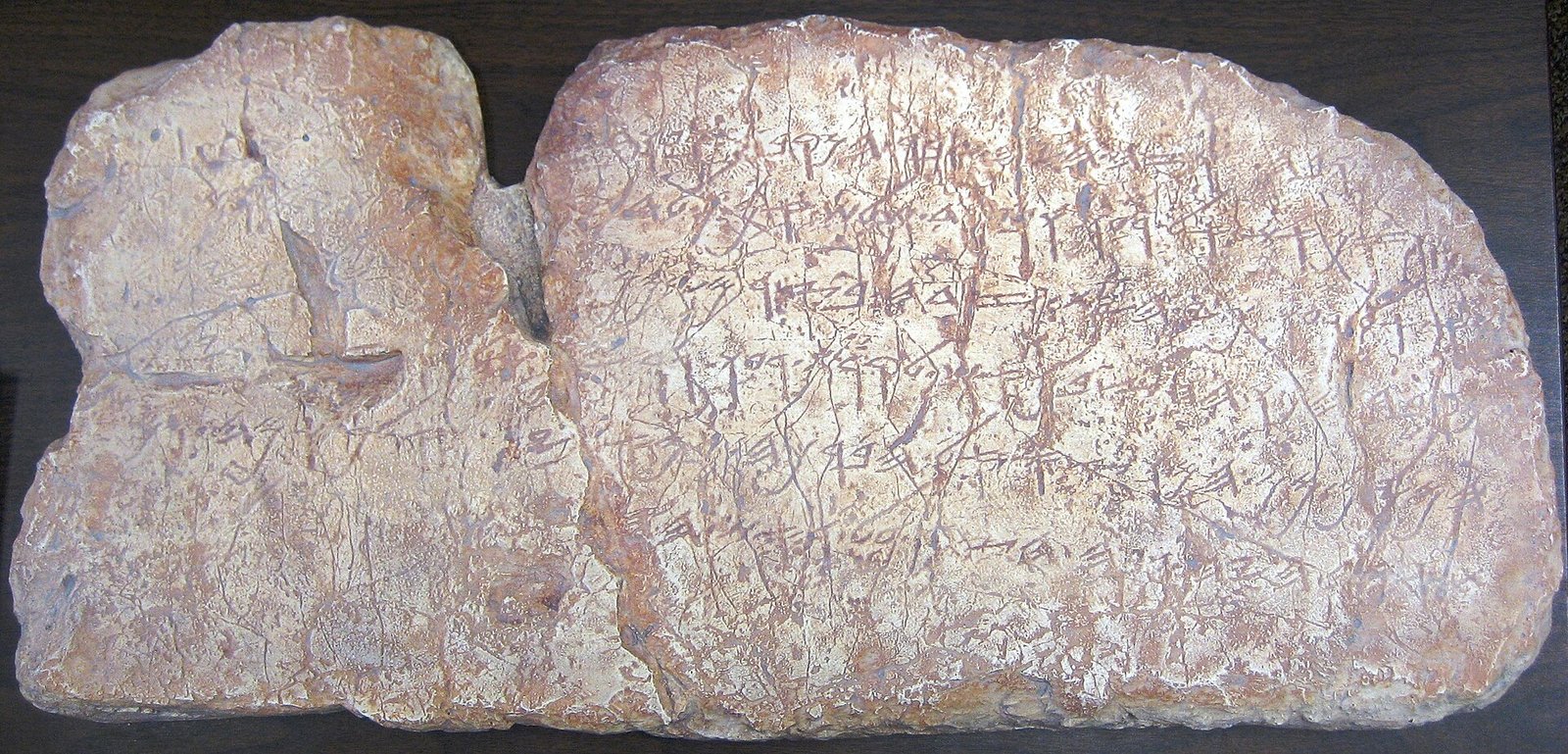
The Siloam Inscription is a six-line Hebrew record of a water tunnel’s completion, generally dated to around 700 BCE. Carved into limestone, it describes workers approaching one another through rock. The stone belongs to the Istanbul Archaeological Museums collection, although it was discovered in Jerusalem.
If you are looking for ancient Hebrew in Istanbul, this inscription connects those two places through a specific engineering project. Its original setting was the tunnel carrying water from the Gihon Spring to the Pool of Siloam. Its later journey to Istanbul followed discovery and removal during Ottoman rule.
What is the Siloam Inscription?
The inscription was found in the City of David, in the Silwan district of East Jerusalem. Its subject is the meeting of two crews digging from opposite ends of a water tunnel. The account follows their final approach, their breakthrough and the flow of water from spring to pool.
It is described as the only known ancient inscription from ancient Israel and Judah commemorating a public construction project. Its emphasis is the work itself. The text celebrates the tunnel builders’ achievement and gives no king’s name.
That subject offers an everyday-life connection: water reaching a destination depends on people completing an infrastructure project. Here, the inscription records the moment a passage became continuous and water began flowing through it. You encounter the workers through their voices, tools and progress through the rock.
Siloam Inscription text: six lines in ancient Hebrew
The language is Hebrew, written in the Paleo-Hebrew alphabet. The inscription consists of six lines, with dots separating its words. These features distinguish the language of the account from the alphabet used to carve it.
The text was cut into the tunnel wall about six metres inside the southern exit near the Pool of Siloam. Its position matters when you picture the discovery. The inscription stood near the outlet, rather than at the place where the two digging teams met.
Its measurements belong to the account itself. The text gives the water’s journey from spring to pool as 1,200 cubits. Near its end, it states that the rock above the workers’ heads was 100 cubits high. Those figures form part of the ancient description of the completed work.
Siloam Inscription translation and meaning
In an English rendering of its central narrative, the workers hear a man calling to his companion when three cubits remain to be excavated between them. The teams then break through the remaining rock with their tools. Water begins to flow from the spring towards the pool.
This sequence explains the inscription’s meaning without turning it into a royal proclamation. Its central event is the successful joining of two excavations. The workers can hear one another before they complete the connection, making the last stretch of digging the focus of the account.
One word complicates translation. The third line contains zadah, whose meaning is uncertain. Translations explain it in different ways, including a crack in the rock or a lateral deviation. The broad story of the breakthrough is clear, but that particular feature of the rock or excavation remains disputed.
If you compare translations, that uncertain word deserves attention. Different renderings can suggest different physical circumstances around the crews’ meeting. The account still describes the same essential outcome: the last rock is broken and water flows through the tunnel.
Siloam Inscription and Hezekiah’s Tunnel
The familiar historical interpretation connects the tunnel with a water project of Hezekiah, king of Judah. That association draws on the account of a pool and watercourse in II Kings 20:20. It links the excavated passage with a named ruler’s building activity.
The inscription itself does not make that identification. It names no king and concentrates on the crews. Keeping that distinction in view helps you read the evidence accurately: the carved account records the breakthrough, while the association with Hezekiah belongs to the interpretation of the tunnel.
Scientific dating has supported the conventional connection. In 2003, Amos Frumkin, Aryeh Shimron and Jeff Rosenbaum published research in Nature using radiocarbon and uranium-thorium measurements. Their study concluded that the tunnel belonged to Iron Age II.
Frumkin and Shimron returned to the question in a 2006 engineering study. They argued that dates from organic material in the tunnel plaster and from mineral formations supported a date around 700 BCE and the connection with Hezekiah.
Siloam Inscription date: why the tunnel’s age is debated
The inscription is generally dated to around 700 BCE. The tunnel’s construction date has nevertheless attracted a competing interpretation. Dating the tunnel affects how confidently it can be connected with Hezekiah’s project.
In a 2011 article in Tel Aviv, Ronny Reich and Eli Shukron argued that the tunnel should date at least as early as the beginning of the eighth century BCE. Their proposal places its construction before Hezekiah. The disagreement concerns the historical setting of the engineering work commemorated by the inscription.
Discovery and removal from Jerusalem
The inscription was discovered in 1880, when Jerusalem was under Ottoman rule. The City of David’s discovery account identifies the child who noticed it as Jacob Eliyahu. He was a student of Conrad Schick, a German architect and researcher living in Jerusalem.
In 1890, the inscription was removed from the tunnel wall and broke into six or seven pieces. Some letters were damaged. Ottoman authorities seized the removed stone and sent it to the imperial museum in Istanbul.
Accounts differ over the transfer chronology. A 2025 DW report gives 1882, while English Wikipedia describes seizure in Jerusalem in 1891 followed by shipment to Istanbul. The Ottoman transfer explains its place in Istanbul’s museum collection, but the reported dates should not be treated as a single settled sequence.
Siloam Inscription in Istanbul, Turkey
The Istanbul Archaeological Museums register the inscription under inventory number 2195 T. This identifies the object within the collection and gives you a precise reference when looking for information about it in Turkey.
Collection ownership and gallery display are separate matters here. A Türkiye Today report dated 18 September 2025 said the inscription was being kept in storage. According to that report, the gallery housing it was closed for restoration. That dated report should guide expectations without being read as a permanent display announcement.
Details you won’t find in guidebooks
The workers’ meeting and the inscription’s location were different places. The carving stood near the southern exit, about six metres inside the tunnel. Its account therefore commemorated an event that happened elsewhere along the passage.
The rock surface was prepared before the letters were carved. Yet this prepared inscription occupied a tunnel interior where people would rarely see it. Its setting combines deliberate preparation with limited visibility.
The early recording process also left a damaged object. Hermann Guthe had casts made in 1881 while the inscription remained in place. One of those casts broke during transport to Germany.
A Smithsonian museum report published in 1896 records another detail of Guthe’s work. In March 1881, he used hydrochloric acid to remove lime deposits covering the letters. Cleaning and casting thus formed part of the inscription’s documentation before its later removal.
Siloam Inscription and Netanyahu
In 2025, Netanyahu said he had requested the inscription from Prime Minister Mesut Yılmaz in 1998. He described offering Ottoman objects held in Israeli museums in exchange. He said the request had been refused.
Netanyahu also claimed that concern about Erdoğan’s electoral base had caused the refusal. Anadolu Agency reported that explanation as Netanyahu’s claim. It should be distinguished from the documented fact that he described making the request.
A separate transfer story appeared in 2022. On 13 March, Anadolu Agency reported that Turkish diplomatic sources denied reports that the inscription would be given to Israel. The stone’s modern diplomatic history therefore includes both requests for transfer and an explicit denial of a reported agreement.
Timeline
- Around 700 BCE: The inscription’s generally accepted date, although an earlier tunnel construction has been proposed.
- 1880: The inscription is discovered in Jerusalem’s water tunnel.
- 1881: Hermann Guthe cleans the letters, and casts are prepared while the inscription remains in place.
- 1890: Removal from the wall breaks the inscription into pieces and damages some letters.
- 1891: English Wikipedia dates the Ottoman seizure to this year, followed by shipment to Istanbul.
- 1998: According to Netanyahu’s 2025 account, he requests the inscription from Mesut Yılmaz and proposes an exchange.
- 2003: The Nature study supports an Iron Age II date for the tunnel.
- 2011: Reich and Shukron publish their argument for construction before Hezekiah.
- 13 March 2022: Turkish diplomatic sources deny reports of a transfer to Israel.
- 2025: Netanyahu revisits his request.
- 18 September 2025: A Türkiye Today report describes the inscription as being in storage during gallery restoration.
FAQ
What does the Siloam Inscription say?
It describes two crews cutting through the remaining rock between their tunnel sections. The workers hear a voice before breaking through, and water then flows from the spring to the pool.
Where is the Siloam Inscription in Turkey?
It belongs to the Istanbul Archaeological Museums collection under inventory number 2195 T. A report dated 18 September 2025 said it was in storage because its gallery was closed for restoration.
When was the Siloam Inscription made?
It is generally dated to around 700 BCE. The tunnel’s association with Hezekiah remains debated, with some researchers arguing for an earlier construction date.
Does the inscription name Hezekiah?
No. It describes the tunnel workers’ achievement without naming a king. Its connection with Hezekiah comes from the historical interpretation of the tunnel.
Sources
- Wikipedia — Siloam inscription en.wikipedia.org
- City of David — The Siloam Inscription cityofdavid.org.il
- Vikipedi — Siloam Yazıtı tr.wikipedia.org
- Posen Library — The Siloam Inscription posenlibrary.com
- Smithsonian Institution — Biblical Antiquities, 1896 repository.si.edu
- Nature / PubMed — Radiometric dating of the Siloam Tunnel, Jerusalem pubmed.ncbi.nlm.nih.gov
- Journal of Archaeological Science — Tunnel engineering in the Iron Age sciencedirect.com
- Tel Aviv — The Date of the Siloam Tunnel Reconsidered tandfonline.com
- DW Türkçe — Netanyahu’nun Mesut Yılmaz’dan istediği Siloam yazıtı nedir? amp.dw.com
- Türkiye Today — Why Netanyahu still wants Siloam Inscription from Türkiye turkiyetoday.com
- Anadolu Ajansı — Türkiye’den Siloam Yazıtı’nı alamayan Netanyahu aa.com.tr
- Anadolu Ajansı — Yazıtın İsrail’e verileceği haberlerine yalanlama aa.com.tr
Image: Siloam Inscription 2.jpg — Wikikati, Public domain