Registan Square in Samarkand: the short answer
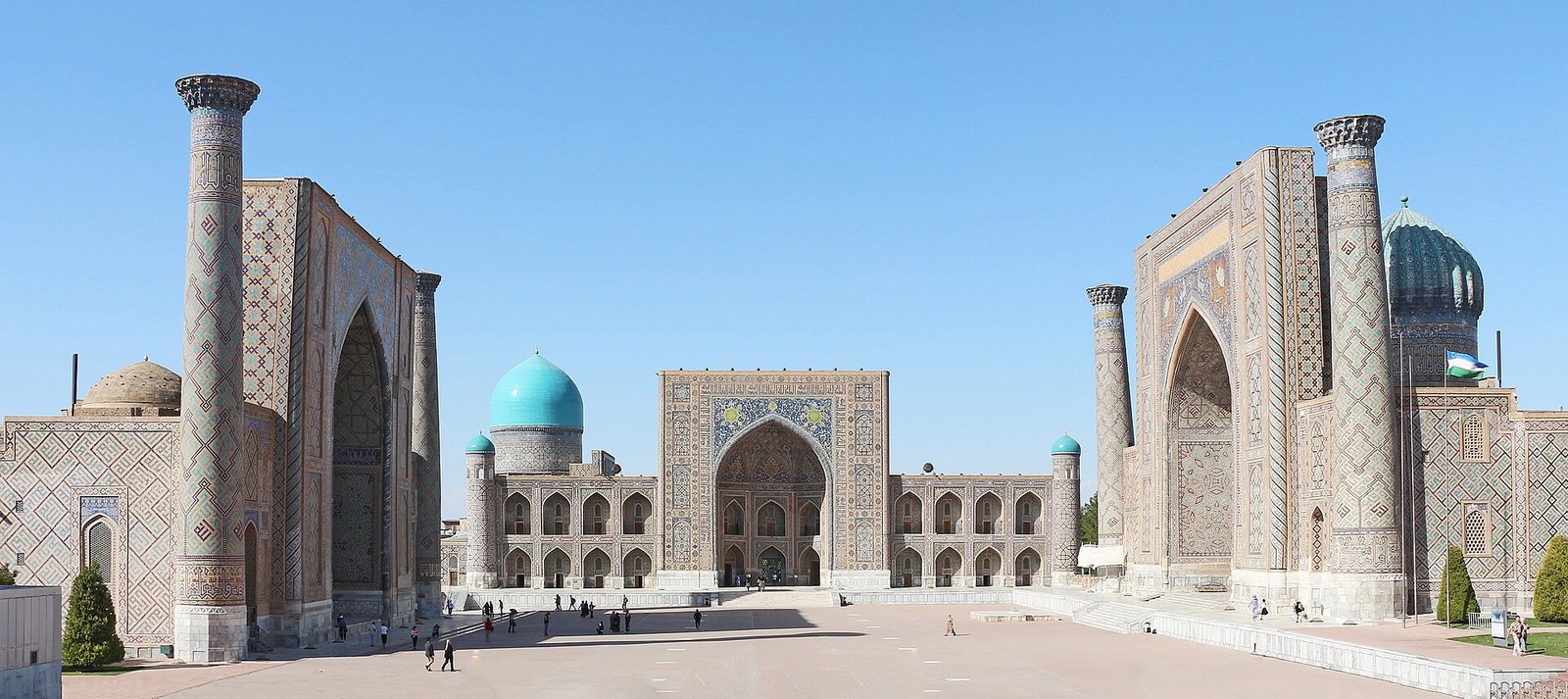
Registan Square is in the centre of Samarkand, Uzbekistan. Three madrasas, which are Islamic schools, frame it. The Ulugh Beg Madrasa dates to the 15th century. The Sher-Dor and Tilla-Kari madrasas date to the 17th century.
The square belongs to a city with deep roots. The ancient settlement of Afrasiab, in the Zerafshan River oasis, dates to the 7th century BCE. Genghis Khan’s armies took Samarkand in 1220. Timur, known in the West as Tamerlane, made it his capital around 1370. So he did not found the city. He rebuilt it on a grand scale.
Where is Registan located?
Samarkand sits in a large oasis in the Zerafshan River valley. Registan lies at the heart of the modern city. UNESCO lists the whole historic area under the name “Samarkand – Crossroad of Cultures”.
Registan meaning in English: why “desert”?
The name is Persian. It means “sandy place” or “desert”. In Uzbek the square is called Registon maydoni.
The name can mislead you. This Registan is not a desert. It is a city square.
How Timur built his capital
In April 1370, Timur took the city of Balkh. He then called military and tribal leaders to a kurultai, a council, there. UNESCO’s history of Central Asia dates his choice of Samarkand as capital to 1370. Encyclopaedia Iranica gives 1371. Sources differ on the date.
What Timur did next is clearer:
- He enclosed Samarkand with a new city wall.
- He built an inner citadel in the west of the city. It held the Gok Saray, a palace used for ceremonies.
- He forced architects, artists and craftsmen from conquered cities to move to Samarkand and work on the capital.
- He named the settlements around Samarkand after great Islamic cities. Cairo, Damascus, Baghdad, Sultaniya and Shiraz were among the names.
After Timur returned from his western campaigns in 1396, building work sped up. A main bazaar street was opened between the Bibi-Khanym Mosque and Registan.
Think of it as a high street joining a landmark to a market square. Registan began as that kind of place. In Timur’s time it was mainly a trading area.
From market to school: Ulugh Beg Madrasa (1417–1420)
Under Timur’s grandson Ulugh Beg, Registan changed. It became a centre for education, ceremonies and official events.
Ulugh Beg had the madrasa built between 1417 and 1420. It is the oldest monument on the square that survives today. It was originally two storeys high. It had four domed classrooms in its corners.
Students did not study religion alone. Teaching also covered mathematics, astronomy and philosophy. Picture a modern university campus. Students there move between lecture halls for different subjects. This building worked in a similar way, but in the 1400s.
Sher-Dor Madrasa (1619–1636)
The next madrasa came two centuries later. Yalangtush Bahadur, the governor of Samarkand, ordered it built. Work ran from 1619 to 1636. It stands on the site of Ulugh Beg’s dismantled khanqah, a lodging house for Sufi followers.
The architect was Abdul Jabbar of Samarkand. Muhammad Abbas decorated it.
The Sher-Dor stands on the east side of the square. It largely repeats the layout of the Ulugh Beg Madrasa opposite. Builders in the 1600s kept the symmetry of the 1400s.
The name has to do with lions. Over the entrance, fantastic predators hunt white gazelles in front of a rising sun.
Tilla-Kari Madrasa (1646–1660)
Yalangtush Bahadur also started the third madrasa. Work began in 1646 on the site of an old caravanserai, a travellers’ inn, on the north side. It was finished in 1660. That completed the three-madrasa layout you see today.
Tilla-Kari was more than a student residence. It also worked as a large congregational mosque, and the mosque lay in the western part of the courtyard. The name comes from the gold leaf used in its interior decoration. “Tilla-Kari” refers to that gilding.
Details you won’t find in guidebooks
- A tower straightened in 1932. The north-east minaret of the Ulugh Beg Madrasa had been leaning. Vladimir Shukhov, an engineer from Moscow, straightened it in 1932.
- A dome nobody could copy. An earthquake in 1818 destroyed the original dome of Tilla-Kari. No photograph or drawing of it survives. The outer dome you see now was added during a restoration that ended in 1975.
- An argument over materials. In the 1920s, the restorer Boris Zasypkin worked on the Sher-Dor. He argued for working with local craftsmen. He also argued for original brick and local alabaster.
- Concrete behind the tiles. Late Soviet restorations of all three madrasas used reinforced concrete reconstruction. They also used newly made glazed tiles.
- A warning from UNESCO. UNESCO says that some inadequate restoration work and modern construction in Samarkand have hurt the authenticity of the World Heritage property.
So what you see is a mix. Some of it is old. Some of it is restoration.
Timeline
- 7th century BCE: the ancient settlement of Afrasiab at Samarkand dates from this period.
- 1220 Genghis Khan’s armies take Samarkand.
- 1370–1371 Timur makes Samarkand his capital. Sources give 1370 or 1371.
- After 1396 major building work speeds up. A main bazaar street opens between the Bibi-Khanym Mosque and Registan.
- 1417–1420 the Ulugh Beg Madrasa is built.
- 1619–1636 the Sher-Dor Madrasa is built on Yalangtush Bahadur’s orders.
- 1646–1660 the Tilla-Kari Madrasa is built. The three-madrasa layout is complete.
- 1818 an earthquake destroys the original dome of Tilla-Kari.
- 1932 the north-east minaret of the Ulugh Beg Madrasa is straightened.
- 1975 a restoration campaign ends. It includes Tilla-Kari’s present outer dome.
- 2001 the historic area of Samarkand, with Registan, joins the UNESCO World Heritage List.
Tips for readers
You now know the order. Face the square and read it as a timeline. The Ulugh Beg Madrasa is the oldest. The Sher-Dor, across from it, copies its plan. The Tilla-Kari fills the north side. When you look at the tiles and domes, remember how much of the surface is restoration.
FAQ
Where is Registan Square located?
Registan Square is in the centre of Samarkand, Uzbekistan. Samarkand lies in a large oasis in the Zerafshan River valley.
What does Registan mean in English?
The name is Persian and means “sandy place” or “desert”. The square’s Uzbek name is Registon maydoni.
Which three madrasas stand on Registan Square?
They are the Ulugh Beg Madrasa (1417–1420), the Sher-Dor Madrasa (1619–1636) and the Tilla-Kari Madrasa (1646–1660).
Is Registan a UNESCO World Heritage Site?
Yes. Registan is part of “Samarkand – Crossroad of Cultures”, which UNESCO added to the World Heritage List in 2001.
Who built Registan?
No single ruler built it. Timur’s grandson Ulugh Beg built the oldest madrasa. The Samarkand governor Yalangtush Bahadur ordered the other two in the 17th century.
Sources
- Wikipedia — Registan en.wikipedia.org
- Vikipedi — Registan tr.wikipedia.org
- UNESCO — Samarkand – Crossroad of Cultures whc.unesco.org
- Leiden University, Iran Turan — Samarqand iranturan.leiden.edu
- Leiden University, Iran Turan — The Registan Square iranturan.leiden.edu
- UNESCO, History of Civilizations of Central Asia — Central Asia under Timur en.unesco.org
- Encyclopaedia Iranica — Samarqand i. History and Archaeology iranicaonline.org
- Uzbekistan official tourism portal — Registan Square uzbekistan.travel
- Uzbekistan official tourism portal — Sherdor Madrasah uzbekistan.travel
- Tourism Services Certification Centre of Uzbekistan — O’zbekistonning madaniy merosi – Registon maydoni tourquality.uz
- Government portal of Uzbekistan — Registon maydoni haqida faktlar gov.uz
Image: Registan 01.jpg — Bernard Gagnon, CC0