You can still walk beside the walls that guarded Constantinople. They are not a ruin hidden in a museum. They run through today’s Istanbul, past streets, gardens and neighbourhoods.
The famous line says they were “unbreached for a thousand years.” That is close to true for one part of the defence. It needs a careful footnote, and this article gives it.
Where are the Walls of Constantinople?
The walls are in Istanbul’s Fatih district. The land walls lie on the western side of the Historic Peninsula. They run north to south between the Golden Horn (Haliç) and the Sea of Marmara.
Think of the old city as a triangle of land. Water protected two sides. The land side faced the west, and that is where the great wall was built.
Walls of Constantinople map: how the line runs
On a map, look for a long north-south line on the western edge of the peninsula. The surviving Theodosian line stretches about 5.7 kilometres. It starts at the Marble Tower (Mermer Kule) on the Marmara shore. It ends around the Tekfur Palace.
The Istanbul Land Walls include more than that main line. In the north they also cover the Komnenian and Blachernae fortifications. So the full protected zone is longer and more varied than the single Theodosian wall.
The sea sides were different. The walls along the Marmara and the Golden Horn had no outer wall and no moat in front of them, unlike the land walls.
Why are they called the Theodosian Walls? (Name)
The walls take their name from the Eastern Roman emperor Theodosius II. You will also see them called the Land Walls, in Turkish Kara Surları.
Theodosius was still a child when the first building phase began. The work was carried out under Anthemius and finished in 413.
Height and layout: how the defence worked
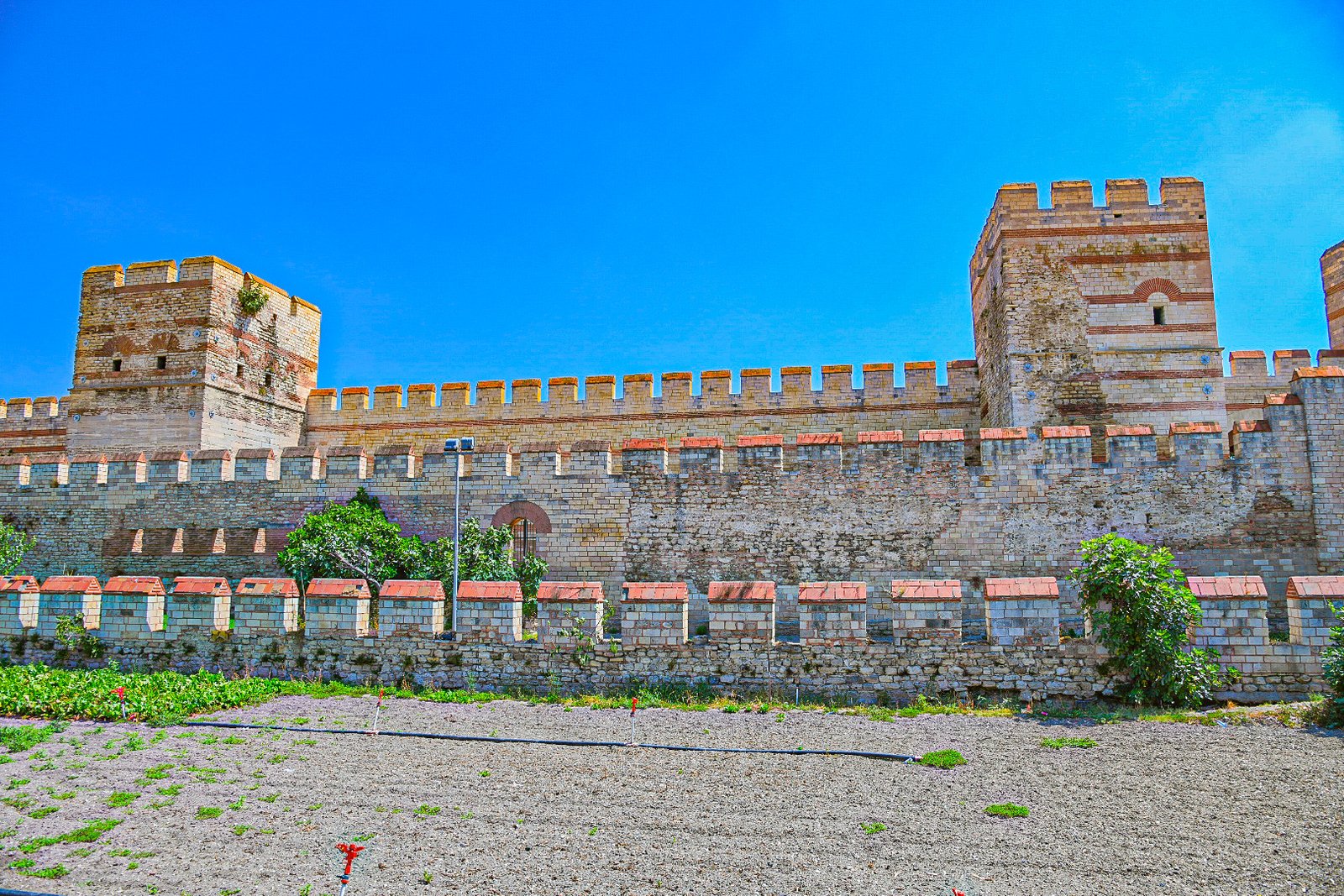
The Theodosian system had three main parts: a moat, an outer wall and an inner wall. An attacker had to cross all three.
- The moat was more than 20 metres wide. In places it was up to 10 metres deep.
- The outer wall stood about 8.5–9 metres high. It was 2 metres thick at its base.
- The inner wall stood about 12 metres high. It was 4.5–6 metres thick.
The main defensive line was reinforced with 96 towers.
There is an everyday comparison. Think of a house with a fence, then a front gate, then a locked door. No single lock is perfect. Together they make a thief give up or slow down. The walls worked on the same idea, only on the scale of a city.
Timeline
- 413: The first phase of the Theodosian land walls, built under Anthemius, was completed.
- 447: An earthquake brought down 57 towers, and the defences were repaired.
- 626: The joint Avar-Sasanian siege failed to take Constantinople.
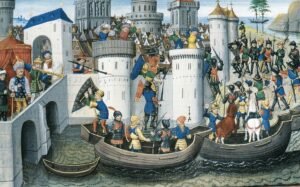
- 1204: Fourth Crusade armies entered the city through the Golden Horn walls.
- 29 May 1453: The Ottomans took Constantinople.
- 1457–1458: The Yedikule inner fortress was added behind the Golden Gate.
- 1985: The Land Walls Conservation Area joined the UNESCO World Heritage List as part of the Historic Areas of Istanbul.
- 2020: İBB Miras began its large restoration of the Land Walls.
- 2022: The Mevlanakapı and Silivrikapı visitor centres and the Silivrikapı Hypogeum reopened.
Was the city really unbreached for a thousand years?
Half yes, half no. The phrase refers to the land defence between 413 and 1453. That is 1,040 years.
The walls did face tests. In 447, an earthquake destroyed 57 towers while the Huns were a threat. Emergency repairs were needed. In 626, the Avars and Sasanians besieged the city together and failed to take it.
But the city itself did fall twice. In 1204, Fourth Crusade armies entered through the Golden Horn walls. They did not break the great land wall. That part of the story is left out of the slogan.
The final fall came on 29 May 1453. Mehmed II’s Ottoman army captured Constantinople and ended the Byzantine Empire.
So the honest version is this. The Theodosian land system held for more than a thousand years. The city as a whole did not stay untouched.
Walls of Constantinople today
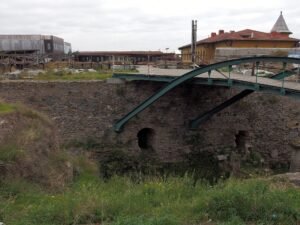
The walls survive in sections. Some parts were restored, and some still show their age.
After the conquest, Mehmed the Conqueror made the Golden Gate area into a stronghold. In 1457–1458 he added an inner fortress behind the gate. This created Yedikule Fortress.
In 1985, the Land Walls Conservation Area became one of four components of the Historic Areas of Istanbul on the UNESCO World Heritage List. UNESCO’s protected zone covers the surroundings on both sides of the Theodosian land walls. It also includes the remains of the old Blachernae Palace.
Restoration began in 2020. İBB Miras started comprehensive work on the Land Walls that year. In 2022, two visitor centres at Mevlanakapı and Silivrikapı reopened, along with the Silivrikapı Hypogeum.
Where to see the Walls of Constantinople
Take these steps if you want to see the walls in person:
- Start in Fatih. The walls lie in this district, along the western edge of the Historic Peninsula.
- Visit Yedikule Fortress. It was formed in 1457–1458 by adding an inner castle behind the Golden Gate.
- Stop at Mevlanakapı and Silivrikapı. Their visitor centres, and the Silivrikapı Hypogeum, reopened in 2022 after restoration.
- Walk north. Aim for the area around the Tekfur Palace, where the surviving Theodosian line ends. Beyond it lie the Komnenian and Blachernae fortifications.
Walking along the wall gives you the best sense of its scale. You will see towers, gates and the line of the moat. Wear comfortable shoes. This is a long route, not a single monument.
Entrance fee
An İBB announcement dated 17 May 2023 says that entry to the Land Walls area it operates is free. Rules can change. Check the current notice before your visit.
Details you won’t find in guidebooks
- Brick bands for earthquakes. The inner wall has brick courses about 40 centimetres thick. They tie the stone facing to the wall’s core, which improved its resistance to earthquakes.
- Sixty days. Two inscriptions preserved at the Mevlevihane Gate honour Theodosius and the eparch Constantinus. They state that the work was finished in sixty days.
- A tax for repairs. In the eighth century, Leo III and Constantine V collected extra taxes to pay for repairs to the land walls.
- A law about towers. The Theodosian Code, section XV.1.51, contains provisions about maintaining the towers of the walls.
- A green belt. In a plan he began preparing in 1935, Henri Prost proposed a strip free of construction. It would reach 500 metres outside the walls and 80–100 metres inside them.
- A debate about the outer wall. Many scholars link the outer wall and moat to the repairs after 447. Others argue the outer wall was already part of the first design.
FAQ
How tall were the Walls of Constantinople?
The inner wall stood about 12 metres high and 4.5–6 metres thick. The outer wall was about 8.5–9 metres high and 2 metres thick at its base.
Is there an entrance fee for the Land Walls?
An İBB announcement of 17 May 2023 states that entry to the Land Walls area it operates is free. Check the current notice before you visit.
Were the walls really never breached?
The claim fits the land defence between 413 and 1453, a span of 1,040 years. It leaves out 1204, when Fourth Crusade armies entered through the Golden Horn walls.
Where are the Walls of Constantinople today?
They are in Istanbul’s Fatih district, on the western side of the Historic Peninsula. They run north to south between the Golden Horn and the Sea of Marmara.
Sources
- Columbia University — Istanbul Documentation Project, Land Walls of Constantinople mcid.mcah.columbia.edu
- Ministry of Culture and Tourism — Historic Areas of Istanbul kulturportali.gov.tr
- Wikipedia — Walls of Constantinople en.wikipedia.org
- TÜBA-KED 24 — Management of Multi-Layered Cultural Landscape Areas tuba.gov.tr
- Vikipedi — Konstantinopolis Surları tr.wikipedia.org
- Harvard University — The Urban Imagination, Protection hum54-15.omeka.fas.harvard.edu
- Rice University OpenStax — World History, The Ottomans and the Mongols openstax.org
- Fatih District Governorate — Yedikule Walls fatih.gov.tr
- UNESCO — Historic Areas of Istanbul whc.unesco.org
- Istanbul Planning Agency — Kültürel Mirasın Kamusal Mekâna Dönüşümü, May 2025 ipa.istanbul
- İBB — İBB Miras ile Anılarımızdaki İstanbul Geri Dönüyor istanbulseninhaber.ibb.istanbul
Image: Theodosian Walls of Constantinople.jpg — Apaleutos25, CC BY-SA 4.0