Tonga was never formally colonized because its unified monarchy, 1875 Constitution and recognition treaties helped preserve its sovereignty, while Britain chose protection as a means of securing its interests. The kingdom survived under British protection from 1900 to 1970, although Britain controlled its foreign relations and sometimes sharply restricted its internal autonomy.
The revealing part is how much power could change hands while Tonga remained a kingdom. If you follow the story from George Tupou I’s unification to the pressure placed on Tupou II, you can see both the strength of Tonga’s institutions and the limits of their protection. The constitution, diplomatic treaties and royal resistance each explain part of that survival.
Where is Tonga located, and why start with the map?
Tonga is a Polynesian country in the South Pacific Ocean, south of Samoa. Its main island groups are Tongatapu, Haʻapai and Vavaʻu. The name Tonga means “south” in Tongan.
Nukuʻalofa, the capital, stands on Tongatapu. At approximately 257 square kilometres, Tongatapu is the country’s largest island. These places matter to the historical story: Tongatapu also contains Heketā and Lapaha, the ancient royal capitals submitted to UNESCO’s Tentative List on 9 August 2007.
James Cook’s reception during his 1773 visit produced the historical Western name “Friendly Islands.” That label describes an encounter. The later treaties with foreign powers provide more direct evidence of how Tonga defended its political standing.
How did George Tupou I help Tonga avoid colonization?
Tāufaʻāhau united the Tongan islands under one kingdom in 1845, ruling as George Tupou I. Unification established the kingdom that later sought recognition through constitutional government and international agreements.
In 1875, George Tupou I established a constitutional monarchy with help from the missionary Shirley Baker. The constitution brought law, land arrangements and freedom of the press within a constitutional framework. Tonga’s Parliament identifies safeguarding sovereignty as one purpose behind the creation of the constitution and Parliament.
That stated purpose matters. The constitutional settlement was part of the kingdom’s effort to protect its independence. You can therefore read the 1875 reforms as both a system of government and an instrument of national survival.
James N. Bade’s 2021 study places particular weight on this combination. It emphasizes the unified constitutional monarchy created by Tupou I and the recognition diplomacy supported by Baker. In this explanation, Tonga’s own political decisions were central to avoiding colonization.
How did friendship treaties protect Tonga’s sovereignty?
Tonga concluded friendship treaties with Germany in 1876, Britain in 1879 and the United States in 1886. According to Bade, these agreements secured recognition of Tonga as a sovereign state.
The sequence is important. The constitution came in 1875, followed by recognition agreements with three foreign powers. Constitutional government and diplomacy reinforced the kingdom’s claim to manage its own affairs.
The American agreement’s later fate also shows the limits of recognition: an agreement made by sovereign Tonga could subsequently be terminated by Britain acting on Tonga’s behalf.
Why did Britain choose protection instead of formal colonization?
Tonga entered British protection through the Treaty of Friendship signed on 18 May 1900. The agreement preserved Tongan autonomy while giving the British Foreign Office sole authority over the conduct of its foreign relations.
Robyn Priestley’s 1976 thesis offers an explanation focused on British interests. She argues that Tonga’s harbours had strategic value and that protection provided control at minimal expense while causing minimal disturbance to other powers. This is an interpretation of Britain’s choice, rather than a reason to discount Tongan diplomacy.
Priestley and Bade emphasize different parts of the same outcome. Priestley examines why Britain favoured protection. Bade stresses how Tonga’s unified monarchy and recognition treaties helped it avoid colonization. Together, these perspectives explain both the kingdom’s preparation and the form British influence took.
The resulting arrangement preserved the monarchy while limiting its freedom to act. Tonga retained autonomy under the 1900 treaty, but foreign relations passed into British hands. Later additions expanded British powers to intervene internally.
How much power did the Tonga royal family retain?
The pressure on Tupou II demonstrates how far British protection could reach. According to Penelope A. Lavaka’s doctoral research, the king was forced in 1905 to accept the British consul’s advice on internal and external affairs under threat of exile.
That episode gives substance to the distinction between formal status and practical power. A kingdom could retain its monarch while that monarch faced coercion over government decisions. Calling Tonga “never colonized” must therefore leave room for the restrictions imposed during British protection.
Tupou II challenged British intervention in 1911. Lavaka’s research finds that London declined to support the consul’s position and restored a substantial portion of the autonomy the king had lost in 1905.
The consul’s reduced role later appeared in revisions to the Treaty of Friendship in 1958 and 1968. British involvement was therefore subject to negotiation and change. The severe intervention of 1905 did not define every subsequent stage of protection.
Details you won’t find in guidebooks
Article 104 of Tonga’s Constitution prohibits anyone, including the king, from selling land in the country. It allows leases and mortgages under legal conditions. This offers an everyday-life connection: if you compare selling a home with renting it, you can see why a ban on sale differs from a ban on every kind of property transaction.
An unusually clear example of British control occurred on 28 July 1920. Acting for Tonga, the British Foreign Office terminated the 1886 American treaty, apart from its provision concerning warships entering ports. Control of foreign relations could therefore reach agreements Tonga had made before British protection began.
Tonga’s settlement history rests partly on very small objects. A 2012 study used uranium-thorium dating on coral files from Nukuleka. It dated the initial settlement phase to 2,838 ± 8 years before the 1950 reference point.
What does the Tonga flag reveal about the constitution?
Tonga’s flag has a red field with a white rectangle in the upper corner beside the flagpole. A red cross sits inside that rectangle. The Constitution of 4 November 1875 formally established the design.
The earlier flag placed a red cross on a white background. Its resemblance to the Red Cross emblem adopted in 1863 prompted the move to the present arrangement with a red field.
Article 47 of the Constitution explicitly states that the national flag must never be changed. The flag therefore belongs to the same constitutional framework that helped the kingdom defend its sovereignty. Its legal protection is a concrete part of that framework.
Timeline
- 2,838 ± 8 years before the 1950 reference point: The initial settlement phase at Nukuleka, based on uranium-thorium dating of coral files in a 2012 study.
- 1773: James Cook visits Tonga; the “Friendly Islands” name emerges from his reception.
- 1845: George Tupou I unites the islands into one kingdom.
- 1875: Constitutional monarchy is established; the Constitution of 4 November formally establishes the national flag’s design.
- 1876: Tonga concludes a friendship treaty with Germany.
- 1879: Tonga concludes a friendship treaty with Britain.
- 1886: Tonga concludes a friendship treaty with the United States.
- 18 May 1900: British protection begins.
- 1905: Tupou II accepts British intervention under threat of exile.
- 1911: Tupou II’s challenge helps recover substantial internal autonomy.
- 1958 and 1968: Revisions to the friendship treaty reflect a reduced British consular role.
- 4 June 1970: British protection ends; Tonga gains full independence and joins the Commonwealth.
What happened after British protection ended?
Tonga’s full independence on 4 June 1970 ended the protection arrangement. The monarchy had survived unification, constitutional reform, foreign recognition and periods of direct British pressure. Commonwealth membership accompanied the end of protection.
The royal succession continued. Tupou VI took the throne after his brother George Tupou V died on 18 March 2012. His coronation followed on 4 July 2015.
For a population reference, the 2021 census recorded 100,179 people in Tonga, including 74,320 in the Tongatapu administrative division. Tongan and English are the official languages. These figures place the surviving kingdom in a concrete human setting beyond its treaties and royal chronology.
FAQ
Why was Tonga never formally colonized?
A unified kingdom, the 1875 Constitution and international recognition helped Tonga resist formal colonization. Britain subsequently protected its interests through an arrangement that preserved the monarchy while restricting Tongan independence.
Was Tonga fully independent under British protection?
No. The 1900 agreement gave Britain sole authority over Tonga’s foreign relations, and later arrangements expanded British intervention in domestic affairs.
When did British protection of Tonga end?
British protection ended on 4 June 1970. Tonga gained full independence and joined the Commonwealth.
What does Tonga’s constitution say about its flag?
Article 47 states that the national flag must never be changed. Its red field, white canton and red cross were formally established under the Constitution of 4 November 1875.
Sources
- Wikipedia — Tonga en.wikipedia.org
- Vikipedi — Tonga tr.wikipedia.org
- UNESCO — The Ancient Capitals of the Kingdom of Tonga whc.unesco.org
- Office of the Historian, U.S. Department of State — Tonga history.state.gov
- Parliament of Tonga — History parliament.gov.to
- James N. Bade — History Australia, 2021 doi.org
- Robyn Priestley — Anglo-Tongan Relations 1899–1905 research.avondale.edu.au
- Penelope A. Lavaka — The Limits of Advice openresearch-repository.anu.edu.au
- Constitution of Tonga — 2016 Revised Edition, UNESCO media.unesco.org
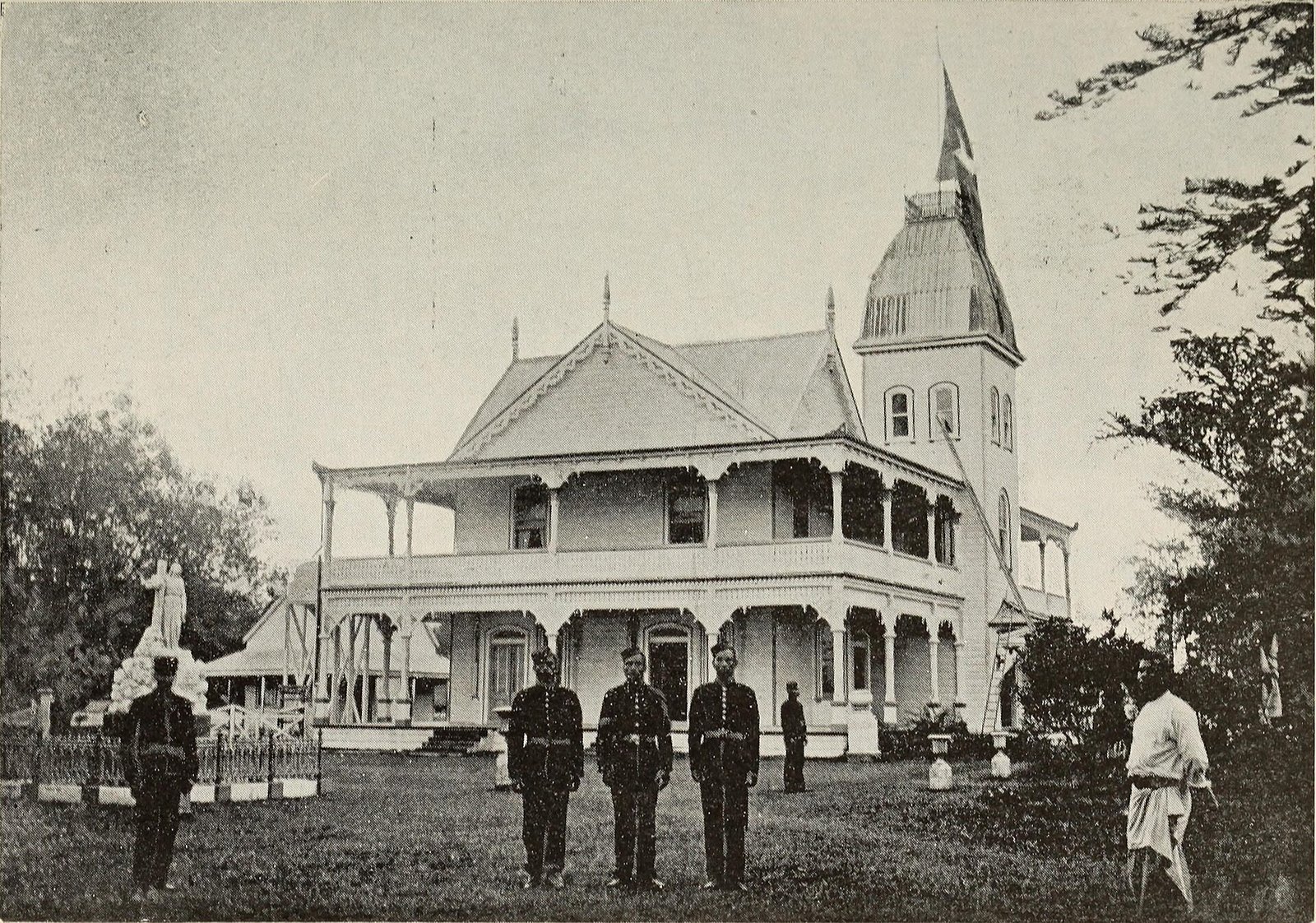
Image: Royal Palace of Tonga in 1900.jpg — Unknown authorUnknown author, Public domain