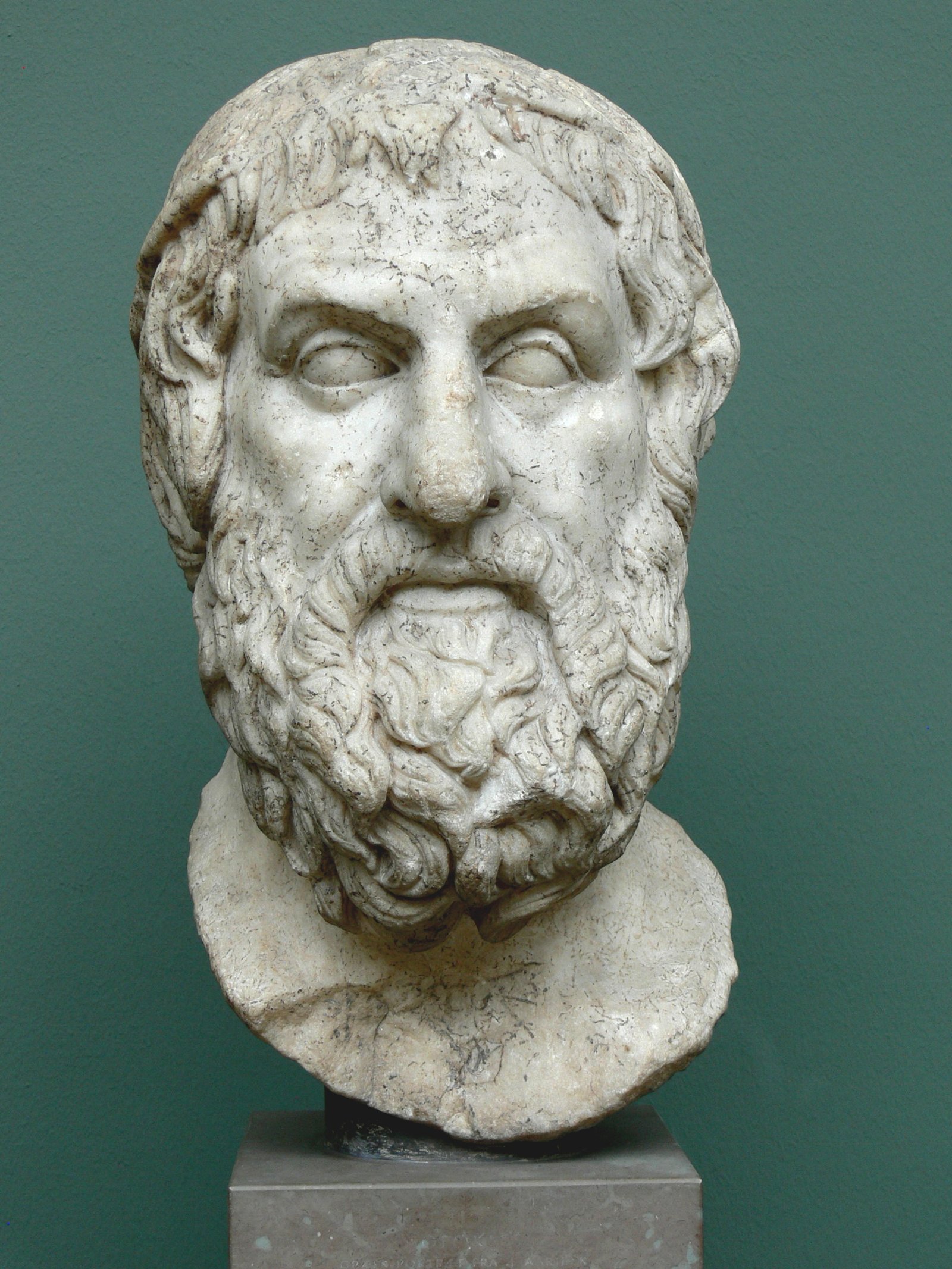
Sophocles was an Athenian tragedy writer born at Colonus around 497/496 BCE, who died in the winter of 406/405 BCE. In Antigone, he explored the limits of political commands against religious obligations; in Oedipus the King, he examined knowledge, fate and responsibility. Performed within Athens’ religious festival culture, these plays made disputed decisions subjects of public discussion.
A forbidden burial and a disputed witness statement bring those questions into focus. Antigone admits breaking Creon’s command, while Oedipus investigates evidence that could establish his own responsibility. If you follow these specific confrontations, you can see how Sophocles built difficult questions from concrete actions. His public offices, festival setting and contested theatrical innovations provide the wider context.
What is known about Sophocles’ life and public roles in Athens?
Sophocles was born at Colonus, near Athens. He is counted alongside Aeschylus and Euripides among the three great writers of ancient Greek tragedy. In 468 BCE, he won his first victory at the Dionysia competition in Athens, defeating Aeschylus.
His work extended into public administration. In 443/442 BCE, Sophocles served among the hellenotamiai, financial officials who managed contributions from Athens’ allies. The playwright who staged arguments about authority therefore also held responsibility within Athenian public life.
The ancient Vita Sophoclis reports that he was elected one of Athens’ ten strategoi in 441 BCE. He served alongside Pericles in the Samos campaign. This biographical testimony places military command beside his theatrical and financial work.
The Suda attributes 123 plays to Sophocles. Only seven survive complete: Ajax, Antigone, Women of Trachis, Oedipus the King, Electra, Philoctetes and Oedipus at Colonus. That difference matters when you assess his career: the complete surviving plays represent only part of the output attributed to him.
How were tragedies performed at religious festivals?
Athens’ spring festival of Dionysus Eleuthereus included processions, sacrifices in the theater and competitions between tragedy writers. Tragedy belonged within this religious occasion. Its arguments about commands, gods and obligations were presented in a setting that combined worship and competition.
The Great Dionysia took place in Elaphebolion, approximately March–April. Competing tragedy writers presented three tragedies and a satyr play. This format should not be confused with the modern grouping of Sophocles’ three plays concerning Oedipus and Antigone. Those works were written for competitions in different years.
Masks allowed actors to perform more than one character. The orchestra was the chorus’s dancing area. The Metropolitan Museum of Art interprets exchanges between actors and chorus as a form of public discourse connected with debate in the Athenian assembly. That connection offers a way to read the plays’ arguments without treating each character as Sophocles’ personal spokesperson.
How does Antigone explore conflict between political commands and religious obligations?
Creon’s command draws a political distinction between two brothers. Around lines 192–206, he orders funeral honors for Eteocles, who defended Thebes. He forbids burial and mourning for Polyneices, who attacked the city. The treatment of a body becomes an expression of the ruler’s judgment about loyalty.
Antigone challenges the authority behind that distinction. In lines 450–460, she acknowledges knowing the command. She argues that a mortal ruler cannot cancel the gods’ unwritten, enduring rules. Her defense makes the conflict explicit: obedience to political authority can collide with a religious obligation.
Think of an everyday disagreement about whether an official rule releases you from a duty to your family. Antigone gives that problem a precise form through the burial of Polyneices. The comparison helps explain the conflict, although the play grounds her defense specifically in divine rules that she considers beyond a ruler’s power.
Creon also understands the challenge through gender. At line 525, he declares that a woman will not rule him while he lives. His response makes Antigone’s disobedience a struggle over male and female power as well as burial. The question becomes whether defending a command also means defending the ruler’s personal dominance.
Haemon challenges another part of Creon’s thinking. When Creon claims the state belongs to its ruler, Haemon answers that a state belonging to one person cannot count as a state. Read beside the burial dispute, this exchange asks who has standing to speak about the community’s decisions.
These scenes support a reading of Antigone as an inquiry into the limits of authority. Creon’s burial order, Antigone’s religious defense and Haemon’s objection each locate those limits differently. Connecting their arguments to Athenian public debate is an interpretation grounded in the text and its performance setting.
How does Oedipus the King address knowledge, responsibility and fate?
The investigation begins with a public disaster. In lines 95–107, Creon reports Apollo’s demand that the pollution arising from the murder of Laius, the former king, be removed through exile or repayment in blood. Finding responsibility for an earlier killing becomes a condition for addressing Thebes’ present suffering.
Oedipus treats testimony as evidence. In lines 840–847, he focuses on whether Laius was killed by several robbers or by one traveler. The difference could determine his own responsibility. If you follow this detail, the inquiry becomes more than a general search for truth: a specific witness statement could implicate the investigator.
The search also raises the question of when knowledge should be pursued. In lines 1056–1065, Jocasta asks Oedipus to stop investigating. He insists on using the available clues to discover his origins fully. Their disagreement gives the pursuit of knowledge an immediate personal cost.
Oedipus then uses his authority to obtain information. In lines 1150–1155, he orders the hands of an unwilling elderly shepherd to be bound. The seeker of evidence is also a ruler able to compel testimony. The scene connects knowledge with power and asks what methods an investigation can justify.
The play distinguishes divine involvement from personal action. In lines 1329–1335, Oedipus attributes the realization of his disasters to Apollo. Yet he specifically identifies his own hand as the agent that blinded his eyes. Fate does not erase every distinction between what happens to him and what he does himself.
Oedipus at Colonus develops the responsibility question further. In lines 960–977, Oedipus argues that he killed his father without knowing his identity. He also challenges the fairness of blaming him for a prophecy announced before his birth. This later defense brings ignorance and fairness directly into the discussion of blame.
The same play considers how another ruler should respond to him. In lines 560–568, Theseus recalls his own experience of exile and says he will not refuse help to the foreign Oedipus. Responsibility here includes a decision about assistance, shaped by the ruler’s memory of displacement.
What evidence supports claims about Sophocles’ theatrical innovations?
In chapter 4 of the Poetics, at 1449a, Aristotle credits Sophocles with increasing the number of actors to three. The same passage attributes skenographia, or scene painting, to him. These claims have identifiable ancient textual support.
The attribution of the third actor is nevertheless disputed within ancient testimony. Aristotle assigns it to Sophocles, while Themistius assigns it to Aeschylus. The disagreement means that identifying one personal inventor requires caution, even when an attribution appears in a surviving ancient source.
The wording of the Poetics has also prompted debate. In a 1984 article, A. L. Brown argued that the sentence concerning Sophocles and scene painting was not Aristotle’s. The widespread textual tradition retains the passage. Brown also acknowledged that his proposal to remove it had attracted little support.
Details you won’t find in guidebooks
Ancient biographical tradition places Sophocles in a celebratory chorus before his first recorded theatrical victory. It reports that, as a young man, he led a hymn-singing chorus celebrating the victory at Salamis in 480 BCE. The attribution belongs to that biographical tradition.
Antigone’s burial action is described with material precision. In lines 429–431, the guard says she scattered earth over the body and poured three liquid offerings from a bronze vessel. Her religious obligation takes the form of particular gestures and an identifiable object.
The three Theban plays were not presented together as a trilogy. Oedipus at Colonus was staged after Sophocles’ death, in 401 BCE, by his grandson of the same name. Shared characters therefore should not lead you to assume a single original performance sequence.
The familiar image of a circular orchestra also needs qualification. According to the Metropolitan Museum, physical evidence for that shape does not precede the theater at Epidaurus, dated around 330 BCE. Fifth-century BCE Athenian spectators may have used a rectilinear seating arrangement.
Timeline
- Around 497/496 BCE: Sophocles is born at Colonus.
- 480 BCE: According to ancient biographical tradition, he leads a chorus celebrating the Salamis victory.
- 468 BCE: He wins his first Dionysia victory.
- 443/442 BCE: He serves as a financial official among the hellenotamiai.
- 441 BCE: According to the ancient Vita Sophoclis, he is elected one of Athens’ ten strategoi; he serves with Pericles in the Samos campaign.
- Winter 406/405 BCE: Sophocles dies.
- 401 BCE: His grandson stages Oedipus at Colonus posthumously.
- 1984: A. L. Brown publishes his challenge concerning the Sophocles and scene-painting passage.
FAQ
Who was Sophocles?
Sophocles was an Athenian tragedian born at Colonus around 497/496 BCE. He also held financial and military office and died in the winter of 406/405 BCE.
What central question does Antigone raise?
Antigone asks whether a ruler’s command can override religious obligations. The conflict concerns Creon’s prohibition on burying Polyneices and Antigone’s defense of the gods’ unwritten rules.
How does Oedipus the King connect fate and responsibility?
Oedipus attributes his disasters to Apollo but identifies his own hand as responsible for blinding his eyes. The play also examines how testimony and the pursuit of knowledge establish responsibility.
Were the three Theban plays written as a trilogy?
No. Antigone, Oedipus the King and Oedipus at Colonus were written for competitions in different years. They were not presented together as a trilogy.
Sources
- Wikipedia — Sophocles en.wikipedia.org
- Vikipedi — Sofokles tr.wikipedia.org
- King’s College London — Who was Sophocles? kvl.cch.kcl.ac.uk
- The Metropolitan Museum of Art — Theater in Ancient Greece metmuseum.org
- BCcampus — Mythoi Koinoi, The Theatre pressbooks.bccampus.ca
- Harvard Center for Hellenic Studies — Antigone chs.harvard.edu
- Fordham University — Ancient History Sourcebook, Sophocles: Antigone sourcebooks.web.fordham.edu
- Harvard Center for Hellenic Studies — Oedipus Tyrannus chs.harvard.edu
- Harvard Center for Hellenic Studies — Oedipus at Colonus chs.harvard.edu
- Durham University — Living Poets, Aristotle, Poetics 4 livingpoets.dur.ac.uk
- Cambridge University Press — A. L. Brown, Three and scene-painting: Sophocles cambridge.org
Image: Ny Carlsberg Glyptothek – Sophokles.jpg — Wolfgang Sauber, CC BY-SA 3.0