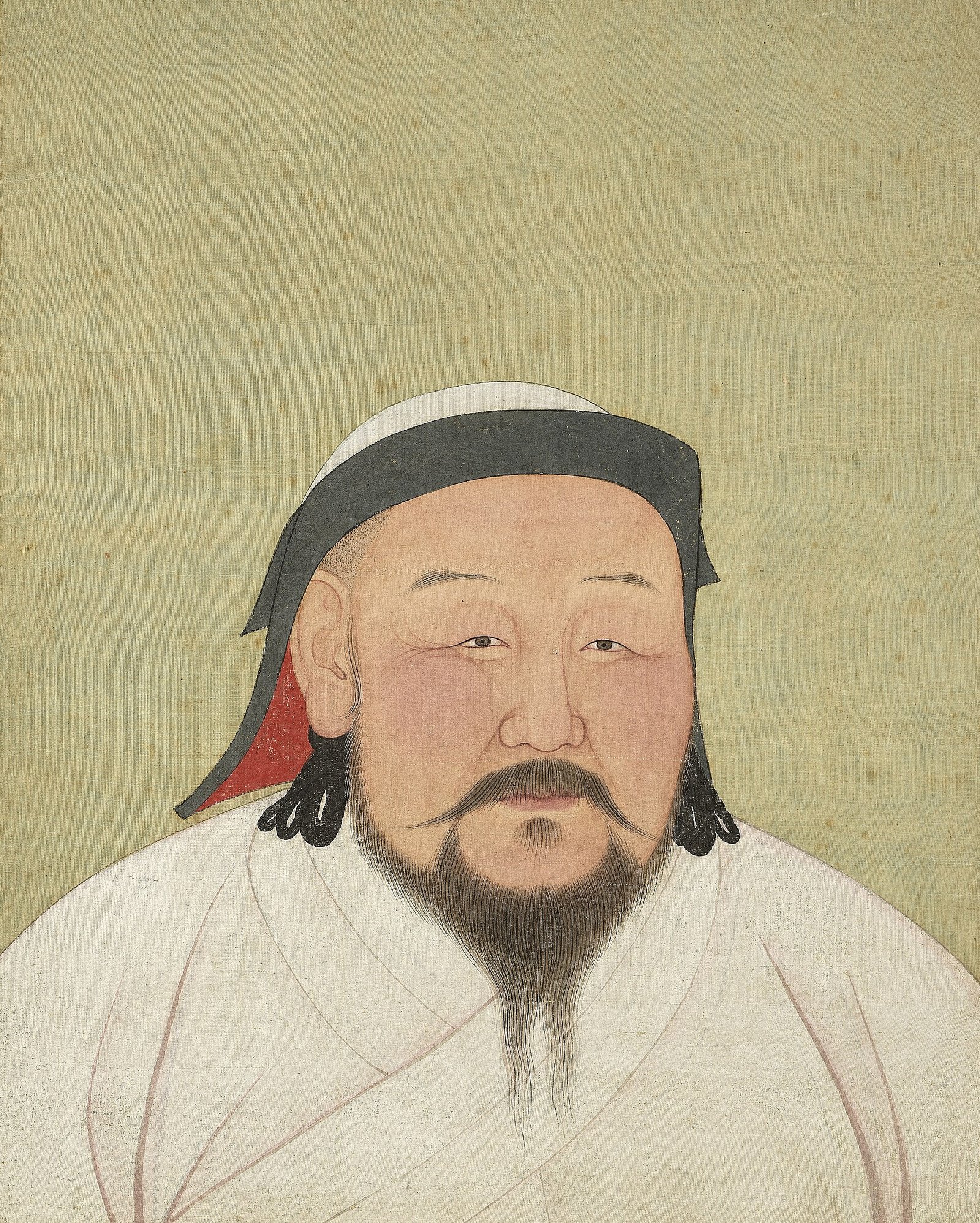
This article covers the ruler: the Mongol who founded the Yuan dynasty and governed China from the city that is now Beijing.
Who was Kublai Khan?
Kublai Khan was born on 23 September 1215. He belonged to the Borjigin dynasty and is defined historically as a Mongol, not a Turk. His father was Tolui, a son of Genghis Khan. His mother was Sorghaghtani Beki.
He had famous brothers. Möngke was the Great Khan. Hülegü founded the Ilkhanate, and Kublai was his elder brother. So Kublai grew up inside the most powerful family in Asia.
When Möngke was elected great khan in 1251, he put Kublai in charge of Mongol affairs in China. This job shaped the rest of Kublai’s life. It gave him years of practice in dealing with Chinese officials, towns and customs.
How did he become Great Khan?
In 1260, Kublai and his brother Ariq Böke each declared a khanate of their own. Two brothers claimed the same title. The struggle ended in 1264 with Kublai on top.
This matters because everything that follows rests on that win. Without it, Kublai would have been one prince among many. After 1264 he could turn his full attention to China.
When did the Yuan dynasty begin?
Kublai announced the Yuan dynasty name in 1271. That date is not the same as the final defeat of the Southern Song, which came in 1279. Many readers mix the two, so keep them apart.
The decisive blow fell on 19 March 1279 at the Battle of Yamen. Song forces lost, and this is taken as the start of Kublai’s rule over all of China.
Where was the Yuan capital?
Kublai’s capital in China was Dadu. It was also called Khanbaliq, and it stands where Beijing stands today. If you walk through Beijing now, you are in the city Kublai chose to rule from.
He also had a second city, Shangdu. His Chinese adviser Liu Bingzhong designed it in 1256. UNESCO lists it as the Site of Xanadu and describes it as an attempt to combine Mongol nomadic culture with Han Chinese culture.
How did Mongol rule in China work?
Kublai did not throw away the Chinese system. His government kept the traditional Six Ministries. It also kept the Secretariat, the central decision-making body.
He went further into Chinese court tradition. He revived Confucian music and dance ceremonies at court. He built ancestral temples for his father and for his grandfather Genghis Khan. So the court honored Mongol ancestors with Chinese ritual forms.
His family followed the same path. Kublai had his son Zhenjin taught in the Chinese manner by Confucian scholars. Zhenjin learned both Confucianism and Buddhism. Kublai’s other children included the sons Dorji, Manggala and Nomughan and the daughters Yuelie and Ulujin.
What did Kublai Khan believe, and who did he support?
Kublai gave special honor to Buddhism. In 1260 he named the Tibetan Buddhist monk Phags-pa his state preceptor. In 1270 he raised him to imperial preceptor.
But he did not stop there. He supported Buddhist monasteries, and also Confucian studies, Muslim mosques and Nestorian Christian churches. If you picture one ruler paying for temples, mosques and churches in the same empire, you have the right idea.
Details you won’t find in guidebooks
- A script for many languages. Kublai had Phags-pa prepare a square script, finished around 1269. It was meant to write several languages. It never spread widely and stayed mostly in official use.
- Where the script appeared. It was not only on documents. It was also used on paper money, seals, travel passes and porcelain.
- Paper money and its exchange rate. The Zhiyuan paper money began to be issued in 1287. One guan of the new note was set equal to five guan of the earlier Zhongtong money. Think of it like a bank today telling you that one new note replaces five old ones. The government rewrote the value of the cash in people’s hands.
- A request for scholars. In Marco Polo’s account, Kublai asked Niccolò and Maffeo Polo to bring him one hundred learned Christians.
- A city designed by an adviser. Shangdu came from the plan of a Chinese counselor.
Kublai Khan and Marco Polo
Marco Polo, with his father Niccolò and his uncle Maffeo, reached Kublai’s summer palace in northern China in 1275.
Is the story true? Frances Wood argues that Marco never went to China. Historian Morris Rossabi disagrees. He says the gaps in the travel book do not disprove the journey, and that the account contains information that matches Chinese and Iranian sources. The debate is still open, so treat the book as a source to weigh, not a camera recording.
Why did the sea campaigns fail?
Kublai’s two naval expeditions against Japan, in 1274 and 1281, both failed. His expedition to Java in 1292–1293 ended in failure too, with no lasting conquest.
So the same ruler who finished the conquest of China on land could not repeat it over water. Three overseas efforts, no gains.
What did his projects cost?
Kublai built capitals, roads, postal stations and Grand Canal works. These needed large spending. Late in his reign, the government increased the money supply to cover its expenses. This is the background to the paper money story above: a state that paid in paper had a tool for paying its bills, and a temptation to print more.
Timeline
- 23 September 1215: Kublai was born.
- 1251: Möngke Khan gave Kublai responsibility for activities in China.
- 1256: Liu Bingzhong designed the city of Shangdu.
- 1260: Kublai and Ariq Böke each declared a khanate.
- 1264: Kublai won the struggle with Ariq Böke.
- 1269: Phags-pa’s square script was completed.
- 1271: Kublai announced the Yuan dynasty name.
- 1274: The first naval expedition to Japan failed.
- 1275: Marco Polo reached Kublai’s summer palace.
- 19 March 1279: The Song were defeated at the Battle of Yamen.
- 1281: The second naval expedition to Japan failed.
- 1287: Zhiyuan paper money began to be issued.
- 1292–1293: The Java expedition ended in failure.
- 18 February 1294: Kublai died in Dadu. His grandson Temür took the throne.
- 1368: The Yuan lost Beijing and the Ming dynasty took power.
How did Kublai Khan die, and where is he buried?
Kublai died on 18 February 1294 in Dadu, today’s Beijing. He was 78. In his last years he is reported to have had health problems linked to gout, excess weight and heavy drinking. These do not amount to a firm diagnosis of the cause of death, and nothing shows he was killed.
The place of his grave is unknown. Some say he was buried near Burkhan Khaldun in Mongolia, but that is an assumption, not a confirmed burial site. If a tour guide gives you a certain spot, remember that no source confirms it.
What happened after him?
Kublai’s son did not take the throne. In 1294 his grandson Temür became ruler of the Yuan. The dynasty lasted until 1368, when it lost Beijing and the Ming dynasty took power in China.
For a full biography, Morris Rossabi’s Khubilai Khan: His Life and Times was published by the University of California Press. A twentieth-anniversary edition with a new preface came out in 2009.
FAQ
Did Kublai Khan meet Marco Polo?
Marco Polo’s account says he reached Kublai’s summer palace in northern China in 1275 with his father Niccolò and his uncle Maffeo. Some scholars, such as Frances Wood, doubt that Marco ever went to China. Morris Rossabi argues that the gaps in the book do not disprove the journey.
Sources
- Wikipedia (Turkish) — Kubilay Han tr.wikipedia.org
- National Geographic Education — Kublai Khan education.nationalgeographic.org
- EBSCO — Kublai Khan ebsco.com
- Wikipedia — Kublai Khan en.wikipedia.org
- Columbia University — Khubilai Khan in China afe.easia.columbia.edu
- Columbia University — Phags-pa afe.easia.columbia.edu
- Columbia University — Khubilai Khan afe.easia.columbia.edu
- Columbia University — Military Successes & Failures afe.easia.columbia.edu
- Columbia University — Public Works Failures afe.easia.columbia.edu
- Encyclopaedia Iranica — Polo, Marco iranicaonline.org
- Columbia University, Morris Rossabi — Did Marco Polo Really Go To China? afe.easia.columbia.edu
- Columbia University — The Polo Brothers Reach China afe.easia.columbia.edu
- HISTORY — Kublai Khan history.com
- UNESCO — Site of Xanadu whc.unesco.org
- Columbia University — Written Language www-1.gsb.columbia.edu
- National Museum of China — Zhiyuan Tongxing Baochao chnmuseum.cn
- University of California Press — Khubilai Khan ucpress.edu
Image: YuanEmperorAlbumKhubilaiPortrait.jpg — Araniko, Public domain