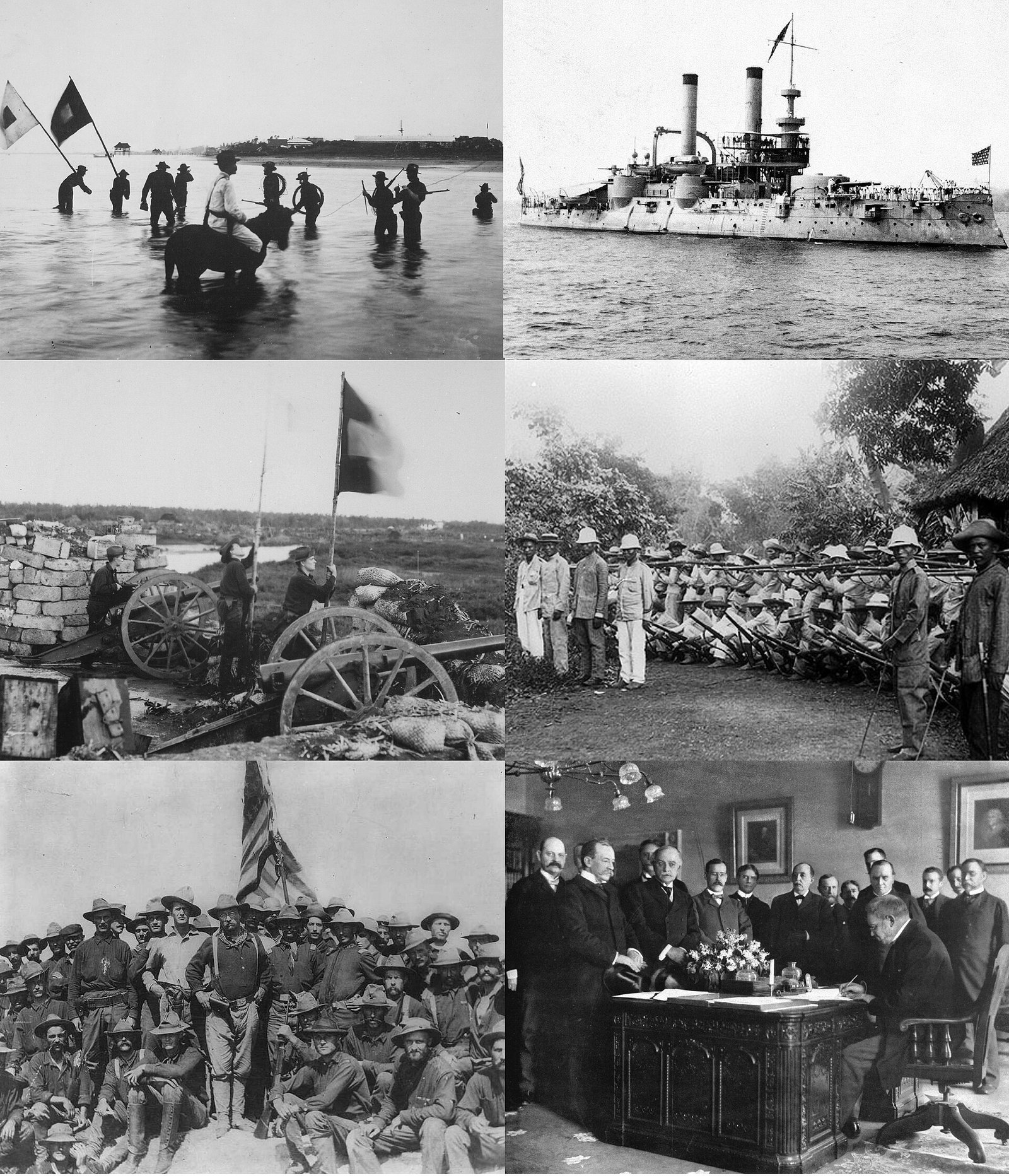
The Spanish–American War began in 1898 because Cuba’s independence struggle and Spanish repression pushed the United States toward intervention. The USS Maine explosion in Havana on 15 February increased pressure for war, although Spain’s responsibility was never proved. American victory forced Spain to relinquish its sovereignty claims over Cuba and surrender Puerto Rico, Guam, and the Philippines.
How did a ship explosion in Cuba become part of a war reaching the Philippines? If you follow the events from the Cuban uprising of 1895 to the Treaty of Paris in December 1898, the connections become clearer. The sequence separates Cuba’s struggle, the Maine controversy, and the decisions that turned intervention into war.
What was the Spanish–American War of 1898?
The Spanish–American War was an armed conflict between the United States and Spain in 1898. It ended in an American victory. Its theaters stretched across the Caribbean and the Pacific, taking in Cuba, Puerto Rico, Guam, and the Philippines.
Cuba’s independence movement preceded American intervention by about three years. Cuban revolutionaries began their struggle against Spanish colonial rule in 1895. That chronology matters: the United States entered a conflict already underway, with Cuban independence at its center.
The settlement also reached beyond Cuba. Spain relinquished its sovereignty claims there and transferred other territories to the United States. The war’s outcome therefore connected a Cuban independence struggle with changes in colonial control across two oceans.
Why did Cuba’s independence struggle lead to intervention?
Spanish repression intensified the crisis. General Valeriano Weyler became governor of Cuba in 1896 and implemented reconcentración. The policy moved approximately 300,000 civilians into fortified towns to cut rural support for the rebels.
Forced relocation carried a severe human cost. According to the Smithsonian’s 1898 exhibition, tens of thousands of affected Cubans died from hunger and disease. Civilian suffering became part of the background to American intervention.
Diplomatic tensions rose further on 9 February 1898. The New York Journal published a private letter in which Spain’s ambassador in Washington, Enrique Dupuy de Lôme, disparaged President William McKinley. Its publication strengthened the pro-war atmosphere in the United States.
The Maine exploded six days later. By then, Cuba’s rebellion, forced relocation, civilian deaths, and the ambassador’s letter had already deepened the crisis. The ship’s destruction added pressure to an existing confrontation.
Did the USS Maine explosion cause the war?
The USS Maine had been sent to Havana to protect American citizens and property in Cuba. On 15 February 1898, it exploded and sank in the harbor. Its destruction became a powerful factor in the demand for intervention.
Joseph Pulitzer’s New York World and William Randolph Hearst’s New York Journal published conspiracy rumors about the sinking. Their coverage fed anti-Spanish opinion. Like a dramatic headline you encounter in everyday life, an allegation could shape your reaction before its evidence was settled; the Maine coverage illustrates that distinction.
An American inquiry chaired by William T. Sampson concluded in 1898 that a naval mine had destroyed the ship. Yet it found no evidence assigning responsibility to any individual. A conclusion about a possible weapon did not establish who had caused the disaster.
Admiral Hyman G. Rickover challenged the mine explanation in a study published in 1976. He considered spontaneous combustion in coal beside the ammunition magazine the most likely cause. Some historians disputed this explanation because they considered an unnoticed fire unlikely.
The United States Naval History and Heritage Command describes the mine evidence as weak and the precise cause as uncertain. You can therefore distinguish two questions: the explosion increased pressure for war, but Spain’s responsibility for it was never proved.
Who was president, and when did the Spanish–American War begin?
William McKinley was the American president during the war. On 11 April 1898, he asked Congress for authority to intervene in Cuba. The request brought the crisis into a formal political process.
On 20 April, McKinley signed a joint resolution demanding Spain’s withdrawal from Cuba. Through the Teller Amendment, it also rejected an American intention to annex the island. Spain rejected the ultimatum and broke diplomatic relations.
The United States imposed a naval blockade of Cuba on 22 April. Congress declared war on 25 April, recognizing that a state of war had existed since 21 April. This explains why the declaration date and the recognized starting date differ.
Where was the Spanish–American War fought?
The war’s geography included Cuba and Puerto Rico in the Caribbean, plus Guam and the Philippines in the Pacific. If you picture only Havana and the Maine, you miss the Pacific theater. One of the major American naval victories occurred in the Philippines.
On 1 May 1898, Commodore George Dewey’s fleet defeated the Spanish fleet at Manila Bay. In Cuba, American forces defeated Spanish defenses at the San Juan Heights on 1 July. These victories occurred in separate theaters within the same war.
American naval forces destroyed the Spanish fleet off Santiago Bay on 3 July. Spanish forces in Santiago surrendered on 17 July. American troops then landed in Spanish-controlled Puerto Rico on 25 July, before the armistice protocol of 12 August.
Timeline
- 1895: Cuban revolutionaries began an independence struggle against Spain.
- 1896: Weyler implemented reconcentración in Cuba.
- 9 February 1898: The New York Journal published the De Lôme letter.
- 15 February 1898: The USS Maine exploded and sank in Havana Harbor.
- 11 April 1898: McKinley requested congressional authority to intervene in Cuba.
- 20 April 1898: McKinley signed the resolution demanding Spanish withdrawal.
- 25 April 1898: Congress declared war, recognizing a state of war from 21 April.
- 1 May 1898: Dewey’s fleet defeated the Spanish fleet at Manila Bay.
- 1 July 1898: American forces defeated Spanish defenses at the San Juan Heights.
- 3 July 1898: American naval forces destroyed the Spanish fleet off Santiago.
- 17 July 1898: Spanish forces in Santiago surrendered.
- 25 July 1898: American troops landed in Puerto Rico.
- 12 August 1898: The United States and Spain signed an armistice protocol.
- 10 December 1898: The Treaty of Paris was signed.
- 4 February 1899: The Philippine–American War began.
- 20 May 1902: American occupation government in Cuba ended.
- 1976: Rickover published his coal-fire explanation for the Maine explosion.
How did Spain lose Cuba and the Philippines?
The Treaty of Paris, signed on 10 December 1898, formalized Spain’s territorial losses. Spain relinquished its sovereignty claims over Cuba and ceded Puerto Rico and Guam to the United States. It also agreed to transfer the Philippines for $20 million.
Cuba remained under American occupation after Spain’s defeat. The American occupation government ended on 20 May 1902. Spain’s loss of sovereignty and the end of American occupation were therefore separate events.
The United States required Cuba to accept an American right of intervention under the Platt Amendment as a condition of independence. That arrangement was abolished in 1934. Cuba’s postwar position thus involved both the end of Spanish rule and continuing American influence.
In the Philippines, Emilio Aguinaldo’s nationalists wanted independence rather than a change of colonial ruler. A separate war between them and American forces began on 4 February 1899. The transfer agreed in Paris did not resolve the question of Philippine independence.
Details you won’t find in guidebooks
The Maine death toll accumulated over time. The naval documentary collection records 250 enlisted personnel and two officers killed initially. Eight wounded men died within the following hours, and six more died over subsequent months, bringing the total to 266.
The term yellow journalism had an origin in newspaper competition. It emerged from Pulitzer and Hearst’s rivalry over the Yellow Kid comic character in 1896. That earlier contest supplied the label associated with sensational coverage before the war.
Spanish–American War uniforms were not uniformly khaki. Although the American army adopted a tropical khaki uniform in 1898, most soldiers arriving in Cuba wore blue. Typical enlisted clothing included a dark blue wool shirt and light blue wool trousers.
A historical map also connects the ship disaster with military operations. Eugenia Wheeler Goff and Henry Slade Goff published a war map in 1899 showing land and naval maneuvers in Cuba and Puerto Rico. It also marked the Maine’s sinking place in Havana.
FAQ
Why did the Spanish–American War begin?
Cuba’s independence struggle, Spanish repression, and American regional interests created the conditions for war. The USS Maine explosion increased pressure for American intervention, although Spain’s responsibility was never proved.
What were the dates of the Spanish–American War?
Congress declared war on 25 April 1898 and recognized a state of war from 21 April. An armistice protocol followed on 12 August, and the Treaty of Paris was signed on 10 December 1898.
Did Spain destroy the USS Maine?
Spain’s responsibility was not proved. The 1898 American inquiry favored a mine, while Hyman G. Rickover’s 1976 study favored a coal fire; the exact cause remains uncertain.
Did the United States annex Cuba after the war?
Spain relinquished its sovereignty claims over Cuba, which remained under American occupation until 20 May 1902. The United States also secured a right to intervene under the Platt Amendment, an arrangement abolished in 1934.
Sources
- Office of the Historian — The Spanish-American War, 1898 history.state.gov
- Smithsonian National Portrait Gallery — 1898 Exhibition Texts npg.si.edu
- National Archives — De Lôme Letter (1898) archives.gov
- Office of the Historian — U.S. Diplomacy and Yellow Journalism, 1895–1898 history.state.gov
- Naval History and Heritage Command — Destruction of the Maine history.navy.mil
- Naval History and Heritage Command — Maine I history.navy.mil
- Naval History and Heritage Command — Maine (Second-class Battleship) history.navy.mil
- Office of the Historian — Cuba history.state.gov
- Office of the Historian — The Philippine-American War, 1899–1902 history.state.gov
- U.S. Army Center of Military History — The American Soldier, 1898 history.army.mil
- U.S. Capitol Visitor Center — Goff’s Historical Map visitthecapitol.gov
Image: Collage infobox for Spanish-American War.jpg — Barbudo Barbudo and TEP, CC BY-SA 4.0