Sagalassos sits high on a mountain slope in southwestern Turkey. It was a Roman-era city of Pisidia. Today it is an archaeological site with a restored fountain, and that fountain carries water again.
This guide covers where the site is, how to reach it and what happened there. It also explains why the fountain matters.
Where is Sagalassos? (Location and Map)
Sagalassos is in Burdur Province. It lies about 7 kilometres north of the district town of Ağlasun. The ruins spread over the slopes of Akdağ, at 1500–1700 metres above sea level.
If you look at a map, you will find the site in the mountains above Ağlasun, not on the plain below.
The Culture Portal of Türkiye lists the site under Burdur’s places to visit. Its page carries photographs of the site from TGA.
How to Get to Sagalassos
The Ministry of Culture and Tourism gives a clear route. You leave the Burdur–Antalya highway at its 14th kilometre. From there you follow a road of about 20 kilometres to the site.
Plan the drive as part of a day trip. The road climbs, and the site itself is a hillside walk.
Visiting Hours and Tickets
Check the official 2026 list from the Burdur Provincial Directorate of Culture and Tourism before you go. It gives these times for Sagalassos:
- Opening: 09.00
- Ticket office closes: 17.00
- Site closes: 17.30
The same list gives these prices:
- Foreign visitors: 8 euros
- Turkish citizens with a Museum Card: 200 TL
- Students and academics with a Museum Card: 100 TL
Prices and hours can change, so confirm them on the official page.
What Was Sagalassos?
The excavation project dates the first traces of settlement at Sagalassos to the late 5th century BC. The city then appears in the account of Arrian. He says Alexander the Great took Sagalassos in 333 BC. To do so he broke the resistance shown on a steep hill south of the settlement.
Roman rule came later. When Amyntas, King of Galatia, died in 25 BC, Augustus added Pisidia to the Roman province of Galatia.
Under Emperor Hadrian, Sagalassos was regarded as the ‘first city’ of Pisidia. A large building programme began in the city.
Sagalassos was also a workshop town. Its fine red-slipped tableware was made from the time of Augustus until the 7th century AD. Geophysical surveys in 2004 found more than 50 kilns in the pottery production area, according to the UNESCO nomination file.
The Antonine Fountain: The Water Still Flowing
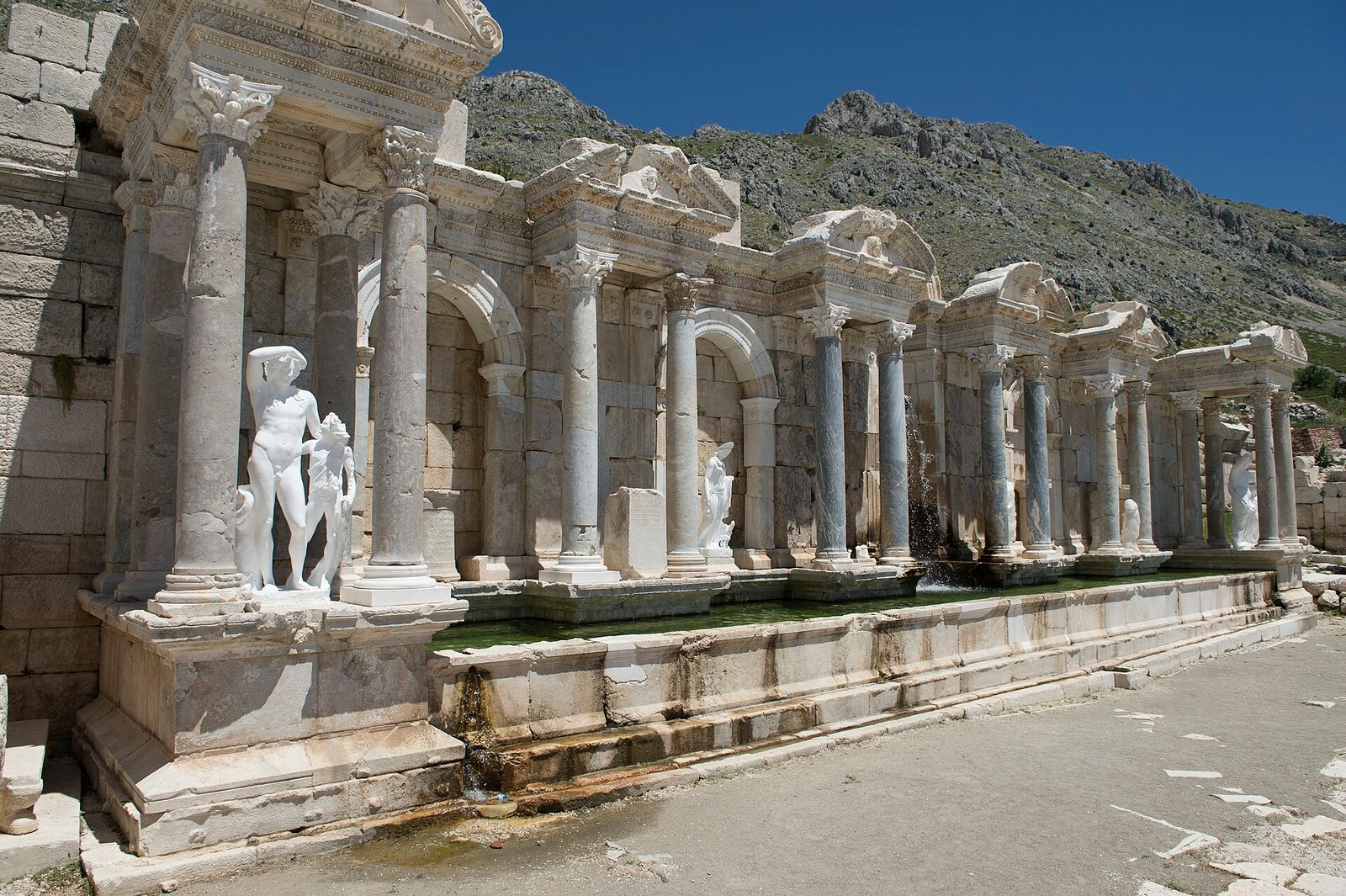
The Antonine Fountain stands north of the Upper Agora. It was built between AD 160 and 180. It is about 28 metres long and 9 metres high.
Its name comes from the Antonine dynasty of Rome. The excavation team, however, says there is no evidence that the emperors of that time paid for it.
Who did? The sources disagree. The General Directorate of Cultural Heritage and Museums suggests that Titus Flavius Severianus Neon and his wife may have commissioned it. The excavation project says the person or institution that ordered it cannot be identified.
An earthquake in the 7th century AD brought the fountain down almost completely. Its remains were uncovered by excavation between 1993 and 1996. Restoration was completed in 2010, and the fountain began to run again that year.
The water is not piped in from far away. According to Burdur Museum Director Hacı Ali Ekinci, it comes from a natural spring on Ağlasun Mountain.
One caution applies when you stand in front of it. The statues on display are copies. The original statues found in the excavations are kept in the Burdur Museum.
Timeline
- Late 5th century BC: The earliest traces of settlement at Sagalassos date to this period.
- 333 BC: Alexander the Great takes Sagalassos.
- 25 BC: Pisidia joins the Roman province of Galatia.
- AD 160–180: The Antonine Fountain is built.
- 7th century AD: A major earthquake destroys the fountain.
- 13th century AD: Life continues in small sheltered settlements within the site area.
- 1824: Arundell reads inscriptions on the ruins and identifies them as Sagalassos.
- 1990: Large-scale excavations begin under Marc Waelkens.
- 1993–1996: The Antonine Fountain is uncovered.
- 6 February 2009: Sagalassos is entered on the UNESCO World Heritage Tentative List.
- 2010: The restored fountain flows again.
Details You Won’t Find in Guidebooks
Seven kinds of stone. The builders used seven different types of stone for the Antonine Fountain. The façade was a mix of materials.
A pool of 81 cubic metres. Water fell from a height of about 4.5 metres. It filled a basin holding 81 cubic metres.
Statues from Aphrodisias. Two groups of Dionysus and satyr belonged to the fountain’s original statue scheme. They were brought from Aphrodisias, a city famous for its sculpture.
Laundry day. East of the city stands a fountain in the Doric order. It was built in the late 1st century BC over a natural spring that is still active today. The wear on its parapets shows that people also washed clothes there. If you have ever hand-washed a shirt at a sink, you have done what they did.
A brewery in the gym. One of the rooms of the Sagalassos gymnasium held a beer-making workshop.
An Archaeological Site Still Being Read
The name of the city was not known for a long time. In 1824 the English clergyman and antiquarian Francis Vyvyan Jago Arundell read inscriptions on the ruins. He identified them as Sagalassos.
Large-scale excavations began in 1990 under Marc Waelkens of the Catholic University of Leuven. Those digs uncovered the Antonine Fountain, among other monuments.
The story did not end with the great monuments. The UNESCO nomination file says that monumental city life declined. Even so, life went on in small sheltered settlements within the site area until the 13th century AD.
UNESCO Status
On 6 February 2009 the Archaeological Site of Sagalassos was entered on the UNESCO World Heritage Tentative List as a cultural heritage candidate. That is a first step, not full inscription.
Tips for Your Visit
Add the fountain to your must-see list. It is a place where the old city and a working water supply meet.
Check the opening times first. The ticket office closes at 17.00, and the site closes at 17.30.
Wear sturdy shoes. The ruins climb a mountainside at 1500–1700 metres.
FAQ
Where is Sagalassos?
Sagalassos is in Burdur Province, about 7 kilometres north of the town of Ağlasun. The ruins lie on the slopes of Akdağ, 1500–1700 metres above sea level.
Does the Sagalassos fountain still have water?
Yes. The Antonine Fountain started to flow again in 2010, when its restoration was completed. The water comes from a natural spring on Ağlasun Mountain.
How do you get to Sagalassos?
The Ministry of Culture and Tourism describes a turn-off at the 14th kilometre of the Burdur–Antalya highway. From there you follow a road of about 20 kilometres to the site.
When was Sagalassos on the UNESCO list?
The Archaeological Site of Sagalassos was entered on the UNESCO World Heritage Tentative List on 6 February 2009. It is a candidate for cultural heritage status.
What are the opening hours and ticket prices?
The 2026 official list gives an opening time of 09.00, a ticket office closing time of 17.00 and a site closing time of 17.30. Foreign visitors pay 8 euros. Turkish citizens use the Museum Card at 200 TL, or 100 TL for students and academics.
Sources
- Kültür Portalı — Sagalassos Antik Kenti kulturportali.gov.tr
- Kültür ve Turizm Bakanlığı — Sagalassos Örenyeri muze.gov.tr
- Sagalassos Archaeological Research Project — History of Sagalassos sagalassos.bilkent.edu.tr
- Turkish Museums — Burdur Sagalassos Örenyeri turkishmuseums.com
- UNESCO World Heritage Centre — Archaeological Site of Sagalassos whc.unesco.org
- Sagalassos Archaeological Research Project — Upper City sagalassos.bilkent.edu.tr
- Sagalassos Archaeological Research Project — East City sagalassos.bilkent.edu.tr
- Archaeology — Antonine Nymphaeum: 2010 Aims interactive.archaeology.org
- Archaeology — Sagalassos Restoration, Marc Waelkens interactive.archaeology.org
- Directorate General of Cultural Heritage and Museums — Sagalassos Antik Kenti (Google Arts & Culture) artsandculture.google.com
- Wikipedia — Sagalassos en.wikipedia.org
- Burdur Provincial Directorate of Culture and Tourism — 2026 visiting hours and fees burdur.ktb.gov.tr
Image: Sagalassos Antonine Fountain in 2012 2684.jpg — Dosseman, CC BY-SA 4.0