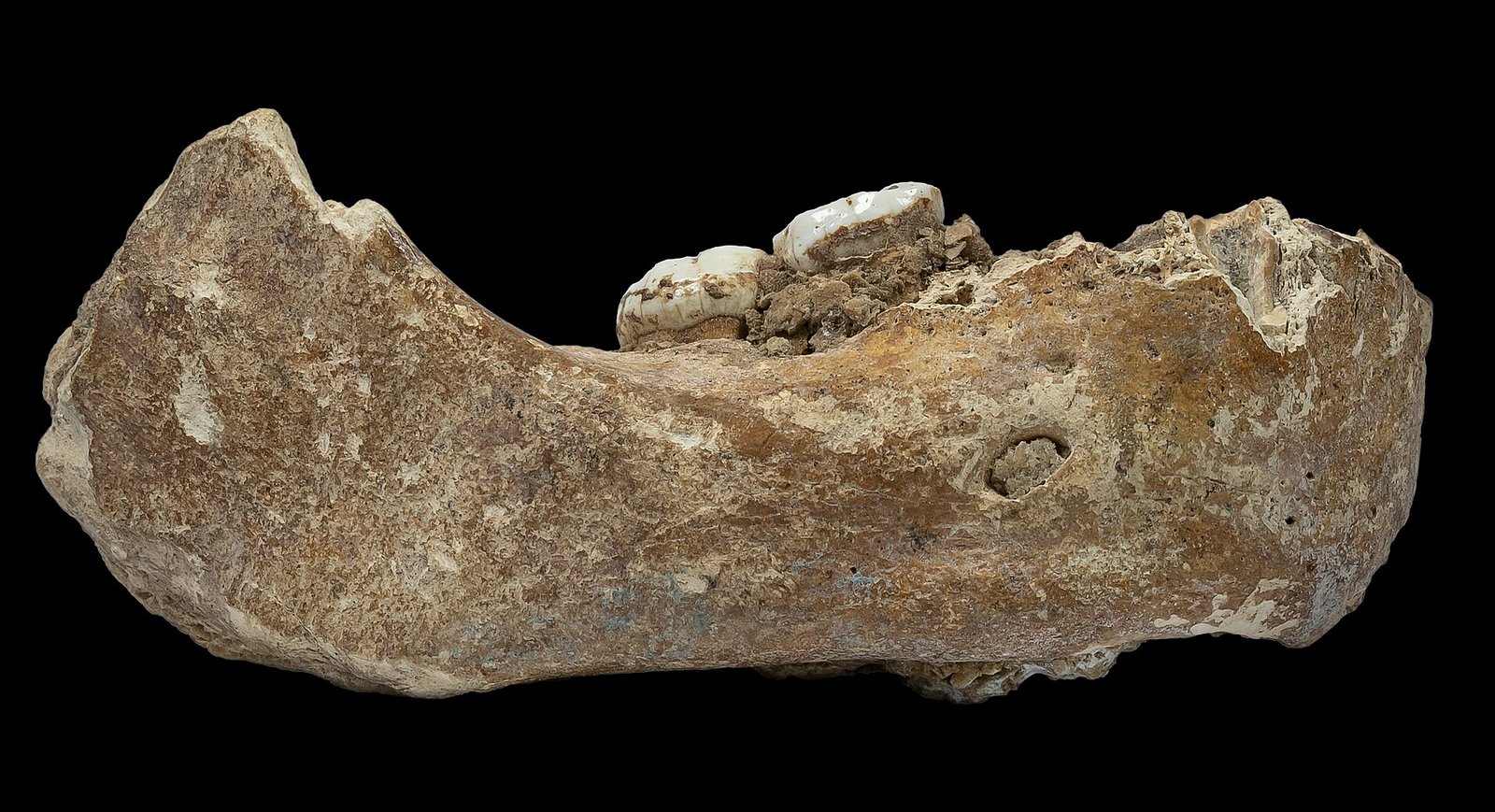
Who were the Denisovans?
Denisovans were an ancient human group closely related to Homo sapiens and Neanderthals. Their genetic identity distinguishes them from both. At Bianfu Cave in southwestern China, five fossils identified through ancient proteins now connect that identity with teeth, skull fragments and part of a forearm.
If you want to understand what the Bianfu discoveries reveal, start with two different time spans. The human fossils date to approximately 167,000–134,000 years ago. The cave’s cultural layers cover approximately 190,000–70,000 years ago. Those dates describe different bodies of evidence, and the distinction matters throughout the story.
Denisovan nuclear DNA shows a close evolutionary relationship with Neanderthals. Yet Denisovans were genetically distinguishable from them. Their relationship with modern humans also included interbreeding, documented by Denisovan DNA surviving in some present-day populations.
How were Denisovans first identified?
The starting point was a child’s finger bone found in 2008. It came from Denisova Cave in Siberia’s Altai Mountains. Analysis of its mitochondrial DNA in 2010 led to the identification of Denisovans as a distinct ancient human group.
That discovery began with genetic evidence from a small bone. Bianfu adds another route to identification: ancient proteins. Researchers used protein analysis to assign five fossils from the Chinese cave to Denisovans, bringing more parts of their anatomy into view.
One individual from Denisova Cave makes the relationship between ancient human groups especially concrete. Denisova 11, known as Denny, had a Neanderthal mother and a Denisovan father. This was a direct family connection between the two groups.
Denisovans also exchanged genes with modern humans. Some Melanesian, Aboriginal Australian and Philippine populations retain Denisovan DNA today. If you think of Denisovans only as distant cave inhabitants, this surviving genetic inheritance connects their story with living people.
What did researchers find in China’s Bianfu Cave?
Bianfu is a Paleolithic site in Yunnan province, southwestern China. Excavations began in 2019. The Chinese Academy of Sciences and the Yunnan Provincial Institute of Cultural Relics and Archaeology conducted the research.
The excavation recovered four human teeth, 1,366 stone tools and more than 64,000 mammal fossils. These totals describe the wider assemblage. Within it, protein analysis confirmed five Denisovan fossils: two skull fragments, a radius fragment and two teeth.
According to the 2026 protein study, Bianfu has yielded more Denisovan fossils than any site outside Denisova Cave in Siberia. Its significance therefore rests partly on the number of identified remains. It also rests on their variety, particularly the addition of a radius.
Two complementary Nature papers appeared on 9 September 2026. Together, they brought anatomical evidence into the same discussion as tools, animal remains and environmental evidence.
How did ancient proteins identify the fossils?
Researchers screened more than 60,000 bone fragments by their shape. They selected 22 possible human specimens. ZooMS protein screening assigned three of those specimens to the human lineage, narrowing the search within the large bone assemblage.
Further protein analysis identified the two skull fragments, radius fragment and two teeth as Denisovan. All five contained the collagen variant COL1A2 R996K, used in identifying Denisovans. That shared marker supported the assignment across different kinds of remains.
The Bianfu identification did not come from successful ancient DNA extraction. Attempts to obtain ancient DNA from three human bones failed. The protein results nevertheless provided evidence for identifying those remains, making proteins central to the Bianfu findings.
Why does the first Denisovan radius matter?
The fossil coded BFD771 was the first identified Denisovan radius, according to the research published in September 2026. The radius is one of the forearm’s two long bones. You can connect this discovery with everyday life by looking at your own forearm: the fossil represents part of that same body region.
Only about 45 millimetres of BFD771 survives. Some features near its elbow end resemble those of Neanderthals. Its overall external shape and the cross-sectional geometry of its neck more closely resemble those of modern humans.
Those comparisons make BFD771 especially informative. A protein-confirmed Denisovan bone carries anatomical features resembling different related human groups. Its identification and its shape therefore contribute different information: the proteins support its Denisovan identity, while its form allows anatomical comparison.
How long does the Bianfu evidence cover?
The dated cultural sequence runs from approximately 190,000 to 70,000 years ago. That is a span of about 120,000 years. The directly documented human fossils belong to a narrower interval, approximately 167,000–134,000 years ago.
Researchers established the chronology by combining several methods. They measured luminescence in sand grains from sediments. They also used methods measuring uranium decay in cave formations and tooth enamel. Together, these approaches established the site’s chronological framework.
The researchers regard Denisovan responsibility for the full cultural sequence as the simplest explanation. That remains an interpretation of the broader archaeological evidence. The fossils themselves directly document Denisovan presence within the shorter interval. When you read about 120,000 years of Denisovan history at Bianfu, keep that difference in view.
What did the cave’s inhabitants eat and make?
Cut marks and breakage patterns on deer, water buffalo and gaur bones indicate that Bianfu’s inhabitants processed large game animals. These traces connect the animal assemblage with human activity. The evidence concerns the handling of animal bodies, alongside the stone and bone tools found at the site.
The inhabitants made stone and bone tools from local materials. Their use of nearby resources is therefore visible in the tools as well as the animal remains. The 1,366 recovered stone tools form part of this evidence for activity in the cave.
Bone retouchers came from layers 7 and 3. These implements were used to adjust the edges of stone tools. They connect the bone and stone assemblages directly: bone served as a tool for working stone, as well as appearing among the processed animal remains.
What was the landscape around Bianfu like?
Pollen and animal remains indicate conifer-dominated forest or forest-steppe around Bianfu during Marine Isotope Stages 6–4. This environmental reconstruction supplies a setting for the cave’s animal processing and use of local toolmaking materials.
Bianfu therefore brings several kinds of evidence together. Pollen and fauna describe the surroundings. Modified animal bones indicate large-game processing. Stone tools and bone retouchers document toolmaking activities. The five protein-confirmed fossils identify Denisovans within the dated human fossil interval.
Details you won’t find in guidebooks
The two studied teeth contained Y-chromosome-associated amelogenin peptides in their enamel. These indicated that both teeth came from male individuals. The result adds information about the people represented by the teeth, alongside their identification as Denisovan.
The two skull fragments had central bone thicknesses of 7.6 and 10 millimetres. These measurements are among the anatomical details recorded for the Bianfu remains. They sit alongside the approximately 45-millimetre preserved portion of BFD771 as concrete descriptions of otherwise fragmentary fossils.
The failed DNA extraction attempts involved three human bones. Read beside the successful protein identifications, that detail explains why the Bianfu story centres on ancient proteins. Both the identification marker and the anatomical measurements contribute to the account of these remains.
Timeline
- Approximately 190,000 years ago: The dated Bianfu cultural sequence begins.
- Approximately 167,000–134,000 years ago: The interval represented by Bianfu’s human fossils.
- Approximately 70,000 years ago: The studied cultural sequence ends.
- 2008: A child’s finger bone is found in Denisova Cave.
- 2010: Ancient DNA analysis identifies Denisovans as a distinct human group.
- 2019: Excavations begin at Bianfu Cave.
- 9 September 2026: Two Nature studies publish findings on the fossils and subsistence evidence.
FAQ
Who were the Denisovans?
Denisovans were an ancient human group genetically distinguishable from modern humans and Neanderthals. Nuclear DNA shows that they were closely related to Neanderthals.
What did researchers discover at Bianfu Cave?
Protein analysis identified five Denisovan fossils: two skull fragments, one radius fragment and two teeth. Excavations also recovered 1,366 stone tools and more than 64,000 mammal fossils.
How old are the Bianfu Denisovan fossils?
The human fossils date to approximately 167,000–134,000 years ago. The cave’s dated cultural sequence spans approximately 190,000–70,000 years ago.
Did Denisovans interbreed with other humans?
Yes. Denny, also called Denisova 11, had a Neanderthal mother and a Denisovan father. Denisovan DNA also survives in some present-day Melanesian, Aboriginal Australian and Philippine populations.
Sources
- Vikipedi — Denisova insanı tr.wikipedia.org
- Wikipedia — Denisovan en.wikipedia.org
- Nature — Ancient proteins identify various Denisovan remains from Southwest China nature.com
- Nature — Denisovans from southwestern China and their subsistence strategies nature.com
- The Leakey Foundation — New finds reveal 120,000 years of Denisovan history leakeyfoundation.org
- University of Wollongong — 190,000-year-old cave reveals how ancient human species lived and adapted uow.edu.au
- Chinese Academy of Sciences — Denisovan Radius Discovered for First Time in Southwest China english.cas.cn
- Science News — Newfound fossils are spilling Denisovan secrets sciencenews.org
Image: Xiahe mandible.jpg — Dongju Zhang, CC BY-SA 4.0