The Taíno were Indigenous Caribbean peoples who spoke a language belonging to the Arawakan family. Their communities lived across the Bahamas, the Greater Antilles, and the northern Lesser Antilles. Columbus encountered Taíno people on Guanahani in the Bahamas in 1492. Their history, however, reaches back through centuries of farming, village growth, and ceremonial life.
After Columbus, Spanish conquest brought warfare, enslavement, and forced labor. Disease added to the devastation. Yet the claim that the Taíno vanished completely does not fit the evidence. If you follow their story into Puerto Rico today, genetic research and contemporary expressions of Taíno identity show connections that survived colonial destruction.
Who were the Taíno people, and where were they from?
The names “Island Arawaks” and “Antillean Arawaks” express connections between Taíno peoples and Arawak communities in South America. The Florida Museum links the origins of Taíno culture to Arawakan-speaking populations around the Orinoco River. This connection places Caribbean history within a wider history of movement between mainland and islands.
According to a migration theory presented by the Florida Museum, Saladoid communities reached eastern Hispaniola around 250 BCE. They carried agricultural and pottery traditions.
On Hispaniola, larger and more regularly planned villages appeared around 1100–1200 CE. Agriculture also became more intensive. These developments help explain Taíno culture through settlements and food production, rather than treating its beginning as the moment Europeans arrived.
Where did the Taíno live?
Taíno communities occupied the Bahamas, the Greater Antilles, and the northern Lesser Antilles. Specific places preserve different parts of their history. Guanahani marks Columbus’s encounter in 1492. Hispaniola provides evidence of village growth and agricultural intensification. Puerto Rico preserves ceremonial sites and records of resistance to Spanish conquest.
At Caguana, in Puerto Rico’s Utuado region, ball courts built around 1270 CE survive alongside stones bearing petroglyphs. On St. Croix, the stone-bordered batey at Salt River served as a gathering place. Games, dance, music, and areyto ceremonies brought Taíno communities together there.
What was Taíno culture like?
Taíno villages were led by chiefs called caciques. Their responsibilities included organizing trade, resolving disputes, and protecting the community. Leadership therefore involved both relations within the village and dealings beyond it. The cacique was part of the practical organization of community life.
Farmers cultivated cassava and maize in raised earth mounds called conucos. These agricultural practices supported village life. On Hispaniola, the intensification of farming accompanied the growth of larger settlements around 1100–1200 CE. Food production and settlement development were connected parts of Taíno cultural history.
Taíno belief included spirits called zemís. They were associated with stones, trees, caves, and natural forces such as rain. Their representations were made from stone, shell, wood, and clay. Belief thus connected features of the surrounding world with objects people could shape and use.
The batey at Salt River shows how several activities shared a communal setting. It accommodated games as well as dance, music, and areyto ceremonies. When you picture Taíno village life, this gathering space belongs beside the agricultural fields and the responsibilities of the cacique.
Taíno language, pronunciation, and meaning
The Taíno language belonged to the Arawakan family. Its use as a native language ended in the seventeenth century, according to the language history summarized by English Wikipedia. Some vocabulary nevertheless passed into other languages. Indigenous words including canoa, hamaca, and barbacoa reached English through Spanish as canoe, hammock, and barbecue.
You encounter this linguistic legacy in everyday life whenever you use the word “barbecue” or talk about resting in a “hammock.” These familiar English words preserve a connection to Indigenous Caribbean vocabulary. Their survival differs from the continued transmission of Taíno as a native language.
For English pronunciation, Merriam-Webster gives Taino as “ˈtī-(ˌ)nō,” approximately “TIE-noh.” The meaning is less settled. José Barreiro explains Taíno as “good people.” Other interpretations connect it with nitayno, the name of an elite social group. “Good people” should therefore be presented as an interpretation rather than an uncontested translation.
The word appears in Spanish records in 1493. Its broader use as an ethnic name encompassing these Caribbean peoples is associated with Constantine Samuel Rafinesque’s work in 1836. The history of the label and the history of the communities it describes consequently have different timelines.
What happened to the Taíno after Columbus?
Columbus’s arrival at Guanahani in 1492 began the encounter described here. Under Spanish colonial rule, Indigenous and African enslaved people worked on sugar plantations, in mines, and in domestic service. Enslavement and labor exploitation formed part of the colonial world that followed.
Puerto Rican records reveal the violence in concrete terms. During conflicts between 1511 and 1515, Spanish raids destroyed Taíno villages and agricultural land. Raiders captured adults, including women, as well as children. The destruction affected homes, food production, and the people needed to sustain communities.
Smallpox added another major blow. A letter dated January 10, 1519, from the Hieronymite friars governing Hispaniola documents an outbreak that began in December 1518. That date matters because the island’s population decline had already begun before this documented epidemic.
Demographer Massimo Livi-Bacci challenges explanations that make epidemics the principal explanation for the collapse. He argues that labor exploitation and reduced fertility must also be considered. Warfare, captivity, damaged agriculture, and disease belong within the account of colonial population loss.
Even the starting population remains debated. Estimates for Hispaniola in 1492 range from 100,000 to more than one million. The Florida Museum suggests that archaeological evidence may support figures nearer the higher estimates. Such disagreement makes any single, precise account of the island’s original population misleading.
Taíno Puerto Rico: resistance and a documented male name
Agüeybaná is a historically documented male Taíno name from Puerto Rico. Agüeybaná II led war against Spanish conquerors in 1511. For readers searching for Taíno boy names, this is a name attached to a recorded historical figure and a specific struggle.
A Puerto Rican treasury document dated February 6, 1512, records a royal tax of 20 percent on Taíno people enslaved through war. The document connects warfare with captivity and royal revenue. Alongside accounts of destroyed villages and fields, it shows how conquest entered administrative records.
Timeline
- Around 250 BCE: According to the migration theory presented by the Florida Museum, Saladoid communities reached eastern Hispaniola.
- 1100–1200 CE: Larger villages and intensified agriculture marked Taíno cultural development on Hispaniola.
- Around 1270 CE: Ball courts were built at Caguana in Puerto Rico.
- 1492: Columbus encountered Taíno people at Guanahani.
- 1493: The word Taíno appeared in Spanish records.
- 1511: Agüeybaná II led war against Spanish conquerors in Puerto Rico.
- December 1518: The documented smallpox outbreak began on Hispaniola.
- Seventeenth century: Taíno ceased to be spoken as a native language.
- 1836: Rafinesque used Taíno as a broader ethnic classification.
- 2018: Ancient DNA research demonstrated ancestral connections with present-day Puerto Ricans.
- 2018–2019: A Smithsonian exhibition explored Taíno heritage and contemporary identity.
Details you won’t find in guidebooks
In batú, players struck a rubber ball with their hips, elbows, shoulders, or heads. This detail gives the game a physical character that the surviving courts alone cannot convey. The ball game belonged to the wider world of Taíno communal activity.
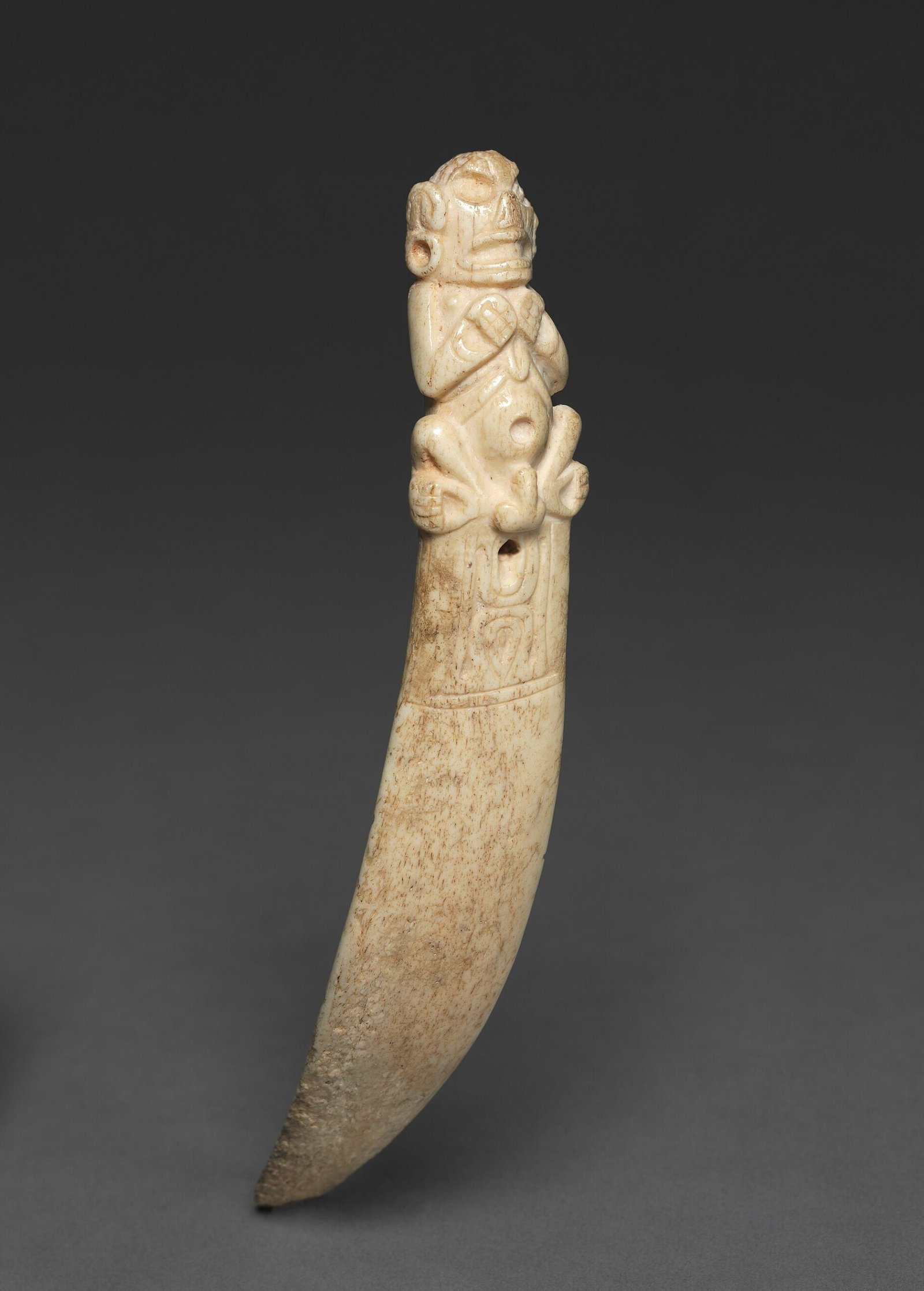
Objects used in cohoba ceremonies included vomiting spatulas. These could be made from Antillean hardwoods or manatee rib bones. Their materials provide a concrete link between ceremonial practices and the natural resources used to make ritual objects.
The British Museum’s Taíno duho stool, catalogued as Am1949,22.118, dates to 1292–1399 CE. Gold inlays appear at its eyes, mouth, and shoulders. Its dated material form offers another view of Taíno life before Columbus’s arrival.
Are there Taíno people today?
A 2018 PNAS study found a close relationship between the Indigenous genetic component of present-day Puerto Ricans and an ancient Taíno individual from the Bahamas. The ancient genome came from a tooth belonging to a woman found at Preacher’s Cave on Eleuthera. The tooth dates to 776–992 CE.
The study did not support a model in which Puerto Ricans descended directly from this single Bahamian woman. It instead pointed to closely related ancestral populations. If you read the finding as evidence of continuity, that distinction matters: the connection concerns populations with shared ancestry.
Contemporary identity provides another part of the picture. The Smithsonian’s 2018–2019 exhibition documented people and organizations expressing Indigenous ancestry through Taíno identity in Cuba, the Dominican Republic, Puerto Rico, and the United States diaspora. Taíno history includes these present-day expressions alongside the archaeological and genetic evidence.
FAQ
Where did the Taíno live?
Taíno peoples lived in the Bahamas, the Greater Antilles, and the northern Lesser Antilles. Their cultural origins connect them with Arawakan-speaking communities around South America’s Orinoco River.
How do you pronounce Taíno?
Merriam-Webster gives the English pronunciation as ˈtī-(ˌ)nō, approximately TIE-noh.
Did the Taíno disappear after Columbus?
Their populations suffered catastrophic losses, but complete disappearance is misleading. Genetic research identifies ancestral connections with present-day Puerto Ricans, while people and organizations continue to express Taíno identity.
What is a historically documented Taíno boy’s name?
Agüeybaná is a documented male Taíno name from Puerto Rico. Agüeybaná II led war against Spanish conquerors in 1511.
Sources
- English Wikipedia — Taíno en.wikipedia.org
- Florida Museum — Taíno Culture History floridamuseum.ufl.edu
- Library of Congress — Columbus and the Taíno wwws.loc.gov
- National Park Service — Taino Life, Belief, and Ceremony nps.gov
- Smithsonian National Museum of the American Indian — Taíno Gallery Guide americanindian.si.edu
- Museo Chileno de Arte Precolombino — Chamanismo en el Caribe museo.precolombino.cl
- British Museum — Stool; duho britishmuseum.org
- English Wikipedia — Taíno language en.wikipedia.org
- Merriam-Webster — Taino merriam-webster.com
- Academia Puertorriqueña de la Historia — Guerra y despojo de los taínos, 1511–1512 academiaprhistoria.org
- Massimo Livi-Bacci — The Depopulation of Hispanic America after the Conquest labdisia.disia.unifi.it
- PNAS — Origins and genetic legacies of the Caribbean Taino pmc.ncbi.nlm.nih.gov
- Smithsonian Institution — Taino: Native Heritage and Identity in the Caribbean si.edu
- English Wikipedia — Caguana Ceremonial Ball Courts Site en.wikipedia.org
Image: Spatula, 900–1492. Caribbean, Greater Antilles, Taino, 10th-15th century. Manatee bone.jpg — Gift of Brian and Florence Mahony, CC0