What was the Gunpowder Plot of 1605?
The Gunpowder Plot was a failed attempt to kill England’s King James I and members of Parliament at Westminster on November 5, 1605. Catholic conspirators planned to explode gunpowder beneath the House of Lords during Parliament’s opening ceremony. Guy Fawkes was caught beside the explosives before the attack could take place.
Robert Catesby proposed the plan in May 1604. Its targets included the king and both houses of Parliament. The conspirators wanted a Catholic monarch on the throne. Their scheme therefore extended beyond an explosion: it also included plans to gather support and seize Princess Elizabeth.
If you know Guy Fawkes mainly through a protest mask, the original conspiracy gives that image a different context. Fawkes had a specific operational role in a group that eventually numbered 13. Catesby supplied the initial plan, while Fawkes was assigned to prepare and ignite the gunpowder.
Who were the Gunpowder Plot conspirators?
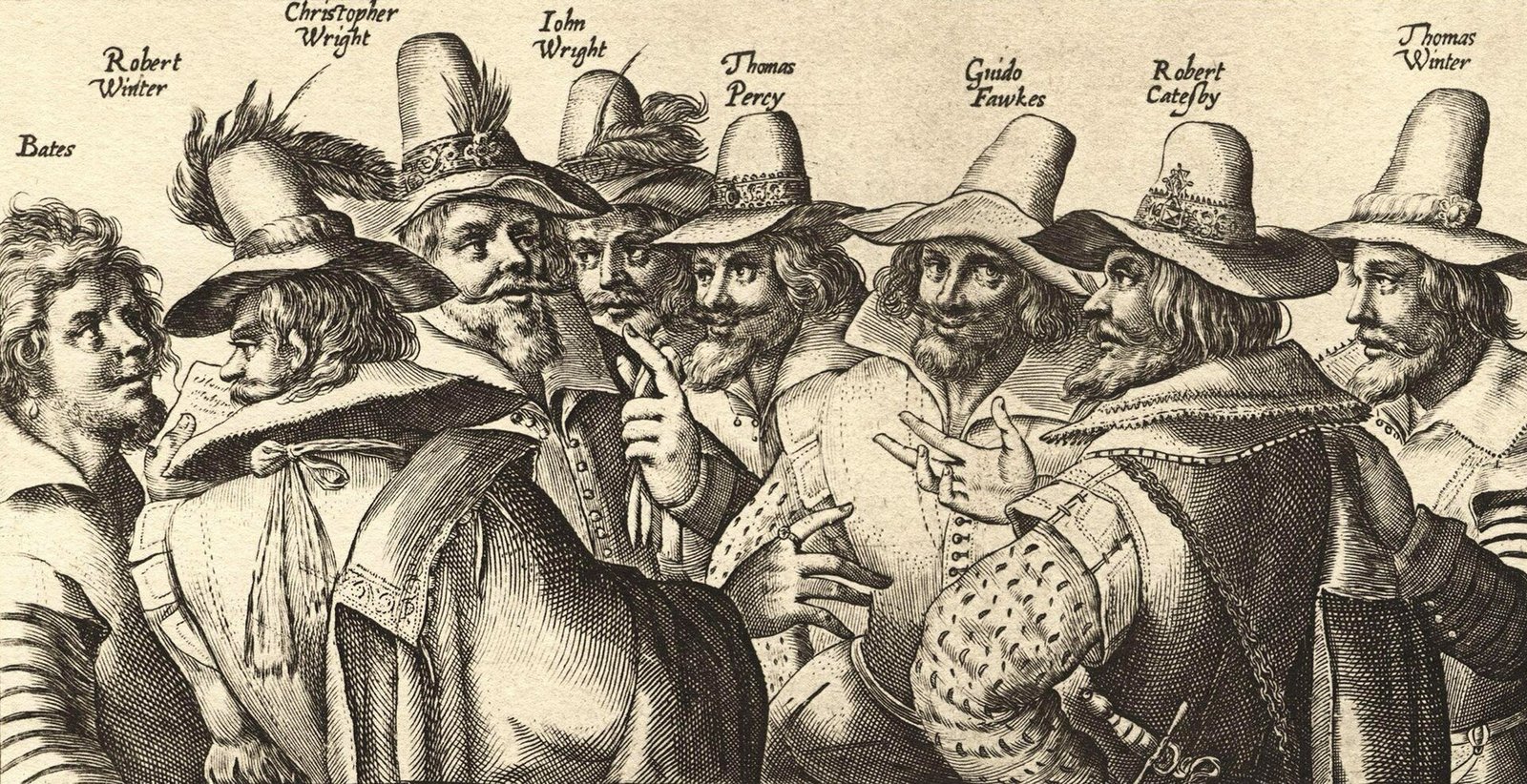
The original five conspirators were Robert Catesby, Thomas Wintour, Thomas Percy, John Wright, and Guy Fawkes. Eight others later joined them: Robert Wintour, Christopher Wright, Robert Keyes, Thomas Bates, John Grant, Ambrose Rookwood, Everard Digby, and Francis Tresham.
These men came from a Catholic community that faced discrimination under the Protestant monarchs Elizabeth I and James I. They sought to replace James with a Catholic ruler. That religious and political purpose explains their choice of target: the king would be present alongside Parliament at the opening ceremony.
Fawkes was born in York in 1570. Before joining the conspiracy, he served in Europe with the army of Catholic Spain. Recruited into the plot in 1604, he received responsibility for the gunpowder because of his experience with explosives. His later prominence can obscure the distinction between Catesby’s leadership and his own assignment.
Where did the Gunpowder Plot happen in London?
The intended explosion was at Parliament in Westminster, London. In March 1605, the conspirators rented a cellar directly beneath the House of Lords. Before the opening scheduled for November 5, they had placed 36 barrels of gunpowder there.
The cellar’s position connected the explosives directly to the planned gathering above. The conspirators intended to kill James I and members of both houses during the same ceremony. When you picture the location, think of a rented storage space beneath the House of Lords, where Fawkes could prepare the gunpowder.
Their next steps were planned for the Midlands. After the explosion, they hoped to rally Catholic nobles and seize Princess Elizabeth, who would not attend the ceremony. The London attack was thus meant to begin a wider attempt to change the monarchy.
What was the Gunpowder Plot date and year?
The planned attack date was November 5, 1605. Fawkes’s capture took place during the night of November 4–5. Keeping those dates together helps distinguish the intended explosion from the overnight discovery that prevented it.
The warning had arrived earlier. On October 26, Lord Monteagle received an unsigned letter at his home in Hoxton, London. It urged him to stay away from Parliament. He passed it to Robert Cecil. Claims that Francis Tresham wrote it, or that it came from government circles, remain competing explanations rather than established conclusions.
After Fawkes was caught beside the gunpowder, most of the other conspirators fled toward the Midlands on the morning of November 5. On November 8, Catesby, Percy, and the Wright brothers were killed in a confrontation at Holbeach House.
Timeline
- 1570: Guy Fawkes was born in York.
- May 1604: Robert Catesby proposed blowing up Parliament.
- March 1605: The conspirators rented the cellar beneath the House of Lords.
- October 26, 1605: Lord Monteagle received the unsigned warning letter.
- Night of November 4–5, 1605: Fawkes was caught beside the gunpowder, preventing the attack.
- November 8, 1605: Catesby, Percy, and the Wright brothers were killed at Holbeach House.
- January 1606: A law established annual thanksgiving observances on November 5.
- January 27, 1606: The surviving defendants were tried at Westminster Hall.
- January 30–31, 1606: The condemned conspirators were executed.
- 1608: William Waad commissioned a Gunpowder Plot memorial at the Tower of London.
- 1641: The lantern attributed to Fawkes was donated to Oxford University.
- 1834: Parliament’s fire destroyed the original gunpowder cellar.
- 1859: The law governing November 5 observances ceased to be in force.
- October 2011: London Museum collected a Guy Fawkes mask from Occupy London.
What happened to Guy Fawkes after his arrest?
Fawkes was interrogated at the Tower of London. James I wrote an order permitting progressively harsher torture if a confession could not be obtained. The capture at Westminster was followed by questioning under the king’s direct authority.
The surviving defendants were tried at Westminster Hall on January 27, 1606. They were sentenced to death for treason. Executions took place on January 30 and 31, with Fawkes executed on January 31. The conspiracy’s discovery belongs to 1605; the trials and executions belong to 1606.
Claims that Cecil engineered the conspiracy to discredit Catholics should be treated as allegations. In 1897, Samuel Gardiner argued that Cecil had gained political advantage from the affair rather than created it. Later work also failed to establish Cecil’s orchestration through clear evidence.
Why do people remember November 5?
A law passed in January 1606 made November 5 a day of annual thanksgiving worship. It remained in force until 1859. The date therefore acquired an official place in the calendar after the failed attack and continued under that law for centuries.
In Britain, the commemorations are known as Bonfire Night, Fireworks Night, and Guy Fawkes Night. Bonfires and fireworks are traditional features. The everyday connection is your calendar: just as a reminder links a date to an event, November 5 links annual observance to the discovery of the plot.
The familiar Gunpowder Plot rhyme begins, “Remember, remember, the fifth of November.” Its opening makes the date itself the memory aid. If you encounter the rhyme alongside fireworks, both point back to the attack planned for Parliament in 1605.
How is the Gunpowder Plot connected to Macbeth?
The Royal Shakespeare Company connects the porter’s references to “equivocation” in the second act of Macbeth with the Gunpowder Plot trials of 1606. This is a specific link between the play’s language and the judicial aftermath of the conspiracy.
That connection concerns the trials, which followed the failed attack. It gives you a useful distinction when reading Macbeth: the relevant historical reference is the prosecution of the conspirators in 1606, alongside the plot’s better-known date of November 5, 1605.
What is the history behind the Guy Fawkes mask?
The protest mask has a documented connection to Alan Moore and David Lloyd’s 1982 comic V for Vendetta. London Museum holds an example inspired by the comic’s mask. It collected that object in October 2011 from the Occupy London camp outside St Paul’s Cathedral.
The museum object connects Fawkes’s name with a later protest setting. Its path runs through the comic and then into the Occupy London collection. This history sits alongside the earlier story of a man assigned to ignite 36 barrels of gunpowder beneath Parliament.
Details you won’t find in guidebooks
Fawkes was using the alias John Johnson when he was caught. The House of Commons record dated November 5, 1605, described him as Thomas Percy’s servant. That recorded identity differs from the name attached to the commemorations and protest mask.
Before the final confrontation at Holbeach House, Catesby and some companions were injured while trying to dry wet gunpowder. An accident with explosives therefore preceded the fighting in which Catesby, Percy, and the Wright brothers died.
The original cellar was destroyed in the fire that devastated Parliament’s buildings in 1834. A ceremonial connection survives in the search of the cellars by the Yeomen of the Guard before Parliament’s official opening. The search recalls the Gunpowder Plot.
A lantern said to have been carried by Fawkes at his arrest measures 34.5 centimetres and is made of iron and horn. It was donated to Oxford University in 1641 and transferred to the Ashmolean Museum in 1887. Its association with Fawkes is an attribution.
At the Tower of London, Sir William Waad commissioned a marble memorial in the Council Chamber in 1608. It included the names of the conspirators and the state officials who interrogated them. The memorial placed both groups within the same account of the plot’s aftermath.
FAQ
What was the date of the Gunpowder Plot?
The planned attack was November 5, 1605. Guy Fawkes was caught beside the gunpowder during the night of November 4–5.
Where did the Gunpowder Plot happen?
The intended attack was at Parliament in Westminster, London. The conspirators stored gunpowder in a rented cellar directly beneath the House of Lords.
Was Guy Fawkes the leader of the Gunpowder Plot?
Robert Catesby proposed the plan in May 1604. Fawkes was responsible for placing and igniting the gunpowder because of his experience with explosives.
How is the Guy Fawkes mask connected to the plot?
Protest masks were inspired by the mask in Alan Moore and David Lloyd’s 1982 comic V for Vendetta. London Museum collected an example from the Occupy London camp in October 2011.
Sources
- UK Parliament — The Plot parliament.uk
- UK Parliament — Gunpowder Plot FAQ parliament.uk
- Historic Royal Palaces — Guy Fawkes and the Gunpowder Plot hrp.org.uk
- London Museum — Guy Fawkes & the Gunpowder Plot londonmuseum.org.uk
- UK Parliament — Parliament receives a tip-off parliament.uk
- UK Parliament — Discovery and flight parliament.uk
- Wikipedia — Gunpowder Plot en.wikipedia.org
- Ashmolean Museum — Guy Fawkes’ Lantern ashmolean.org
- Royal Shakespeare Company — Macbeth: Dates and Sources rsc.org.uk
- London Museum — Mask, 2011.83/2 londonmuseum.org.uk
Image: Gunpowder Plot conspirators.jpg — Crispijn van de Passe the Elder, Public domain