John F. Kennedy’s assassination: date and summary
John F. Kennedy, the 35th president of the United States, was shot on Friday, November 22, 1963. The attack happened at 12:30 p.m. local time in Dealey Plaza, Dallas, Texas. He was declared dead at Parkland Memorial Hospital at 1:00 p.m. Governor John Connally, wounded in the same limousine, survived his serious injuries.
The investigations reached different conclusions about responsibility beyond the gunman. The Warren Commission concluded in 1964 that Lee Harvey Oswald acted alone. The HSCA reported a probable conspiracy in 1979. A National Research Council review rejected the acoustic evidence supporting a second gunman in 1982. You need these separate findings to understand why the investigations cannot be summarized as one agreed verdict.
When did the events begin? The Texas visit in 1963
Kennedy and Jacqueline Kennedy began their Texas visit on November 21, 1963. The trip was planned to cover five cities over two days. One purpose was to address disagreements among Democratic Party leaders in Texas before the 1964 election. The journey therefore had a specific political purpose before the events in Dallas.
The visit’s start date and the assassination date are different. November 21 marks the beginning of the Texas trip. November 22 marks the shooting in Dealey Plaza. If you are building a chronology for an assignment, keeping those dates separate prevents the political visit from being confused with the attack itself.
Where was John F. Kennedy shot in Dallas?
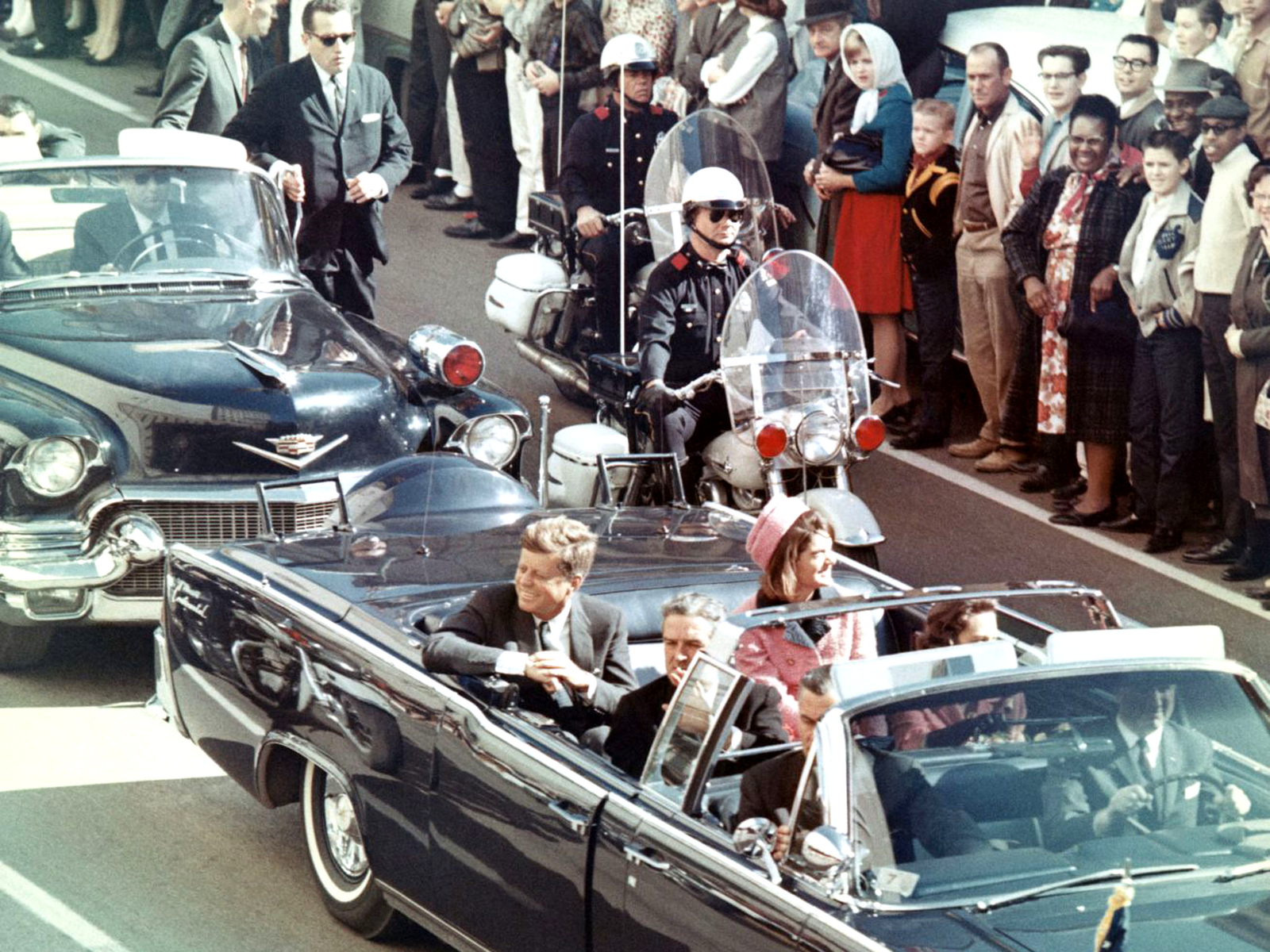
Kennedy was shot as the presidential motorcade passed through Dealey Plaza. Jacqueline Kennedy was also in the limousine. Texas Governor John Connally and his wife, Nellie Connally, occupied the seats in front of the presidential couple. Connally was also struck during the attack.
The HSCA concluded that the two bullets that hit Kennedy were fired from behind him. It identified their origin as the sixth-floor window at the southeast corner of the Texas School Book Depository. This finding concerned the shots that struck the president. The committee’s separate claim about a possible second gunman depended on acoustic analysis.
Timeline
- November 21, 1963: Kennedy and Jacqueline Kennedy began their Texas visit.
- November 22, 1963, 12:30 p.m.: Kennedy was shot in Dealey Plaza, Dallas.
- November 22, 1963, 1:00 p.m.: Kennedy was declared dead at Parkland Memorial Hospital.
- November 22, 1963, about 1:50 p.m.: Oswald was arrested at the Texas Theatre.
- November 22, 1963, 2:38 p.m.: Lyndon B. Johnson took the presidential oath aboard Air Force One.
- November 24, 1963: Jack Ruby shot Oswald, who died that day.
- November 29, 1963: Johnson established the Warren Commission.
- September 24, 1964: The commission submitted its report to Johnson.
- 1979: The HSCA issued its report finding a probable conspiracy.
- 1982: The National Research Council rejected the acoustic evidence offered in support of a second gunman.
- March 18, 2025: The National Archives published additional assassination records online.
- January 30, 2026: The National Archives released another 11,022 pages.
What happened after the shooting?
Kennedy was taken to Parkland Memorial Hospital, where he was declared dead at 1:00 p.m. The Warren Commission concluded that Dallas police officer J. D. Tippit was killed by Oswald about 45 minutes after the attack on Kennedy. Police arrested Oswald at approximately 1:50 p.m. inside the Texas Theatre in Dallas’s Oak Cliff area.
The transfer of presidential authority followed that afternoon. At 2:38 p.m., Lyndon B. Johnson took the presidential oath aboard Air Force One at Love Field. Federal judge Sarah T. Hughes administered the oath. The hospital declaration, Oswald’s arrest, and Johnson’s swearing-in all occurred on November 22.
Oswald never faced trial for Kennedy’s assassination. At 11:21 a.m. on November 24, nightclub operator Jack Ruby shot him during a transfer in the basement of Dallas police headquarters. The shooting appeared on live television. Oswald died at Parkland Hospital at 1:07 p.m. that day.
What did the Warren Commission find?
Johnson established the investigating commission on November 29, 1963. He appointed Chief Justice Earl Warren to lead it. Its 888-page report reached Johnson on September 24, 1964, and became public three days later. The commission concluded that Oswald had acted alone in assassinating Kennedy.
The commission identified the weapon as an Italian 6.5-millimeter Mannlicher-Carcano rifle belonging to Oswald. It concluded that three shots had been fired. One probably missed both the limousine and its occupants. These were findings about the weapon and shooting sequence, alongside the broader conclusion about Oswald’s responsibility.
The single-bullet theory addressed how Kennedy and Connally were wounded. It held that a bullet passing through Kennedy’s neck also caused Connally’s wounds. The commission considered expert findings strong support for this explanation. It also acknowledged disagreement arising from Connally’s testimony. You should distinguish this question about the wounds from the separate question of whether anyone assisted Oswald.
Why did the HSCA report a probable conspiracy?
The HSCA’s 1979 report concluded that Kennedy was probably assassinated as the result of a conspiracy. Acoustic analysis supported that conclusion. Yet the committee could not identify a second gunman or establish the conspiracy’s scope. Its finding therefore did not supply a named second shooter or a complete account of coordinated participation.
The committee also criticized presidential protection and earlier investigative work. It concluded that Kennedy had been inadequately protected. It found that previous investigations had not sufficiently explored the possibility of conspiracy. These criticisms appeared alongside its conclusion that the CIA, FBI, and Secret Service had not participated in the assassination.
The acoustic finding faced a substantial challenge in 1982. The National Research Council concluded that the sounds interpreted as gunshots had been recorded about one minute after the attack. Its review found that reliable acoustic evidence did not support a second gunman. This directly challenged the evidence behind the HSCA’s probable-conspiracy conclusion.
Details you won’t find in guidebooks
The limousine’s plastic bubble top was not fitted because the rain in Dallas had stopped. That detail connects the motorcade to an everyday decision: you may change your plans when the weather clears. In Dallas, the end of the rain affected how the presidential car was prepared.
A ticket purchase also became part of the sequence leading to Oswald’s arrest. Ticket clerk Julia Postal called the police after learning that he had entered the Texas Theatre without buying a ticket. His arrest there at about 1:50 p.m. followed the shooting in Dealey Plaza and the killing of Tippit.
Abraham Zapruder had left his camera at home on the morning of November 22. Encouraged by his secretary, he returned to collect his Bell and Howell Zoomatic. He recorded approximately 26 seconds of silent 8-millimeter footage of the attack. The fatal head impact appears in frame 313.
The handling of Kennedy’s body also produced a jurisdictional dispute. In 1963, killing the president was not itself defined as a federal crime. Dallas medical examiner Earl Rose and the presidential party disagreed over authority concerning the autopsy. This dispute formed another part of the immediate aftermath.
Kennedy assassination files and the 2025–2026 releases
Oliver Stone’s 1991 film JFK increased interest in assassination records and contributed to the passage of the JFK Records Act in 1992.
The National Archives published two separate online releases on March 18, 2025. They contained 31,419 pages and 37,127 pages respectively. Its release schedule also records a further publication on January 30, 2026: 140 PDF files containing 11,022 pages. These dates describe document releases, distinct from the dates of the investigations and their reports.
FAQ
What was the date of John F. Kennedy’s assassination?
Kennedy was shot on Friday, November 22, 1963, at 12:30 p.m. local time in Dallas. He was declared dead at Parkland Memorial Hospital at 1:00 p.m.
Where was John F. Kennedy shot?
Kennedy was shot while his presidential motorcade passed through Dealey Plaza in Dallas, Texas. The HSCA concluded that the two bullets that struck him came from behind, from a sixth-floor window of the Texas School Book Depository.
What did the investigations conclude?
The Warren Commission concluded in 1964 that Oswald acted alone. The HSCA reported a probable conspiracy in 1979, but the acoustic evidence supporting a second gunman was rejected by the National Research Council in 1982.
What Kennedy assassination files were released in 2025 and 2026?
The National Archives released two online batches containing 31,419 and 37,127 pages on March 18, 2025. Its release schedule also records 11,022 additional pages in 140 PDF files on January 30, 2026.
Sources
- Vikipedi — John F. Kennedy Suikastı tr.wikipedia.org
- JFK Library — November 22, 1963: Death of the President jfklibrary.org
- National Archives — Warren Commission Report, Chapter 1 archives.gov
- National Archives — Warren Commission Report, Chapter 3 archives.gov
- Wikipedia — Assassination of John F. Kennedy en.wikipedia.org
- National Archives — HSCA Summary of Findings archives.gov
- National Academies — Report of the Committee on Ballistic Acoustics nationalacademies.org
- National Archives Foundation / DocsTeach — Abraham Zapruder Camera docsteach.org
- National Archives — JFK Assassination Records: 2025 Documents Release archives.gov
Image: JFK limousine.png — Walt Cisco, Dallas Morning News, Public domain