Who was Jack the Ripper? Identity and established facts
Jack the Ripper was the nickname of an unidentified killer associated with five women’s murders around London’s Whitechapel district in 1888. The murders were real. The National Archives preserves documents from the investigation. Yet the existence of those records does not turn a proposed identity into an established one.
The clearest starting point is the distinction between the crimes and their attribution. The broader Whitechapel murders file covers eleven killings between 3 April 1888 and 13 February 1891. It has not been proved that one person committed them all. The five principal victims form a narrower group within that larger investigation.
If you want to understand the case, keep those two groups separate. A date in the Whitechapel file does not automatically establish another murder by Jack the Ripper. That distinction matters when considering both the number of victims and theories about when the killer stopped.
What was Jack the Ripper’s real name?
The killer’s real name remains unknown. Before Jack the Ripper became the familiar label, the names Whitechapel Murderer and Leather Apron were used. These were labels attached to the case, rather than verified personal identities.
A famous letter signed Jack the Ripper reached the Central News Agency on 27 September 1888. Its signature is part of the history of the name. It does not, by itself, establish who committed the murders or prove that the writer was the killer.
Another letter bearing that signature was posted in Birmingham on 8 October 1888. The National Archives identifies it as a hoax. Think of the difference between a signed message and a verified sender in everyday life: the name on a message is a claim about authorship. This documented hoax shows why you should treat a Ripper signature cautiously.
Who were Jack the Ripper’s victims?
The five principal victims were Mary Ann Nichols, Annie Chapman, Elizabeth Stride, Catherine Eddowes, and Mary Jane Kelly. All five were living in poverty when they were killed. Their circumstances belong at the centre of the account, alongside the dates and locations of their deaths.
London Museum rejects the blanket description of all five women as sex workers. It identifies Mary Jane Kelly as the woman certainly known to have been doing that work at the time of the murders. Describing the whole group in the same way turns a disputed generalisation into an apparent fact.
Stride’s inclusion raises a separate question about the attacks. She did not have abdominal injuries comparable to those inflicted on other victims. One interpretation proposes a different killer. Another suggests that the attacker was interrupted. Neither explanation should be presented as a demonstrated sequence of events.
Hallie Rubenhold’s 2019 book, The Five: The Untold Lives of the Women Killed by Jack the Ripper, focuses on the women’s lives before the murders. Its subject offers a useful change of emphasis: Nichols, Chapman, Stride, Eddowes, and Kelly had histories beyond their place in an unsolved case.
Where did Jack the Ripper kill?
The principal locations were around Whitechapel, Spitalfields, and the City of London. Nichols’s body was found in Buck’s Row, Whitechapel, at about 03:40 on 31 August 1888. Chapman’s body was discovered at about 06:00 on 8 September in the rear yard of 29 Hanbury Street, Spitalfields.
Stride’s body was found at about 01:00 on 30 September in Dutfield’s Yard, off Berner Street. Eddowes’s body was discovered roughly forty-five minutes later in Mitre Square, in the City of London. The two discoveries occurred on the same night, but their proximity does not resolve the debate over Stride’s attacker.
Kelly’s body was found on 9 November in her room at 13 Miller’s Court, Spitalfields. Her location differs from the street, yard, and square locations associated with the other discoveries. When you follow these addresses, remember that the recorded discovery times are not automatically precise times of death.
Timeline
- 3 April 1888: The period covered by the broader Whitechapel murders file began.
- 31 August 1888: Mary Ann Nichols’s body was found in Buck’s Row.
- 8 September 1888: Annie Chapman’s body was found at 29 Hanbury Street.
- 27 September 1888: The letter signed Jack the Ripper reached the Central News Agency.
- 30 September 1888: Elizabeth Stride and Catherine Eddowes were killed on the same night.
- 9 November 1888: Mary Jane Kelly’s body was found at 13 Miller’s Court.
- 13 February 1891: The period covered by the broader Whitechapel murders file ended.
- 12 March 2019: The disputed shawl and DNA study appeared online.
- 12 August 2024: The journal published an expression of concern about the study.
- 4 April 2025: A correction supplied the study’s missing funding declaration.
Did DNA establish Jack the Ripper’s identity?
A study by Jari Louhelainen and David Miller, published online on 12 March 2019, reported DNA matches from a shawl linked to the case. Claims surrounding the analysis pointed to Aaron Kosminski, a Polish barber. That proposed identification remains unproven.
The objections concern both the object and the genetic evidence. The shawl has been described as coming from Eddowes’s murder scene. Historian Hallie Rubenhold has stated that no historical document connects it to Eddowes. Without an established connection, the shawl’s claimed origin remains part of the dispute.
Experts have also stressed the limits of mitochondrial DNA. Many people who share a maternal line can share it. A reported mitochondrial match therefore does not necessarily single out one individual. The claim about Kosminski cannot be assessed simply by treating the word “match” as a personal identification.
On 12 August 2024, the Journal of Forensic Sciences published a formal expression of concern. It stated that objections to the conclusions could not be resolved because the original mitochondrial DNA data could not be supplied. That notice is material to any account presenting the study as a solution.
A correction published on 4 April 2025 added a missing funding declaration about the researchers’ annual institutional allowances. It addressed funding disclosure. It did not provide a resolution of the objections described in the expression of concern.
Where was Jack the Ripper from?
The murder locations establish a connection with London, but they do not establish the killer’s birthplace. Aaron Kosminski’s description as a Polish barber belongs to a proposed identification. It cannot establish the unidentified killer’s origin while that identification remains disputed.
London Museum also describes the widespread suspicion in 1888 that the killer must be Jewish as an antisemitic assumption without evidence. Such suspicion is evidence of prejudice surrounding the case. It is not a reliable basis for assigning the killer a background.
What happened to Jack the Ripper?
According to London Museum, police conducted thousands of interviews but brought no formal charge against anyone for the Jack the Ripper murders. The scale of the inquiry and its failure to produce a charge are both established parts of the investigation’s history.
Theories explain the end of the murders through the killer’s death, imprisonment, institutionalisation, or emigration. These remain proposed explanations. None supplies a verified account of the unidentified killer’s fate, and the broader Whitechapel file covers killings through 13 February 1891.
Details you won’t find in guidebooks
None of the five principal victims was born in Whitechapel, although all had lived there. That shared connection to the district should not erase their different origins. Whitechapel was part of their lives, rather than a birthplace common to all five.
Elizabeth Stride moved to London from Sweden. She and her husband ran a coffeehouse. This detail gives her a concrete place in everyday working life, beyond the account of where her body was found.
The investigation records also preserve practical proposals. In a letter dated 9 October 1888, Charles Warren recommended closer communication between the Metropolitan Police and the City of London Police. His correspondence makes coordination between the two forces a documented concern.
Warren also wrote to dog breeder Percy Lindley in 1888 about using tracking dogs in the investigation. A citizen’s letter dated 11 November proposed that police officers dress as women to catch the killer. These documents record suggestions; their existence does not establish that the suggested methods succeeded.
FAQ
Was Jack the Ripper a real person?
The Whitechapel murders were real, and The National Archives preserves investigation records. Jack the Ripper was a nickname associated with the unidentified killer.
What was Jack the Ripper’s real name?
The killer’s real name remains unknown. Claims identifying Aaron Kosminski through DNA from a shawl have not established his identity.
Who were the five principal victims?
They were Mary Ann Nichols, Annie Chapman, Elizabeth Stride, Catherine Eddowes, and Mary Jane Kelly. Their bodies were found between 31 August and 9 November 1888.
Did DNA solve the Jack the Ripper case?
No confirmed identification followed from the disputed shawl study. The Journal of Forensic Sciences published an expression of concern in 2024 because objections could not be resolved without the original mitochondrial DNA data.
Sources
- Vikipedi — Karındeşen Jack tr.wikipedia.org
- The National Archives — Hoax letter signed by ‘Jack the Ripper’ nationalarchives.gov.uk
- Oxford Dictionary of National Biography — Jack the Ripper academic.oup.com
- Wikipedia — Jack the Ripper en.wikipedia.org
- London Museum — Jack the Ripper londonmuseum.org.uk
- The National Archives — Jack the Ripper education documents cdn.nationalarchives.gov.uk
- Journal of Forensic Sciences — Forensic Investigation of a Shawl Linked to the Jack the Ripper Murders onlinelibrary.wiley.com
- Smithsonian Magazine — No, We Still Cannot Confirm the Identity of Jack the Ripper smithsonianmag.com
- Journal of Forensic Sciences — Expression of Concern onlinelibrary.wiley.com
- Journal of Forensic Sciences — Correction to: Forensic investigation of a shawl onlinelibrary.wiley.com
- TIME — A New Book About Jack the Ripper’s Victims Wants to Change That time.com
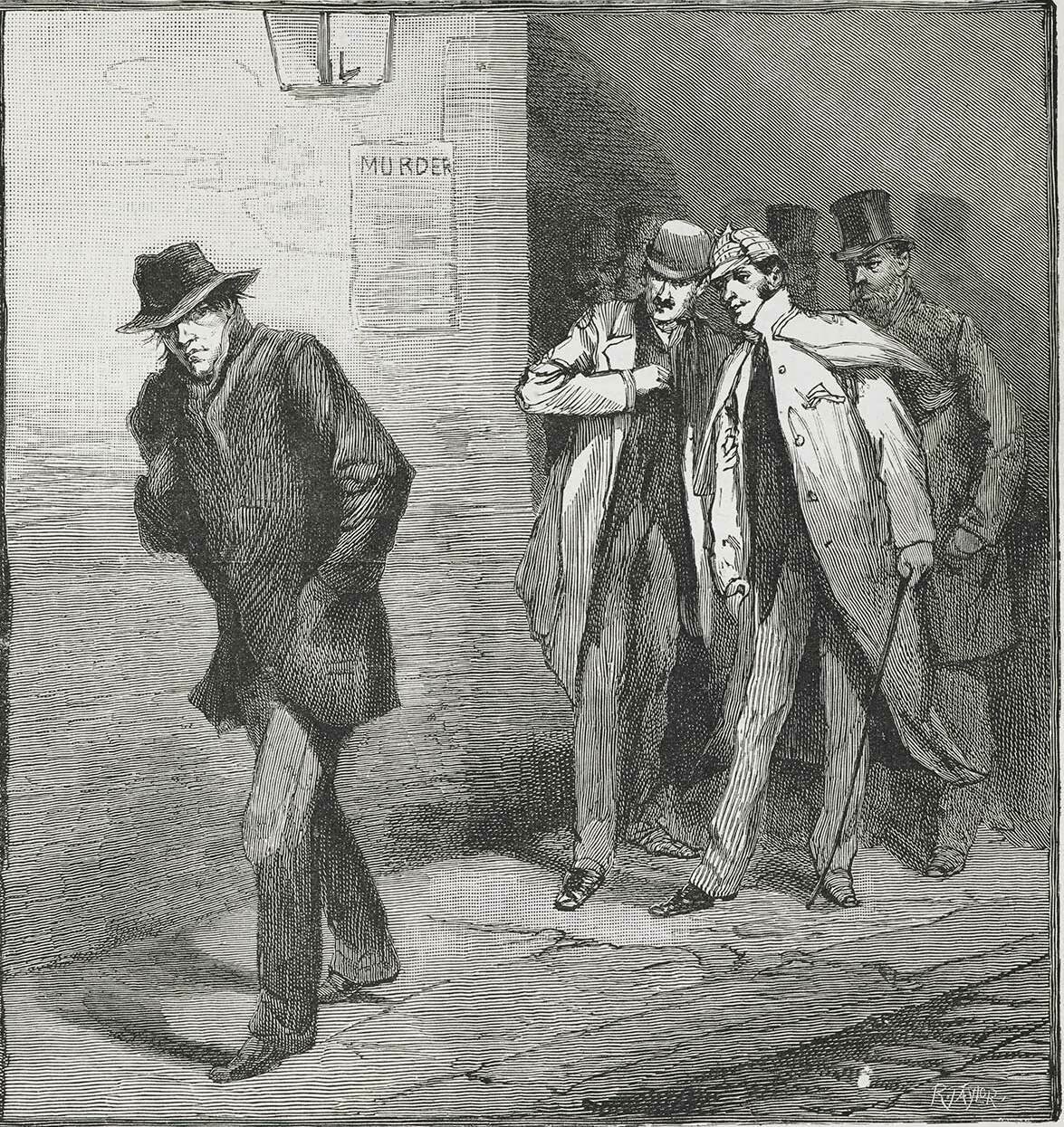
Image: JacktheRipper1888.jpg — R. Taylor (R. & E. Taylor (Firm)), Public domain