Apollo 11 mission: the basic record
Apollo 11 was NASA’s crewed mission of 16 to 24 July 1969. It was the first time humans landed on the surface of the Moon. The spacecraft had three main parts: the command module Columbia, the service module, and the lunar module Eagle. Before you weigh any conspiracy claim, you need this record in front of you. Everything below rests on museum collections, observatory data and published papers.
Apollo 11 crew: who were the astronauts?
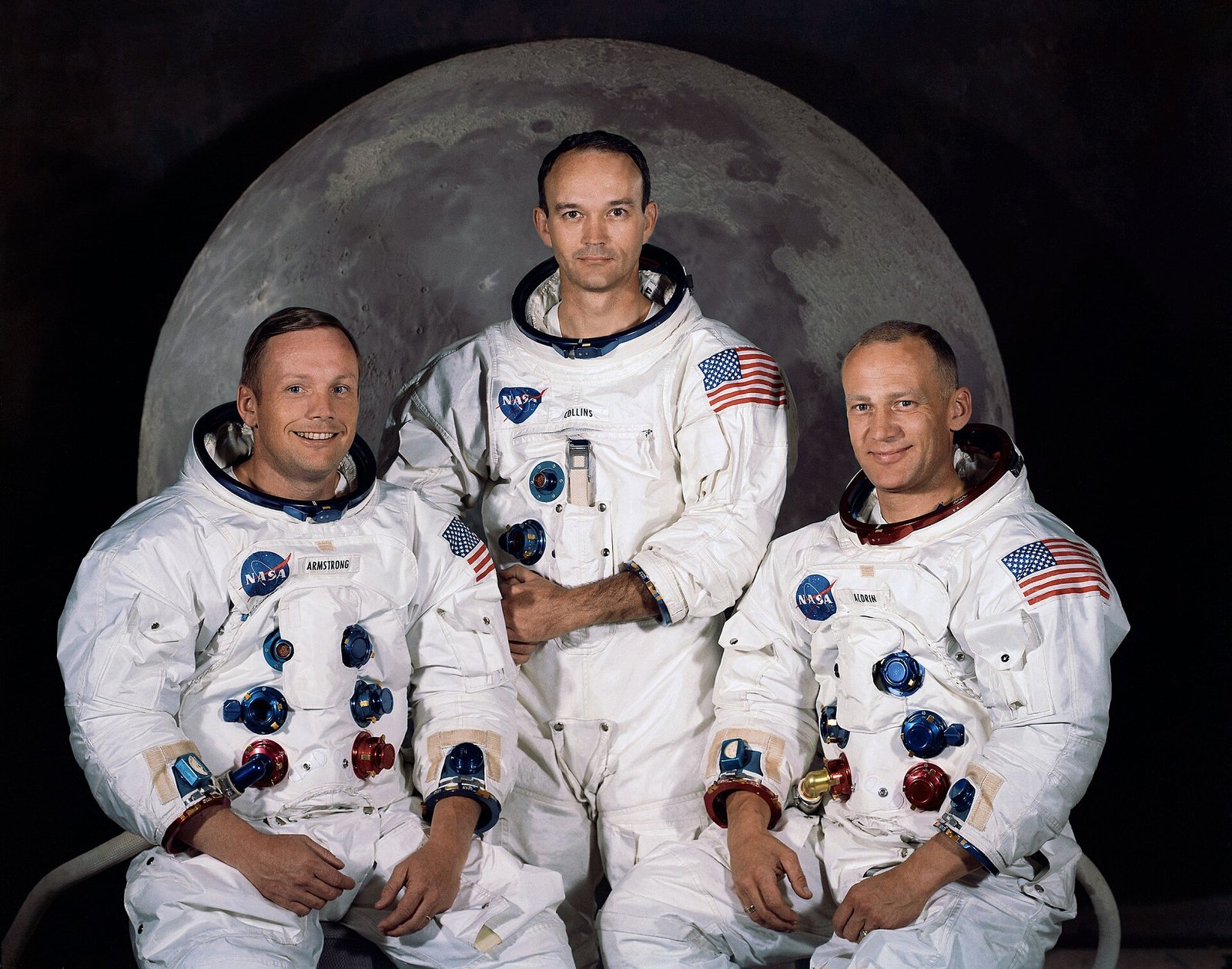
The crew had three members. Neil Armstrong was mission commander. Michael Collins was command module pilot. Edwin ‘Buzz’ Aldrin was lunar module pilot. On 20 July 1969 Armstrong and Aldrin went down to the surface in Eagle. Collins stayed alone in Columbia, circling the Moon. Only two of the three astronauts walked on the Moon. That detail trips up many people who tell the story from memory.
Apollo 11 moon landing: where did it land?
The mission launched on 16 July 1969 at 13:32:00 UTC on a Saturn V rocket, serial number SA-506. The pad was LC-39A at the Kennedy Space Center in Florida. Eagle touched down on 20 July 1969 at 20:17:40 UTC in Mare Tranquillitatis, on the side of the Moon that faces Earth. Turkish readers know the region as Huzur Denizi or Sükûnet Denizi. The landing spot was named Tranquility Base. Its coordinates are about 0.67416° north and 23.47314° east.
Armstrong’s first step came on 21 July 1969 at 02:56 UTC. In the eastern United States the date was still 20 July. That is why you will see both dates in different books, and both are correct. The astronauts made one moonwalk. It lasted 2 hours 31 minutes 40 seconds. They brought 21.55 kilograms of lunar samples back to Earth.
The return to Earth
Columbia splashed down in the North Pacific Ocean on 24 July 1969 at 16:50:35 UTC. The USS Hornet recovered the crew. The command module was the only part of the spacecraft that came home. In 1971 the capsule was physically handed over to the Smithsonian, which lists it in its collection today.
Why the conspiracy theories are wrong
Four claims come up again and again. Royal Museums Greenwich has answered each of them, and the answers are short.
No stars in the photos. The claim says a studio set explains the black sky. The real reason is exposure. The cameras were set for a surface lit by direct sunlight. Such short exposures cannot record faint stars. You can test this yourself tonight. Photograph a friend standing under a bright streetlight with your phone. The sky behind them will come out black, even if the stars are out.
Shadows that are not parallel. The claim says several studio lamps cast the shadows. Royal Museums Greenwich points out that a three-dimensional scene flattened into a two-dimensional photo produces this look through perspective alone.
A flag that seems to wave. The claim says a moving flag proves wind, and wind proves Earth. The flag was held open by a horizontal telescopic rod. The creases came from being packed for the trip. A rod and some wrinkles produce the rippled look in a still image.
The Van Allen radiation belts. The claim says the belts make a crewed flight to the Moon impossible. Royal Museums Greenwich explains that the spacecraft passed through the belts quickly, and the short transit limited the radiation dose the crew received.
Evidence that does not come from NASA
A hoax would need every outside observer to play along. They did not. In July 1969 the Jodrell Bank Observatory of the University of Manchester tracked Eagle by its radio signals. During the same period it tracked the Soviet probe Luna 15. A British observatory listening to an American lander and a Soviet probe at once is hard to fake.
The second line of evidence sits on the Moon right now. Apollo 11 left a laser retroreflector panel at Tranquility Base. Observatories on Earth fire lasers at it and time the returning light. A 2012 paper by T. W. Murphy and colleagues reported that the Apache Point Observatory received a record 1,148 photons per minute back from the Apollo 11 reflector.
The third line is the rock. A 2001 preprint by Paul Lowman and David Smith in the NASA archive, written for science teachers, explains what the samples show. The lunar material contains agglutinates and glass beads. Those textures are evidence of a surface with no air.
Apollo 11 landing site: the 2011 and 2019 images
The landing site has been photographed from lunar orbit by the Lunar Reconnaissance Orbiter Camera, or LROC. On 22 January 2011 LROC took images numbered M150361817 and M150368601. Those two frames form the digital terrain model of the Apollo 11 site. On 19 June 2019 NASA published an LROC image with a description noting that the Eagle descent stage, left behind on the Moon, is visible. The description also notes the trails made by the astronauts’ footpaths. If you search for Apollo 11 2011 or Apollo 11 2019, these images are usually what you are looking for.
Apollo 11 astronauts in Ankara
The crew came to Turkey. Between 20 and 22 October 1969 the three astronauts visited Ankara. On 20 October they went to Anıtkabir. Photographs of the visit appeared in issue 45 of Hayat magazine, dated 30 October 1969. If you travel to Ankara, you can stand where they stood.
A claim circulates online that the crew came to Anıtkabir out of loyalty to a figure named Arsev Eraslan. Doğruluk Payı examined the claim. The Ankara stop was part of a world goodwill tour covering 22 countries. The visit was real. The motive attached to it later was not.
Apollo 11 Albanian connection
Searches for Apollo 11 Albanian point to one man. English Wikipedia describes Wilson Kokalari as an Albanian-American engineer born in Gjirokastër, Albania. He is listed among the people who contributed to the systems testing and the engineering report for Apollo 11.
Timeline
- 16 July 1969, 13:32 UTC: Apollo 11 launched from pad LC-39A at the Kennedy Space Center.
- 20 July 1969, 20:17:40 UTC: Eagle landed at Tranquility Base in Mare Tranquillitatis.
- 21 July 1969, 02:56 UTC: Neil Armstrong took the first step on the Moon.
- 24 July 1969, 16:50:35 UTC: Columbia and the three astronauts splashed down in the North Pacific.
- 20 October 1969: The crew visited Anıtkabir in Ankara.
- 22 January 2011: LROC took the images used in the digital terrain model of the landing site.
- 2019: Todd Douglas Miller’s documentary Apollo 11 was released.
Details you won’t find in guidebooks
- Neil Armstrong’s Omega Speedmaster chronograph, issued for the July 1969 mission, was transferred to the Smithsonian in 1973.
- The laser reflector panel at Tranquility Base holds 100 corner-cube prisms, each 3.8 centimetres across, arranged in a 10 by 10 grid.
- Buzz Aldrin said he saw the flag knocked over during liftoff. NASA’s published LROC survey of the site found no flag shadow there, which matches his account.
- An engineer born in Gjirokastër, Albania, Wilson Kokalari, has a credit on the Apollo 11 engineering report.
FAQ
Who was on the Apollo 11 crew?
Three astronauts: Neil Armstrong as mission commander, Michael Collins as command module pilot and Edwin ‘Buzz’ Aldrin as lunar module pilot. Armstrong and Aldrin landed in Eagle on 20 July 1969 while Collins stayed in lunar orbit in Columbia.
Where did Apollo 11 land?
Eagle landed in Mare Tranquillitatis, the Sea of Tranquility, on the side of the Moon that faces Earth. The site, named Tranquility Base, lies at about 0.67416° north and 23.47314° east.
Why are there no stars in the Apollo 11 photos?
The cameras were set for a surface lit by direct sunlight. Those short exposures cannot record faint stars, according to Royal Museums Greenwich. The same thing happens when you photograph someone under a streetlight at night.
Did the Apollo 11 astronauts really visit Anıtkabir?
Yes. The crew visited Ankara on 20 to 22 October 1969 and went to Anıtkabir on 20 October. Photographs appeared in Hayat magazine issue 45, dated 30 October 1969. The stop was part of a 22-country goodwill tour.
Sources
- NASA — Apollo 11 nasa.gov
- NASA — Apollo 11 Mission Overview nasa.gov
- Smithsonian National Air and Space Museum — Apollo 11 airandspace.si.edu
- Smithsonian — Apollo 11 Command Module Columbia airandspace.si.edu
- Smithsonian — Apollo 11 Timeline airandspace.si.edu
- Smithsonian — Chronograph, Armstrong, Apollo 11 airandspace.si.edu
- Türkçe Vikipedi — Apollo 11 tr.wikipedia.org
- English Wikipedia — Apollo 11 en.wikipedia.org
- University of Manchester — Recording of USSR’s lunar gatecrash attempt released manchester.ac.uk
- NASA Science — Apollo 11 Landing Site science.nasa.gov
- LROC Data Archive — Apollo 11 Landing Site DTM data.lroc.imldi.com
- University of California San Diego — Lunar Retroreflectors tmurphy.physics.ucsd.edu
- Classical and Quantum Gravity — APOLLO: millimeter lunar laser ranging tmurphy.physics.ucsd.edu
- Royal Museums Greenwich — Moon landing conspiracy theories, debunked rmg.co.uk
- NASA NTRS — Did We Really Land on the Moon? Suggestions for Science Teachers ntrs.nasa.gov
- NASA Apollo Lunar Surface Journal — Six Flags on the Moon nasa.gov
- Teyit — Apollo 11 astronotlarının Anıtkabir ziyareti teyit.org
- Doğruluk Payı — Apollo 11 Astronotları Anıtkabir’i Ziyaret Etti mi? dogrulukpayi.com
Image: Apollo 11 Crew.jpg — NASA, Public domain