A hillside complex in Sivas
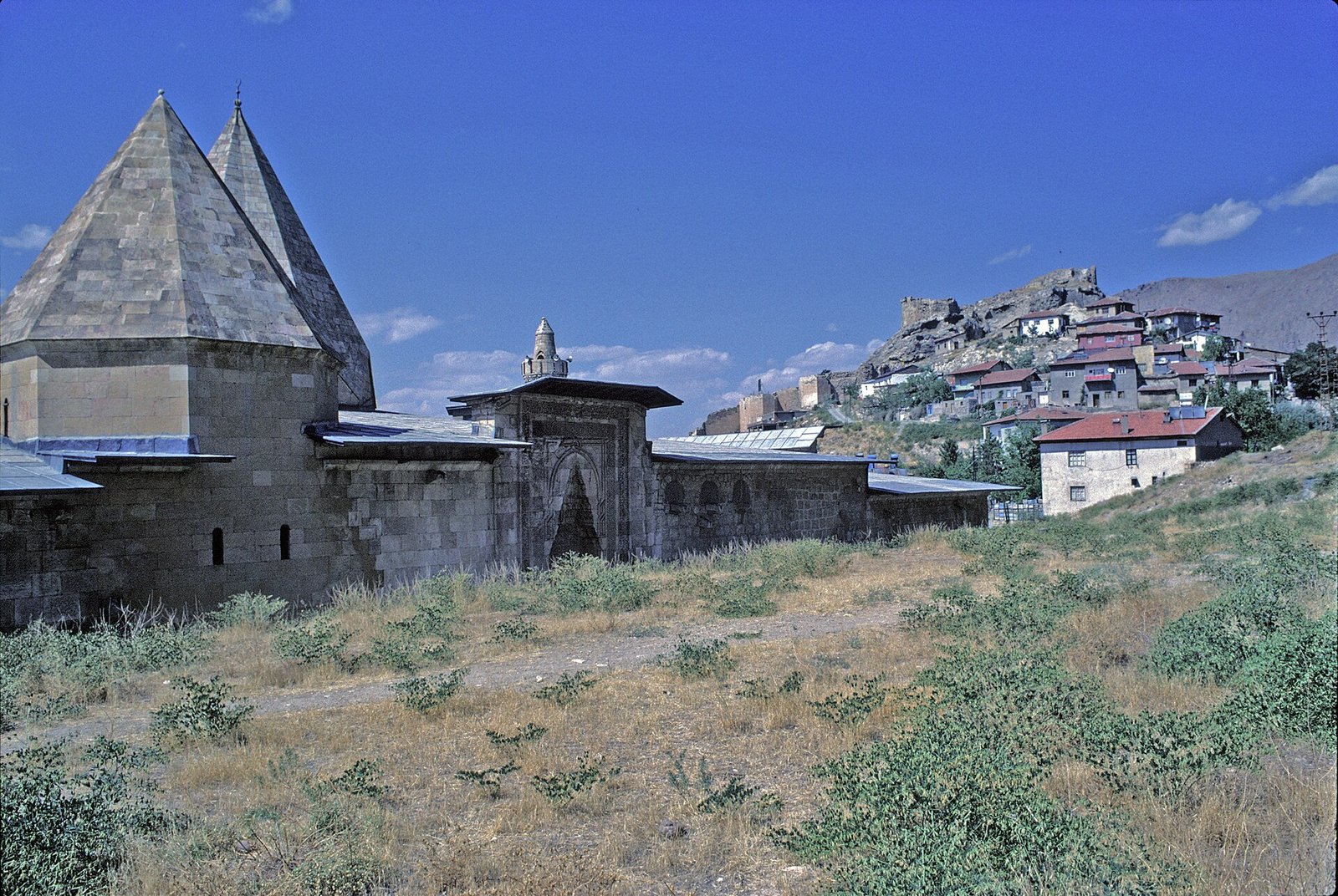
The Divriği Great Mosque and Hospital stands in the Divriği district of Sivas province. It sits on the slope below the castle. It is a group of buildings: a mosque, a hospital and a tomb.
The address given by Sivas Municipality is Kemenkeş Mahallesi, Ulu Cami Caddesi, 58300 Divriği/Sivas.
The name has two parts in Turkish. Ulu Camii means Great Mosque. Darüşşifa means a house of healing, a hospital. The two buildings stand side by side. The hospital is attached to the south of the mosque.
Who built it, and when
The Ministry of Culture and Tourism bases its account on the inscriptions. It says the Mengücekli ruler Ahmed Şah built the mosque. Turan Melek, daughter of Fahreddin Behramşah, built the hospital. Both date to 1228–1229.
The founding inscription is on the mosque’s north portal. It names the patron as Ahmed Şah bin Süleyman. It gives the date as 626 in the Islamic calendar, which is 1228–1229 in the Gregorian calendar.
The chief architect is also named in the inscriptions. He is Hürrem Şah, son of Muğis, from Ahlat.
A dating question
Sources do not fully agree on the dates. UNESCO dates the foundation to 1228–1229. The Sivas Governorate says the complex began in 1228 and was finished in 1243. If you read both, you are not seeing a mistake. You are seeing a difference between sources.
A marriage that is only claimed
Turkish Wikipedia and the Ministry publication introduce Turan Melek as Ahmed Şah’s wife. English Wikipedia disagrees. It cites Oya Pancaroğlu’s 2009 research and says no inscription or other evidence confirms the marriage. Treat it as a common claim, not a proven fact.
The stone lacework
The mosque is built of cut stone. It has three separate portals, on the north, west and east sides. The hospital has a fourth portal on its west side.
UNESCO ties the variety of carving on these portals to different groups of masters. The carving is three-dimensional. It mixes geometric patterns with plant forms.
UNESCO also names the contrast that defines the building. The doors carry dense, sculpted decoration. The interior walls are plain. Add to that an advanced technique of building stone vaults.
Think of a plain wall at home with one heavily embroidered cloth hung over the door. The eye goes straight to the cloth. Here the “cloth” is stone, and it is repeated four times.
Sivas Municipality records two nicknames for this work: “the Divriği miracle” and “the Alhambra of Anatolia”. They are labels, not measurements. The portals themselves are the evidence.
The west portal
Turkish Wikipedia lists double-headed eagles and falcons among the carvings on the west portal. Look for them when you stand in front of it.
Inside the mosque
The prayer hall has five aisles running perpendicular to the mihrab, the niche that shows the direction of prayer. The middle aisle is wider than the others.
The plain interior is part of the contrast. After the portals, the quiet walls give your eyes a rest.
The hospital
The Ministry describes the hospital as a building with a covered courtyard and three eyvans, which are vaulted halls open on one side. Its west wing has two floors.
The roof uses many vault types: barrel, pointed, mirror, diagonal, cross and star vaults. A visitor who looks up will see how many ways a stone ceiling can close.
The tomb inside the hospital holds 16 sarcophagi. The Ministry publication attributes two of them, covered in turquoise, to Turan Melek and Ahmed Şah.
Healing with sound
The Sivas Governorate gives a historical account of treatment here. In it, the sound of water from the central pool, Quran recitation and Sufi music were used to treat patients with mental and nervous illness. This is the governorate’s narrative, so read it as a tradition passed down, not a medical record.
Bedri Selim Benek and colleagues published a paper in 2015 in Acta Medica Anatolia. Its title is “An example for the application of music therapy in the medical history: Divrigi Darüssifa”. It treats the building as a historical example of music treatment.
Timeline
- 1228–1229: According to the founding inscriptions, Ahmed Şah’s mosque and Turan Melek’s hospital were built.
- 1243: The Sivas Governorate gives this as the completion date of the complex. UNESCO dates the foundation to 1228–1229.
- 18th century: The hospital was used as a medrese, a religious school.
- 1985: The mosque and hospital entered the UNESCO World Heritage List.
- 2015: A large restoration began. It lasted nine years.
- 6 May 2024: The complex reopened for worship and visits.
Details you won’t find in guidebooks
Eleven inscriptions. The complex has 11 inscriptions. Five give the name of the patron and a date. Six give the names of masters.
Two named craftsmen. Above the door of the old ruler’s gallery on the east facade is the name of Ahmed, a decorative artist from Ahlat. In the verse band on the south wall is the name Ahmed, son of Mehmed.
A hospital that became a school. It was built as a hospital. In the 18th century it served as a medrese.
Carvings in Ankara. Some carved panels said to belong to the wooden ruler’s gallery inside the mosque are shown in the Ankara Foundation Works Museum (Vakıf Eserleri Müzesi). If you cannot find them in Divriği, that is why.
A shadow at the door. Turkish Wikipedia reports that in the afternoon sun a shadow shaped like a person forms at the entrance. People read it as someone reading the Quran or praying. The Sivas Governorate goes further and says the shadow was deliberately calculated. Wikipedia only reports the interpretation, so the two accounts do not offer the same evidence for design intent. Enjoy the story, and keep the difference in mind.
Photos, reviews and what to look for
Photos of the Great Mosque and Hospital of Divriği nearly always show the portals. That is for good reason. The carved doors are the part that photographs best.
Before you raise your camera, walk around the building. There are four portals: three on the mosque and one on the hospital. Compare them. UNESCO links their differences to different groups of masters, and you can see that difference with your own eyes.
For your own review of the place, make a short list:
- Count the portals and compare their patterns.
- Look for the eagles and falcons on the west portal.
- Step into the plain interior and notice the contrast.
- Look up in the hospital and count the vault types.
- Try the entrance in the afternoon to see whether the shadow appears.
Protection and restoration
UNESCO lists threats to the site. For the stone carving, it names atmospheric effects, damp and salt. For the structure as a whole, it names drainage problems.
The Sivas Governorate announced on 2 May 2024 that the restoration, begun in 2015, had lasted nine years. The pool in the hospital was made to work again. Sivas Municipality reports that the complex reopened for worship and visits on 6 May 2024.
So you can now enter both the mosque and the hospital. Remember that it is a working mosque, so dress and behave as you would in any place of worship.
Why it matters
UNESCO listed the site in 1985 under criteria (i) and (iv). Put simply, it counted the building as a masterpiece of human creativity and as an outstanding example of a type of building.
The facts behind that listing are concrete. There are 11 inscriptions, four carved portals and a roof that uses six vault types. A named architect from Ahlat and named craftsmen left their names on the stone. That is what you are looking at when you stand below the castle in Divriği.
FAQ
Who built the Divriği Great Mosque and Hospital?
According to the inscriptions, as summarized by the Ministry of Culture and Tourism, the Mengücekli ruler Ahmed Şah built the mosque and Turan Melek, daughter of Fahreddin Behramşah, built the hospital, both in 1228–1229. The chief architect named in the inscriptions is Hürrem Şah of Ahlat.
Why is it called the Alhambra of Anatolia?
Sivas Municipality records this phrase, along with “the Divriği miracle”, as a description of the stonework. The portals carry three-dimensional geometric and plant carving, which UNESCO links to different groups of masters.
When was it listed by UNESCO?
The mosque and hospital entered the UNESCO World Heritage List in 1985 under cultural criteria (i) and (iv).
Can you visit it now?
Yes. After a restoration that began in 2015 and lasted nine years, the complex reopened for worship and visits on 6 May 2024. The address is Kemenkeş Mahallesi, Ulu Cami Caddesi, 58300 Divriği/Sivas.
Were Ahmed Şah and Turan Melek married?
Turkish sources, including the Ministry publication, present Turan Melek as Ahmed Şah’s wife. English Wikipedia, citing Oya Pancaroğlu’s 2009 research, says no inscription or other evidence confirms the marriage.
Sources
- UNESCO World Heritage Centre, Divriği Great Mosque and Hospital whc.unesco.org
- Ministry of Culture and Tourism, Sivas-Divriği Ulu Camii ve Darüşşifası ekitap.ktb.gov.tr
- Ministry of Culture and Tourism, Darüşşifa ekitap.ktb.gov.tr
- English Wikipedia, Divriği Great Mosque and Hospital en.wikipedia.org
- Turkish Wikipedia, Divriği Ulu Camii ve Darüşşifası tr.wikipedia.org
- Sivas Municipality, Divriği Ulu Camii sivas.bel.tr
- Sivas Municipality, Divriği Ulu Camii ve Darüşşifası İbadete Açıldı sivas.bel.tr
- Sivas Governorate, Divriği Ulu Camii ve Darüşşifası sivas.gov.tr
- Sivas Governorate, Divriği Ulu Cami ve Darüşşifası Açılıyor sivas.gov.tr
- TR Dizin, Acta Medica Anatolia article record search.trdizin.gov.tr
Image: Divriği Great Mosque and Hospital.jpg — Dosseman, CC BY-SA 4.0