Teotihuacan is a ruined city of pyramids and wide avenues in central Mexico. You may know it as the site with the Pyramid of the Sun. The harder question is who built it. This article sorts out what is known, what is argued, and what is still open.
Teotihuacan: where is it?
The ancient city stands in the State of México. It lies about 50 kilometres northeast of the capital, Mexico City. UNESCO lists it as the Pre-Hispanic City of Teotihuacan. The site joined the World Heritage List in 1987.
At its peak the city covered about 20 square kilometres. That is a large footprint for a place with no modern machines behind it.
What does Teotihuacan mean?
The name is not the city’s own. The Aztecs gave it to the abandoned ruins. It comes from Nahuatl, and translations vary.
- UNESCO renders it as “place where the gods were created”.
- Turkish sources give “the place where the gods live” as one equivalent.
How do you pronounce Teotihuacan?
In present-day Spanish the word is written [teotiwaˈkan]. English speakers can say it as “te-o-ti-wa-KAN”. Put the strong beat on the last syllable. The “hua” in the middle sounds like “wa”.
Who built the City of the Gods before the Aztecs?
The honest answer is that we do not know the exact ethnic identity of the founders. We do know the Aztecs were not among them. The city was already a ruin when the Aztecs came to dominate the region.
One older idea said the Toltecs, centred on Tula, founded Teotihuacan. This clashes with the calendar. The Toltec civilization developed centuries after Teotihuacan.
Another suggestion names the Totonacs among the founders. Yet finds linked to the Zapotec, Mixtec and Maya also point to a city with many ethnic groups.
Manzanilla supports that multi-ethnic picture. She dates the founding to about 150 BCE. That was when the first architectural complexes began to rise in the valley. In her assessment, local people were joined by workers from Veracruz, Oaxaca, Puebla, Tlaxcala and Hidalgo. Workers from Michoacán came later.
So the city was not the work of one tribe. It looks more like a project that drew labour from across the region.
How big was the city?
The National Institute of Anthropology and History (INAH) describes the peak as running from 350 to 450 CE. In those years the city held about 100,000 people. Its urban area reached about 20 square kilometres.
Most of those people did not live in palaces. INAH says the city had about 2,000 apartment complexes. It estimates that 20 to 100 people lived in each one.
Think of your own apartment building. You share a stairwell, a wall and a door with many neighbours. A Teotihuacan compound worked on a similar principle. Many households lived together behind a single set of walls.
Teotihuacan pyramids: what to look for
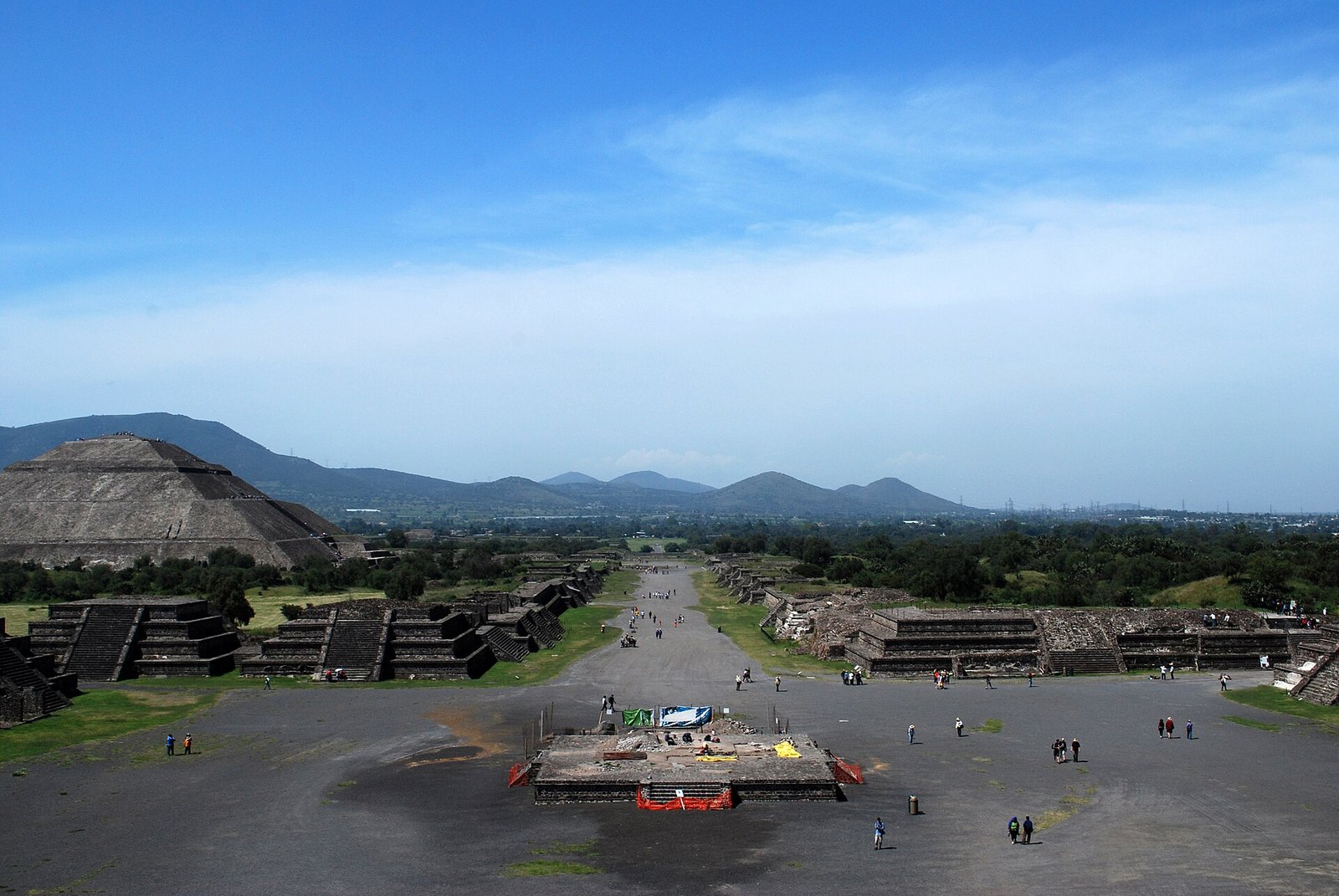
The main monuments are the Pyramid of the Sun, the Pyramid of the Moon, and the Temple of Quetzalcoatl. The last is also known as the Feathered Serpent.
Pyramid of the Sun
INAH’s visitor pages give the base as about 222 by 225 metres. The height is about 65 metres. The core is compacted earth, stone and volcanic material. The outer surface was covered with stone walls and painted plaster.
If you stand at its foot, remember that the paint is gone. The original surface was coloured.
Pyramid of the Moon
The Pyramid of the Moon sits at the northern end of the Avenue of the Dead. The INAH guide gives its height as about 42 metres. It is smaller than the Sun Pyramid.
Temple of Quetzalcoatl
This is the Feathered Serpent temple. In 2003 a tunnel linked to it was discovered. It runs about 103 metres.
The building style
The city’s architecture is known for the talud-tablero layout. A sloping wall surface carries a rectangular panel above it. Once you spot the pattern, you will see it again and again on the site.
Teotihuacan tour: reading the site
A walk along the Avenue of the Dead shows the plan of the city. The Moon Pyramid closes the avenue at its northern end. The Ciudadela area has earlier layers beneath it.
Excavations there from 2002 to 2008 uncovered early architectural complexes. They date to the early Tzacualli phase, 1 to 50 CE.
Details you won’t find in guidebooks
A river bent to fit the plan. The city’s planners altered the bed of the San Juan River. They made it cross the Avenue of the Dead. The city did not just sit beside nature. It moved it.
Seven pyramids in one. Rubén Cabrera and Saburo Sugiyama dug tunnels inside the Pyramid of the Moon. They found seven stacked building phases. Each phase was built over the one before.
A tunnel full of offerings. Findings announced in 2014 from the Feathered Serpent tunnel included about 4,000 wooden objects. They also included 15,000 seeds and eight preserved rubber balls.
A captive monkey. A 2022 study in PNAS examined a spider monkey sacrificed in Teotihuacan between 250 and 300 CE. It had lived under human care for more than two years. Its diet was mostly maize.
A disputed top tier. Between 1905 and 1910, Leopoldo Batres restored the Pyramid of the Sun. He added a fifth tier. Its authenticity is still debated.
What ended Teotihuacan?
The old story said outside invaders burned the city. Newer work points elsewhere.
Manzanilla places a major destruction event at about 570 CE. She bases this on radiocarbon dating of burnt beams in the Xalla Palace. She also uses archaeomagnetic dating of its floors.
The fires were concentrated in elite buildings. That supports the idea of an internal uprising rather than a foreign attack. Drought and food stress may also have helped weaken the city. This environmental explanation does not rule out conflict inside the city.
INAH now describes the end as a process, not a single disaster. It involved selective fires, gradual emigration, and partial resettlement by later communities.
Timeline
- About 150 BCE: By Manzanilla’s dating, the architectural complexes that mark the founding began to be built.
- 1–50 CE: Early Tzacualli-phase complexes were built in the Ciudadela area.
- 250–300 CE: The spider monkey studied in 2022 was sacrificed in Teotihuacan.
- 350–450 CE: The city peaked at about 100,000 people.
- About 570 CE: By Manzanilla’s hypothesis, major destruction hit the Xalla Palace and elite buildings.
- 1905–1910: Leopoldo Batres carried out extensive restoration on the Pyramid of the Sun.
- 1987: UNESCO added Teotihuacan to the World Heritage List.
- 2003: The tunnel linked to the Feathered Serpent temple was discovered.
FAQ
Who built Teotihuacan?
The exact ethnic identity of the founders is unknown. UNAM archaeologist Linda Manzanilla says local people were joined by workers from Veracruz, Oaxaca, Puebla, Tlaxcala, Hidalgo and, later, Michoacán.
Did the Aztecs build Teotihuacan?
No. The city was already in ruins when the Aztecs came to dominate the region. They gave it the name we use today.
Where is Teotihuacan?
It lies in the State of México, about 50 kilometres northeast of Mexico City.
How do you pronounce Teotihuacan?
In modern Spanish it is [teotiwaˈkan]. In English letters, think ‘te-o-ti-wa-KAN’, with the stress on the last syllable.
What does Teotihuacan mean?
It is a Nahuatl name. UNESCO translates it as ‘place where the gods were created’. Another rendering is ‘place where the gods live’.
Sources
- UNESCO — Pre-Hispanic City of Teotihuacan whc.unesco.org
- Wikipedia — Teotihuacan en.wikipedia.org
- Vikipedi — Teotihuacan tr.wikipedia.org
- UNAM Global — Surgimiento de Teotihuacan unamglobal.unam.mx
- INAH — Ciudad prehispánica de Teotihuacan lugares.inah.gob.mx
- INAH — Pirámide del Sol visitateotihuacan.inah.gob.mx
- INAH — Teotihuacan arqueológica site guide arqueologia.inah.gob.mx
- Julie Gazzola — Características arquitectónicas de algunas construcciones de fases tempranas en Teotihuacán revistas.inah.gob.mx
- INAH — El túnel y los nuevos hallazgos visitateotihuacan.inah.gob.mx
- Meksika Kültür Bakanlığı — Piel, cabello y pelotas de goma gob.mx
- Sugiyama et al. — Earliest evidence of primate captivity and translocation pubmed.ncbi.nlm.nih.gov
- Meksika Kültür Bakanlığı — Nuevos estudios precisan fecha de la caída de Teotihuacan gob.mx
- INAH — La historia de un colapso visitateotihuacan.inah.gob.mx
- Meksika Kültür Bakanlığı SIC — Ciudad Prehispánica de Teotihuacán sic.cultura.gob.mx
Image: Avenue of the Dead at Teotihuacan 3.jpg — Polimerek, CC BY-SA 3.0