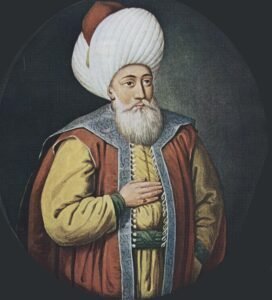
Osman I is also called Osman Bey and Osman Gazi. He founded the Ottoman principality and the Ottoman dynasty. The word “Ottoman” comes from his name. If you have ever wondered how a small frontier territory became the base of a state, his story is the place to start.
This guide covers what is known about his life, his family, his campaigns and his tomb. Where historians disagree, you will see both sides.
Who was Osman Gazi?
Osman led a frontier principality around Söğüt. He expanded it toward Yenişehir and İznik. Later centuries turned that political structure into an empire.
Historians know him by several names. The Byzantine historian Georgios Pachymeres, who wrote in his own time, recorded the name as Atmanes. That detail is easy to miss in modern retellings.
When and where was Osman I born?
Tradition dates his birth to 1258. Another calculation, which rests on Kemalpaşazâde, points to 1254–1255. The exact date is unknown.
The place is better supported. Current accounts name Söğüt, in today’s Bilecik province, as his birthplace.
Osman I’s father and family tree
His father was Ertuğrul Gazi, who headed the principality around Söğüt.
The longer family tree is contested. Ottoman tradition links the dynasty to the Kayı branch of the Oghuz Turks. Cemal Kafadar and other researchers read this lineage as a legitimacy story created later. So treat the Kayı line as tradition, not as settled fact.
What was Osman I’s religion?
English Wikipedia’s biographical information describes Osman Gazi as a Sunni Muslim.
Osman I’s wife and first wife
The most familiar name is Mal Hatun, also written Malhun. The sources do not agree about her.
- Âşıkpaşazâde calls her the daughter of Sheikh Edebali.
- The Mekece foundation deed, dated 8–18 March 1324, records her father as Ömer Bey.
- Stories about Osman’s wife use the names Malhun, Râbia and Bâlâ in different ways.
Because of this, no reliable “first wife” can be named. The accounts do not allow a firm order of marriages.
Osman I’s children and son
His sons include Orhan and Alâeddin Ali. The Mekece deed of 1324 also mentions Çoban, Melik, Hamid, Pazarlı and Fatma among his children.
Most people accept Mal Hatun as Orhan’s mother. Feridun Emecen notes, however, that this has not been firmly established.
Orhan is the son who matters most for the state’s story. He took over the principality after his father.
How the principality grew
Osman’s rise happened on a frontier, not in a capital. Several steps stand out.
- Local conflicts. In Halil İnalcık’s chronology, the clashes of 1285–1286 relate to the lord of İnegöl. He blocked movement between Söğüt and the Domaniç highland pastures.
- Karacahisar. Its capture was one of the main stages in Osman’s growth as a frontier lord around Söğüt and Eskişehir.
- Yenişehir. Osman made it the center for raids on Byzantine land. After that he turned toward İznik.
- Bapheus. On 27 July 1302, at Yalakova, his forces defeated a Byzantine imperial army of about 2,000 men.
- Bursa and beyond. İnalcık places the Dimbos victory and the invasion of the Bursa plain before the siege of Bursa in spring 1303. He dates the capture of Lefke and Geyve to 1304, aimed at isolating İznik.
İznik held out. Osman tried to besiege it, but it fell only in 1331, to Orhan.
Founding date: 1299 or 1302?
Tradition dates the founding of the Ottoman state to 1299. İnalcık prefers 1302. For him, the victory at Bapheus marks the emergence of an independent state.
You will see both years in books and on museum panels. They are two ways of choosing a starting point, not two different stories.
The dream of the tree
A famous tale says a tree grew from Osman’s navel and shaded the world. It is read as a sign of divine sovereignty for his house. Modern historians treat it as a founding myth, not as an event that happened.
Death and succession
Traditional accounts tie Osman’s death to the conquest of Bursa in 1326. İnalcık compared the Asporça and Mekece foundation deeds and dated his death to 1324.
The Asporça Hatun deed was drawn up in early September 1323. It records the villages of Narlı and Kıyaklı, which Osman gave to Orhan’s wife. The Mekece deed followed in March 1324 and lists Osman’s family members.
After him, his son Orhan headed the principality.
Osman I’s tomb in Bursa
The tomb is in Tophane Park, in Bursa’s Osmangazi district. Orhan took Bursa in 1326. He then had his father’s grave moved from Söğüt to the site of the Aya Eliya Monastery in Bursa.
The building has been through damage and rebuilding.
- The first tomb was damaged in the fire of 1801.
- The earthquake of 1855 brought it down.
- Sultan Abdülaziz had the present tomb built in 1863.
The present tomb has an octagonal plan and a dome. Seven windows light the interior.
Osman I near me: visiting Bursa
If you travel to Turkey, Bursa is the place to see Osman’s story on the ground. The tomb sits in Tophane Park, so you can reach it on foot from the park itself.
Bursa and Cumalıkızık were added to the UNESCO World Heritage List in 2014. The site represents the relationship between town and village in the early Ottoman capital. Cumalıkızık appears in historical documents as a foundation village that supplied income to the Orhan Gazi Complex.
Think of a modern trust that pays for a library from the rent it collects on a few buildings. A foundation village worked on a similar idea. The village produced, and the income kept a complex running in the town.
Timeline
- c. 1254–1258: Osman is believed to have been born in Söğüt. The exact year is disputed.
- 1285–1286: According to İnalcık’s chronology, clashes occur with the lord of İnegöl on the Söğüt–Domaniç route.
- 1299: The traditional founding date of the Ottoman state.
- 27 July 1302: Victory at Bapheus, İnalcık’s proposed turning point for the founding.
- Spring 1303: In İnalcık’s chronology, the siege of Bursa follows the Dimbos victory.
- 1304: In İnalcık’s chronology, Lefke and Geyve are taken.
- September 1323: The Asporça Hatun foundation deed is drawn up.
- 8–18 March 1324: The Mekece deed records members of Osman’s family.
- 1324: Osman’s death, according to İnalcık’s dating from the deeds.
- 1326: Orhan conquers Bursa.
- 1331: Orhan conquers İznik.
- 1855: The Bursa earthquake destroys Osman’s tomb.
- 1863: Sultan Abdülaziz has the tomb rebuilt.
- 2014: Bursa and Cumalıkızık join the UNESCO World Heritage List.
Details you won’t find in guidebooks
- A Byzantine contemporary, Georgios Pachymeres, wrote Osman’s name as Atmanes.
- The Asporça Hatun deed of September 1323 records that Osman gave the villages of Narlı and Kıyaklı to Orhan’s wife.
- The tomb you see today is not the original. The first building was damaged in 1801 and destroyed in 1855. The present one dates from 1863.
- Cumalıkızık is described in historical documents as a village whose income supported the Orhan Gazi Complex.
FAQ
Where is Osman Gazi buried?
His tomb stands in Tophane Park in the Osmangazi district of Bursa. Orhan Gazi moved his father’s grave there from Söğüt after taking Bursa in 1326. The present building dates from 1863.
Who was Osman Gazi’s father?
His father was Ertuğrul Gazi, who headed the principality around Söğüt. Osman took over that frontier territory and expanded it.
When was the Ottoman state founded, 1299 or 1302?
Tradition gives 1299. Historian Halil İnalcık takes the victory at Bapheus on 27 July 1302 as the moment an independent state appeared. Both dates appear in the literature.
Who succeeded Osman Gazi?
His son Orhan became head of the principality after him. Orhan took Bursa in 1326 and İznik in 1331.
What was Osman Gazi’s religion?
English Wikipedia’s biographical entry describes him as a Sunni Muslim.
Sources
- Türkçe Vikipedi — Osman Gazi tr.wikipedia.org
- English Wikipedia — Osman I en.wikipedia.org
- Belleten — Osmanlı Beyliği’nin Kurucusu Osman Beg belleten.gov.tr
- TDV İslâm Ansiklopedisi — Osman I islamansiklopedisi.org.tr
- TDV İslâm Ansiklopedisi — Mal Hatun islamansiklopedisi.org.tr
- Kültür Portalı — Osman Gazi Türbesi kulturportali.gov.tr
- UNESCO — Bursa and Cumalıkızık: the Birth of the Ottoman Empire whc.unesco.org
Image: Osman Gazi2.jpg — Unknown authorUnknown author, Public domain