The Battle of Vienna in 1683: the short version
The Second Siege of Vienna began on 14 July 1683. It ended on 12 September 1683 with the victory of a relief army. The Ottoman army was led by Grand Vizier Merzifonlu Kara Mustafa Pasha, who served Sultan Mehmed IV.
The siege failed, and the war that followed cost the empire a large part of its European lands. That is why many readers ask whether 1683 is where Ottoman decline began. The answer has two sides, and this article gives both.
Why the Ottomans marched on Vienna
The campaign did not come out of nowhere. Before the siege, the Ottomans were backing the Hungarian forces of Imre Thököly, who had risen against Habsburg rule.
The other side was also preparing. The 1683 Treaty of Warsaw set out mutual help. If the Ottomans attacked Vienna, Poland would send aid. If they attacked Kraków, the emperor would send aid. When Kara Mustafa Pasha marched on Vienna, that promise was already in place.
The Battle of Vienna in 1529: the first try
The first Ottoman siege came in 1529. It ended without the city falling. What matters for 1683 is what Vienna did next.
In 1530 the city began replacing its medieval walls with modern fortifications built on the Italian model. The City of Vienna’s own history of the sieges credits the modern fortifications, together with the resistance of the defenders, for the city’s survival in 1683.
How the siege unfolded
Emperor Leopold I left Vienna before the siege. Count Ernst Rüdiger von Starhemberg took over the defence.
The Ottoman army had a problem. According to the TDV Islamic Encyclopedia, it lacked large siege guns. The Austrian artillery was also superior. Both facts helped drag the siege out.
So the Ottomans dug. Their miners tunnelled under the city walls and packed the tunnels with gunpowder to blow breaches. On 8 September 1683 they captured the Burg ravelin and the low defensive wall near it.
That was four days before the decisive battle.
The relief army and the cavalry charge
Before the battle of 12 September, Kara Mustafa Pasha prepared to meet the relief army. He decided that the soldiers in the siege trenches would stay at their duties. The siege and the field battle therefore ran at the same time.
The relief army fought around Kahlenberg. It was made up of imperial, German and Polish forces under the overall command of King Jan III Sobieski of Poland.
At about 18:00 that evening came the great cavalry charge. By the common estimate, about 18,000 horsemen took part. About 3,000 of them were Polish heavy lancers led by Sobieski himself.
The charge decided the day. The siege was lifted.
Hussars: what the records say
People often ask about the hussars at Vienna. A study by the historian Zbigniew Hundert offers a precise number. It counts 24 hussar companies that fought at Vienna and at Párkány. Their registered strength in the accounting period of 1 August to 31 October 1683 was 3,045 horses.
That is far smaller than the 18,000 horsemen of the whole charge. The hussars were one part of a larger mounted force.
Details you won’t find in guidebooks
Straw on helmets. Lipka Tatars fought on the Polish side. Tatars also served in the Ottoman army. To avoid confusion in the melee, the Lipka Tatars wore straw on their helmets.
A printing press lost to fire. Meninski’s multilingual dictionary was printed in Vienna between 1680 and 1687. A large part of the press, the type and the printed works was damaged in a fire during the 1683 siege.
A bell with a story. The new Pummerin bell in St. Stephen’s Cathedral carries a relief showing the 1683 siege. It also has an inscription marking 1711, the year the earlier bell was cast from captured Turkish cannons.
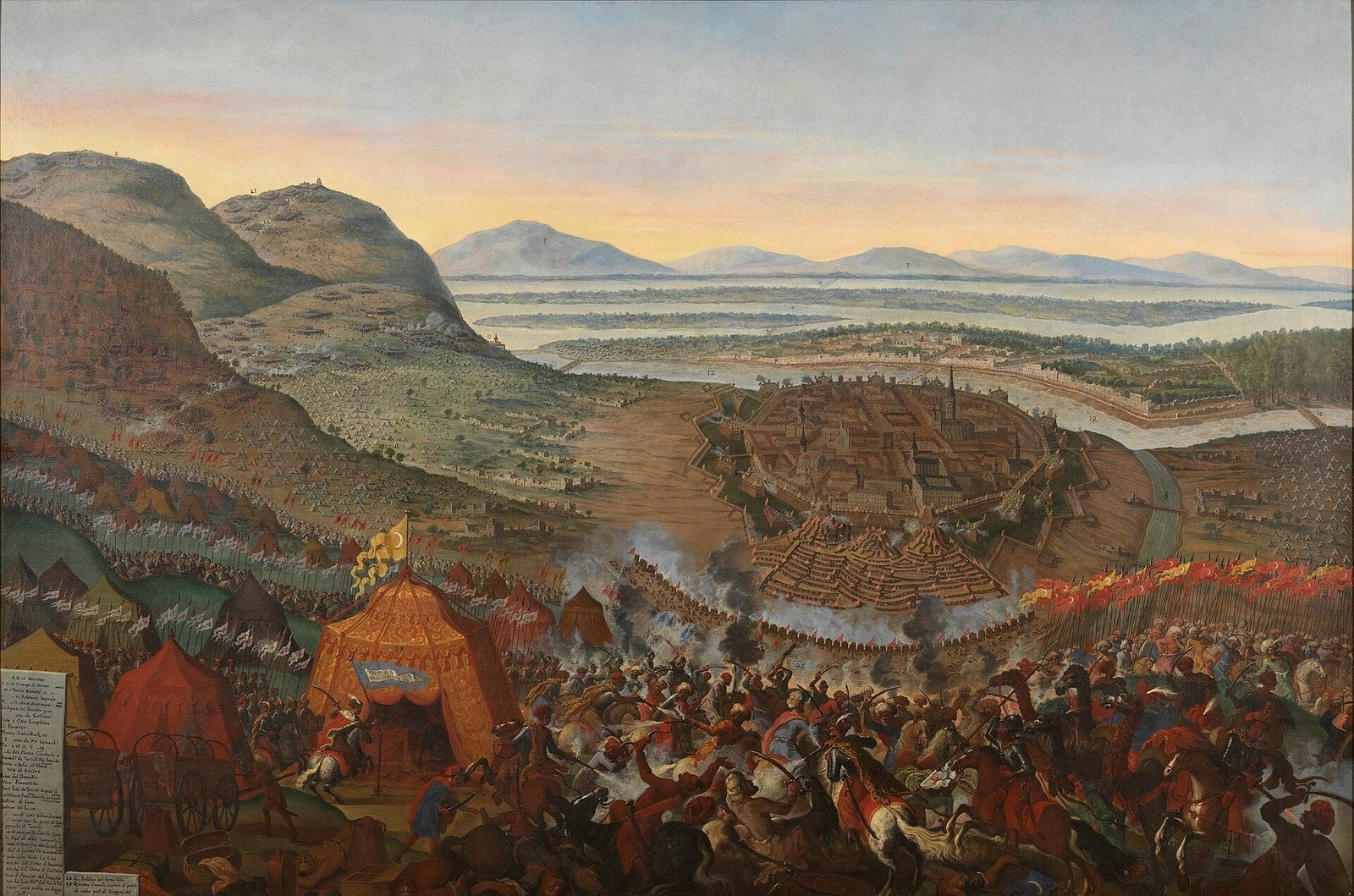
One painting, one number. Franz Geffels painted the relief of Vienna between 1683 and 1694. It belongs to the Wien Museum under inventory number 40132. If you want to see how Vienna remembered the battle, that is a good painting to look up.
The croissant myth
Here is the link to your breakfast. You may have heard that the croissant was invented in 1683 to mock the Ottoman crescent. The Austrian Academy of Sciences says otherwise. A similar pastry was documented in the 13th century. The supposed inventor, Peter Wendler, died in 1680, three years before the siege.
So enjoy the pastry, but do not credit it to the siege.
After the defeat: Kara Mustafa Pasha
The defeat had a personal price. On 25 December 1683, in Belgrade, Kara Mustafa Pasha was executed on the order of Mehmed IV.
The empire’s trouble was not over. Vienna was never besieged by the Ottomans again, but the war went on.
Sixteen years of war
After Vienna, the Ottoman state fought Austria, Poland and Venice for about 16 years, on several fronts at once.
The pressure for peace grew in 1697. The defeat at Zenta forced Ottoman troops back to the Danube. That raised the pressure toward the Karlowitz peace.
The Treaty of Karlowitz was signed on 26 January 1699. It ended the long war that began with the Vienna campaign of 1683. Its terms were heavy:
- The Ottomans gave most of Hungary and Transylvania to Austria.
- They gave the Morea to Venice.
- They gave Podolia to Poland.
Amcazade Hüseyin Pasha defended the peace. He said the 16-year war had caused extraordinary taxes and emptied villages. It had also made it very hard to supply soldiers and munitions. His words show the cost to ordinary people, not only to the army.
Was 1683 really the start of decline?
This is the part where historians disagree.
One side points to the chain of events. Vienna failed, a long war followed, and Karlowitz took away large territories. On that reading, 1683 is a real turning point.
The other side warns against a single date. Donald Quataert describes the years 1683–1798 as a time of military defeats and shrinking territory. But he sees the change in Ottoman politics as transformation, not decline.
A fair summary is this. 1683 is a clear turning point for the empire’s military position in Europe. Whether it marks decline in every field of Ottoman life is still debated.
The film
The 2012 Polish-Italian film The Day of the Siege: September Eleven 1683 is about the siege.
Timeline
- 1529: The first Ottoman siege of Vienna ends without the city being taken.
- 1530: Vienna begins building modern fortifications.
- 1683: The Treaty of Warsaw sets up Habsburg-Polish mutual help.
- 14 July 1683: Kara Mustafa Pasha’s army besieges Vienna.
- 8 September 1683: Ottoman forces capture the Burg ravelin.
- 12 September 1683: The relief army under Sobieski defeats the Ottoman army and lifts the siege.
- 25 December 1683: Kara Mustafa Pasha is executed in Belgrade.
- 1697: The defeat at Zenta increases the pressure for peace.
- 26 January 1699: The Treaty of Karlowitz is signed.
FAQ
Who commanded each side?
Grand Vizier Merzifonlu Kara Mustafa Pasha led the Ottoman army under Sultan Mehmed IV. Count Ernst Rüdiger von Starhemberg ran the city’s defence after Emperor Leopold I left. King Jan III Sobieski of Poland held overall command of the relief army.
Sources
- TDV İslâm Ansiklopedisi — Viyana islamansiklopedisi.org.tr
- TDV İslâm Ansiklopedisi — Merzifonlu Kara Mustafa Paşa islamansiklopedisi.org.tr
- TDV İslâm Ansiklopedisi — Karlofça islamansiklopedisi.org.tr
- Wikipedia — Battle of Vienna en.wikipedia.org
- Vikipedi — II. Viyana Kuşatması tr.wikipedia.org
- City of Vienna — The Turkish Sieges wien.gv.at
- Millî Savunma Bakanlığı — Türk Silahlı Kuvvetleri Tarihi, İkinci Viyana Kuşatması msb.gov.tr
- Zbigniew Hundert — Jeszcze o organizacji husarii koronnej na kampanię 1683 roku ceeol.com
- German Historical Institute — German History in Documents and Images germanhistorydocs.org
- Austrian Academy of Sciences — Stephansdom, Neue Pummerin oeaw.ac.at
- Austrian Academy of Sciences — Grünangergasse, Kipfel- oder Bäckerhaus oeaw.ac.at
- Cambridge University Press — Donald Quataert, The Ottoman Empire, 1683–1798 cambridge.org
Image: Vienna Battle 1683.jpg — Frans Geffels, Public domain