The Last Supper in Milan: where is it?
The Last Supper is a wall painting, not a canvas. You cannot carry it to a museum. It stays where Leonardo made it.
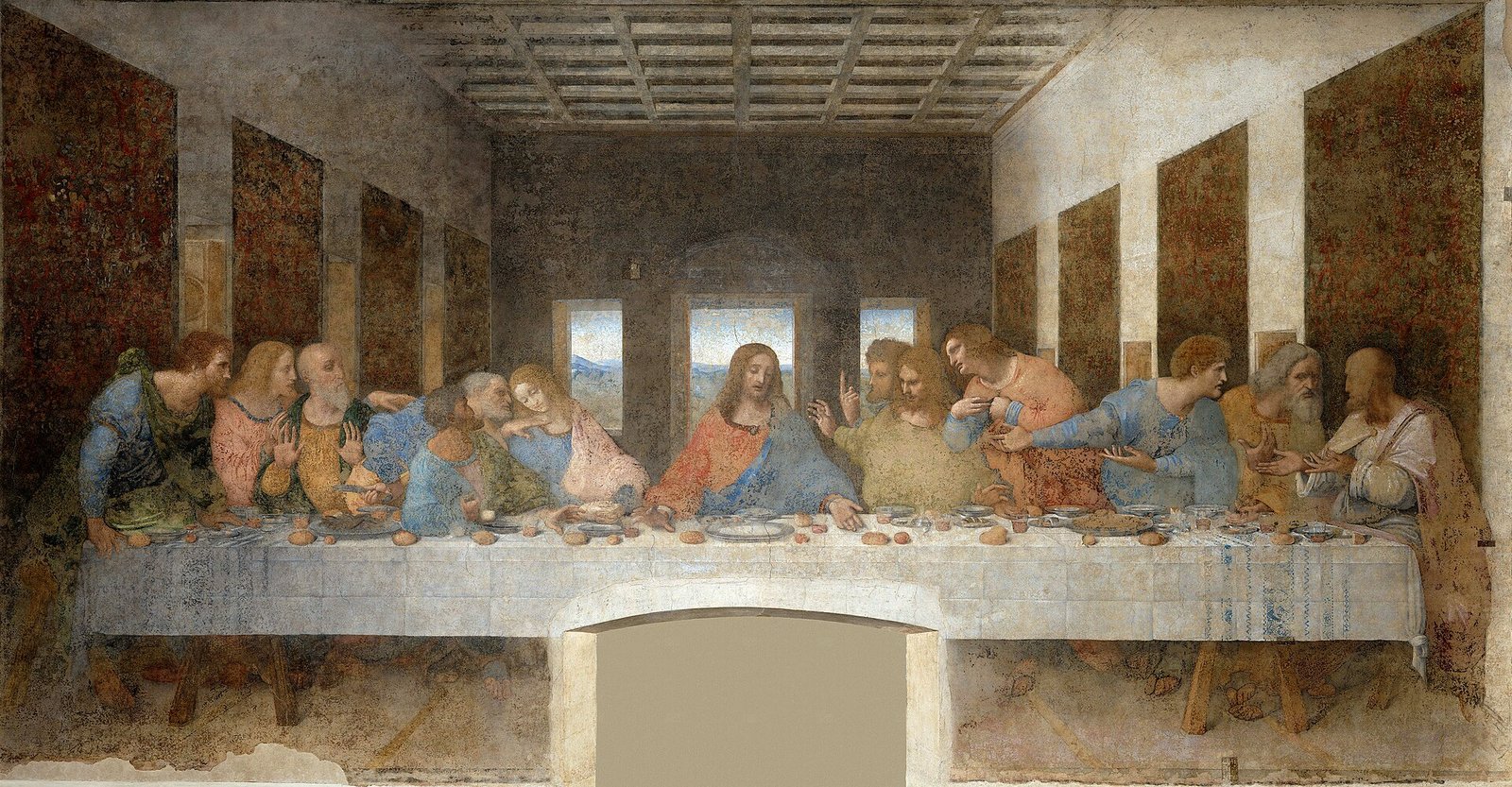
The original is on the north wall of the refectory, the dining hall, of the Santa Maria delle Grazie Dominican convent in Milan, Italy. It measures 460 × 880 centimetres. Leonardo da Vinci painted it around 1495–1498. Ludovico Sforza, ruler of Milan and also known as Ludovico il Moro, commissioned it.
In 1980 UNESCO added the church, the convent and the painting to the World Heritage List.
What the Last Supper painting shows
In the Gospel accounts, the Last Supper is the final meal Jesus shared with his apostles in Jerusalem before the crucifixion. That is the answer to the common question about the Last Supper in the Bible: it is a meal in the story, and Leonardo chose one moment from it.
He did not paint the meal itself. He painted the reaction to one sentence. Jesus has just said that one of the apostles will betray him. The painting shows the apostles’ reaction right after that announcement.
The composition has a clear structure:
- Jesus sits in the centre.
- The 12 apostles form four groups of three, not two rows of six.
- The vanishing point of the perspective sits beside Jesus’s right temple, about four metres above the floor.
Why Leonardo’s mural started to decay
The damage began with a technical choice. The classic method for a wall painting is fresco. You paint on wet plaster, and the colour sinks in as the plaster dries. The work is fast and permanent. It also leaves no room for second thoughts.
Leonardo wanted time. He worked on dry plaster instead and laid the paint over a white preparatory layer. This let him work slowly, build thin layers of paint and change areas he had already painted.
The museum’s technical notes add that he applied oil-based tempera, with pigments mixed with egg yolk, the way a painter treats a wooden panel. That is a panel method used on a wall.
The price was adhesion. The paint did not soak into the plaster. It sat on the surface. Together with unfavourable conditions in the room, this caused pigment loss in the years right after the work was finished.
Think of paint on a bathroom wall that is steamy every day. Paint that only sits on the surface will flake sooner or later. The Last Supper had the same weakness, on a far more valuable wall.
The early reports are blunt:
- In 1517, about 20 years after the painting was finished, Antonio de Beatis recorded that it was starting to deteriorate.
- In 1625, Cardinal Federico Borromeo reported that flakes of paint were falling from it.
Timeline
- About 1495–1498: Leonardo paints the Last Supper in the refectory for Ludovico Sforza.
- About 1515–1520: Giampietrino, and possibly Giovanni Antonio Boltraffio, make an early copy that preserves details later lost.
- 1517: Antonio de Beatis records that the work is deteriorating.
- 1625: Federico Borromeo reports paint flakes falling.
- 1652: A door cut into the wall destroys the lower centre, including Jesus’s feet.
- 15 August 1943: Allied bombing hits the refectory. Sandbags in front of the painting protect it.
- 1980: UNESCO lists the church, convent and painting.
- 1999: The major restoration led by Pinin Brambilla Barcilon is completed.
- 2003: The novel The Da Vinci Code spreads a false claim about the figure of John.
Damage, a door and a bombing
Nature was not the only enemy. In 1652 someone opened a door in the wall. It destroyed the lower centre of the composition, including the feet of Jesus.
Then came the Second World War. On 15 August 1943 Allied bombers hit the refectory. Sandbags had been placed in front of the painting, and they shielded it from bomb fragments. A pile of sandbags saved one of the most famous paintings in the world.
The museum also records nine restoration attempts from the early 18th century onward. Its verdict is hard. Earlier repainting changed the look of the work and made its condition worse.
The 1999 restoration and the argument about it
The last big campaign was led by Pinin Brambilla Barcilon and finished in 1999. Its stated aim was to uncover the parts that belong to Leonardo and had been buried under later repainting.
Not everyone approved. The art historian James Beck criticised changes in colour, tone and the shapes of faces after the restoration. The restorers’ reply was built into their aim: they wanted to reveal what remained of the original paint, not to rebuild a lost picture.
That is the honest answer to the question about the original painting. The wall is original. The surface you see is a mix of surviving Leonardo paint and later work.
How the room is protected today
The refectory now works like a controlled laboratory. The air composition, light and humidity levels are monitored continuously to control the risks of environmental damage.
Details you won’t find in guidebooks
- The feet of Jesus survive in a copy. An early copy dated about 1515–1520 is attributed to Giampietrino and possibly Giovanni Antonio Boltraffio. It keeps the feet that the 1652 door removed. Royal Academy of Arts holds it.
- A spilled salt cellar. In the same copy a salt cellar lies overturned beside Judas’s right arm. The Royal Academy explains it through a belief in bad luck in 16th-century Western Europe.
- Doors that clean the air. The automatic doors visitors walk through open and close in sequence. This limits how much dirty outside air enters the refectory.
- The purse. Judas holds a purse. The museum links it to the 30 silver coins he received for betraying Jesus.
- The knife. Peter holds the knife in his right hand. The museum does not attach that hand to a separate or unidentified person.
Myths around the painting
The famous myths cluster around the figure at Jesus’s side.
Myth: it is Mary Magdalene. Dan Brown’s 2003 novel The Da Vinci Code reads the figure on Jesus’s right as Mary Magdalene. Art historians accept that the figure is the apostle John. The museum’s analysis points the same way: it names the young person sitting next to Jesus, toward whom Peter leans, as John.
Myth: a Fibonacci code. Some writers link the numbers 1, 2, 3, 5, 8 and 13 in the composition to the Fibonacci sequence. Art historians do not agree that Leonardo used the sequence on purpose. Treat it as speculation.
The novel is the only popular retelling this article needs. The facts above come from the museum and UNESCO.
Last Supper tickets in Milan: how to visit
Plan before you go. Under the museum’s current visiting rules, a reservation is mandatory. The work can be seen in groups of at most 40 people for 15 minutes.
Book early through the museum’s official channels, and check its page for the latest rules. If you arrive without a reservation, you should not expect to get in.
A practical way to use your 15 minutes:
- Look first at Jesus and the vanishing point beside his temple.
- Read the groups of three, left to right.
- Find Judas and his purse.
- Find Peter and his knife.
- Look at the bottom centre and imagine the feet that the door took.
FAQ
Where is the Last Supper painting?
It is on the north wall of the refectory of the Santa Maria delle Grazie Dominican convent in Milan, Italy.
Do I need tickets for the Last Supper in Milan?
Yes. The museum’s current visiting rules require a reservation. Groups of up to 40 people see the work for 15 minutes.
Is the Last Supper in Milan the original painting?
Yes. It is a mural painted directly on the wall around 1495–1498. It has been restored several times, so not every surface is Leonardo’s own paint.
Where is Judas in the Last Supper?
The museum notes that Judas holds a purse. It links the purse to the 30 silver coins he received for betraying Jesus.
Is the figure beside Jesus Mary Magdalene?
No. The museum identifies the young person beside Jesus as John. Art historians accept this identification. Mary Magdalene is a claim from Dan Brown’s 2003 novel The Da Vinci Code.
Sources
- Museo del Cenacolo Vinciano — The Last Supper cenacolovinciano.org
- Museo del Cenacolo Vinciano — Backstage cenacolovinciano.org
- UNESCO — Santa Maria delle Grazie whc.unesco.org
- Wikipedia — The Last Supper (Leonardo) en.wikipedia.org
- Wikipedia — Last Supper en.wikipedia.org
Image: Leonardo da Vinci (1452-1519) – The Last Supper (1495-1498).jpg — Leonardo da Vinci, Public domain