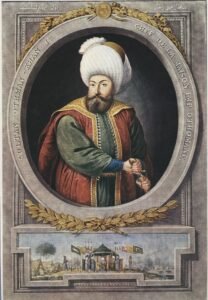
Who was Orhan Gazi?
Orhan Gazi was the son of Osman Gazi. He was the second ruler of the Ottoman dynasty. When people say “the first Ottoman capital,” they mean the city he took in 1326: Bursa.
His early life is hazy. One common version gives his birth as about 1281 in Söğüt. The same source also lists 1274, 1279 and 1287. Treat any single date as a best guess.
His accession is also debated. Chronicles put it in 1326. A foundation deed from 1324 supports the view that he was already ruling by then. Historians have not settled the question, so this article does not either.
A blockade that lasted more than ten years
Bursa did not fall in a single battle. The blockade began under Osman Bey and ran for more than ten years. No help reached the city, and its people went hungry. In the end, Bursa gave in.
One step made this possible. Before the surrender, Atranos fell. Its fortress is today’s Orhaneli Castle. Its capture cut the last link that had carried aid to Bursa.
Think of it like a town whose last supply road is closed. A few months of that is an inconvenience. More than ten years is a crisis. That is what the people inside Bursa faced.
April 1326: the surrender
In the spring of 1326, Orhan Gazi came before Bursa with all his forces. He asked the Byzantine tekfur to hand the city over. Bursa surrendered on 6 April 1326.
The agreement set out clear rules:
- Ottoman soldiers were not to harm the people.
- They were not to plunder the city.
- They were not to take residents captive.
- Anyone who wished to leave could go, with their goods, under the protection of Ottoman soldiers.
You may know this kind of deal from daily life. It works like a moving-out agreement: you can leave, and you take your belongings with you. In 1326 it was written for a whole city.
Details you won’t find in guidebooks
A few details rarely reach tourist leaflets.
- A price in gold. Among the surrender terms reported by Halil İnalcık was a payment of 30,000 gold coins to Orhan Bey.
- A man on the tower. In Âşıkpaşazâde’s account, the Bursa tekfur left first. Ahî Hasan then took position on the tower. After that, the Muslims entered the city.
- A bishop who stayed. After the conquest, Bursa’s Orthodox metropolitan was allowed to remain in the city and keep his duties.
- A river that moved. The Orhan Gazi complex was built on land gained by changing the bed of the Gökdere stream.
- Mosaics under the tomb. In the floor of Orhan Gazi’s tomb you can see mosaics left from the Byzantine monastery that once stood on the site.
From captured town to capital
Orhan Gazi made Bursa the capital of the Ottoman principality. The move turned a conquered fortress town into the center of a growing state.
He built his palace inside Bursa’s citadel. The Bey Sarayı stood in the part now called Tophane, which looks out over the plain.
In 1327 he had silver coins struck in Bursa in his own name. A coin carries a ruler’s name into every market. The mint showed that Bursa was now the seat of a state.
He also dealt with his father’s memory. After the conquest of 1326, Orhan had Osman Gazi’s grave moved from Söğüt to the Gümüşlü Kümbet inside the Bursa citadel. The founder of the dynasty now lay in the new capital.
The complex that shaped the city
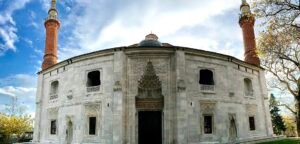
The Orhan Gazi Külliyesi was a whole neighborhood of services. It had a mosque, a madrasa, an imaret-zâviye (a charitable kitchen and lodge), a han (an inn for traders), a bath and a primary school.
The inscription over the mosque door gives the date. It says Orhan Bey built the mosque in the Hijri year 740, which is 1339–1340.
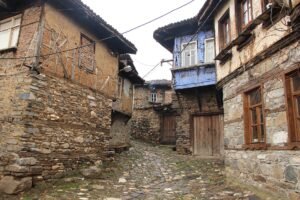
A complex like this needed steady income. Cumalıkızık, a village near Bursa, appears in historical documents as a foundation village that supported it. Today the village is part of the UNESCO listing.
What a traveler saw in 1333
In 1333, seven years after the surrender, the traveler Ibn Battuta visited Bursa. He described it as a fine town with lively markets and wide streets. So within a decade the city had become a place worth writing about.
Beyond Bursa: İznik and İzmit
Bursa was the start, not the end. Orhan Gazi added İznik to Ottoman lands in 1331. He added İzmit in 1337. The state grew outward from Bursa.
The end of his reign and his tomb
Orhan Gazi died in Bursa in March 1362. His son, Murad I, became ruler.
His tomb is in Tophane Park, in Bursa’s Osmangazi district. It stands opposite the tomb of Osman Gazi.
The building you see is not the original. An earthquake in 1855 destroyed the tomb completely. Sources disagree on the rebuilding. The TDV Encyclopedia of Islam says Sultan Abdülaziz had it rebuilt in 1863. The Bursa Alan Başkanlığı dates the rebuilding of both Osman’s and Orhan’s tombs to 1868, in the same ruler’s reign. Both agree on the ruler. They differ on the year.
Timeline
- About 1281: Common but unconfirmed date for Orhan Gazi’s birth in Söğüt.
- 1324: A foundation deed supports the view that he was already ruling. Chronicles give 1326.
- 6 April 1326: Bursa surrenders after a long blockade and becomes the Ottoman capital.
- 1327: Silver coins are struck in his name in Bursa.
- 1331: İznik joins Ottoman lands.
- 1333: Ibn Battuta visits Bursa.
- 1337: İzmit joins Ottoman rule.
- 1339–1340: Date of construction given on the Orhan Gazi Mosque inscription.
- March 1362: Orhan Gazi dies in Bursa; Murad I becomes ruler.
- 1855: Earthquake destroys the tomb.
- 1863 / 1868: Sources give different years for the rebuilding under Sultan Abdülaziz.
- 2014: Bursa and Cumalıkızık enter the UNESCO World Heritage List.
Why Bursa is on the UNESCO list
In 2014, UNESCO listed Bursa and Cumalıkızık as a site representing the birth of the Ottoman Empire. The city is where the state first had a capital, a mint and a major religious complex. You can still walk through that story.
FAQ
When did Bursa fall to Orhan Gazi?
Bursa surrendered on 6 April 1326. Orhan Gazi had arrived in the spring of that year with all his forces and asked the Byzantine governor, the tekfur, to hand over the city.
Was Bursa taken by storm?
No. Bursa surrendered under an agreement after a blockade that lasted more than ten years. The terms said Ottoman soldiers must not harm the people, plunder the city or take residents captive.
Where is Orhan Gazi buried?
His tomb is in Tophane Park in Bursa’s Osmangazi district. It stands opposite the tomb of his father, Osman Gazi.
Can I visit the places linked to Orhan Gazi in Bursa?
Yes. You can visit the tomb in Tophane Park and the Orhan Gazi Mosque, part of his külliye. You can also see Cumalıkızık, a village tied to the complex’s income. Bursa and Cumalıkızık joined the UNESCO World Heritage List in 2014.
Do historians agree on when Orhan Gazi was born or took the throne?
No. Sources give several birth years, including 1274, 1279, 1281 and 1287. Chronicles place his accession in 1326, while a foundation deed dated 1324 supports the view that he was already ruling then.
Sources
- Vikipedi — Orhan Gazi tr.wikipedia.org
- H. Doğru — academic study on Orhan Gazi’s accession and the conquest of Bursa isamveri.org
- TDV İslâm Ansiklopedisi — Bursa, Halil İnalcık islamansiklopedisi.org.tr
- TDV İslâm Ansiklopedisi — Orhan, Halil İnalcık islamansiklopedisi.org.tr
- TDV İslâm Ansiklopedisi — Orhan Gazi Külliyesi, Doğan Yavaş islamansiklopedisi.org.tr
- TDV İslâm Ansiklopedisi — Orhan Gazi Türbesi, Doğan Yavaş islamansiklopedisi.org.tr
- Bursa İl Kültür ve Turizm Müdürlüğü — Tarihçe bursa.ktb.gov.tr
- UNESCO — Bursa and Cumalıkızık: the Birth of the Ottoman Empire whc.unesco.org
- Kültür ve Turizm Bakanlığı Kültür Portalı — Orhangazi Türbesi kulturportali.gov.tr
- Bursa Alan Başkanlığı — Orhan Gazi Türbesi alanbaskanligi.bursa.bel.tr
Image: Sultan Gazi Orḫan Han – السُلطان الغازي أورخان خان.jpg — Original: K.K. Original Uploder was Osmanlı98
Derivative: با, Public domain