You probably picture a big man in a horned helmet, shouting on a longship. Most of that picture is wrong. The real Vikings were farmers, traders, craftspeople and raiders. Some of them also sailed to North America, and we can now date one of their camps to the exact year.
This article covers who they were, what they wore, and what the evidence in Newfoundland shows.
Where are the Vikings from?
The Viking homeland was Scandinavia. That means the lands of today’s Denmark, Norway and Sweden.
They were not a Turkic people. They are described as Scandinavian communities who spoke languages of the Germanic family. Their common language was Old Norse. Inscriptions used a runic alphabet called Younger Futhark.
The word itself is older than the myth. In Old Norse, víking meant a raiding expedition overseas. A víkingr was a person who took part in one. So “Viking” first described a job, not a whole nation.
When was the Viking Age?
Scholars often use the years 800 to 1050. The start is traditionally tied to 793, when raiders attacked Lindisfarne monastery in England.
In England the end is traditionally tied to 1066. That year Norway’s King Harald Hardrada was defeated at the battle of Stamford Bridge.
These are convenient markers, not hard borders. Voyages, trade and settlement did not start or stop on a single day.
Raiders, but mostly farmers
Raiding is the famous part. It was not the daily life of most people.
The National Museum of Denmark says most Scandinavians of the Viking Age farmed. They kept animals and produced what their households needed on their own farms. A farm, not a ship, was the usual workplace.
The raiders and the farmers were often the same communities. A person could farm at home and take part in a sea expedition abroad.
Ships, rivers and trade
Viking ships had hulls built from overlapping planks. They also sat shallow in the water. This design let them travel on rivers as well as the open sea.
That matters for the map. In the west, Vikings reached Iceland, Greenland and North America. In the east they moved along the Volga and Dnieper rivers. Those routes took them toward the Caspian Sea and Byzantine lands.
Trade followed the same routes. Viking networks carried fur, timber, iron and amber. Links to the east stretched as far as Baghdad.
So if you are reading this from Turkey, the Viking story is not far away. Their eastern routes pointed toward the Caspian and the Byzantine world.
The darker side: the slave trade
The Vikings also trafficked people. At centres such as Hedeby and Birka, captives were bought and sold. Enslaved people were taken to Europe, Byzantium and the Islamic world.
This is a basic part of Viking trade, not a side note. It sits next to the fur, iron and amber.
The horned-helmet myth
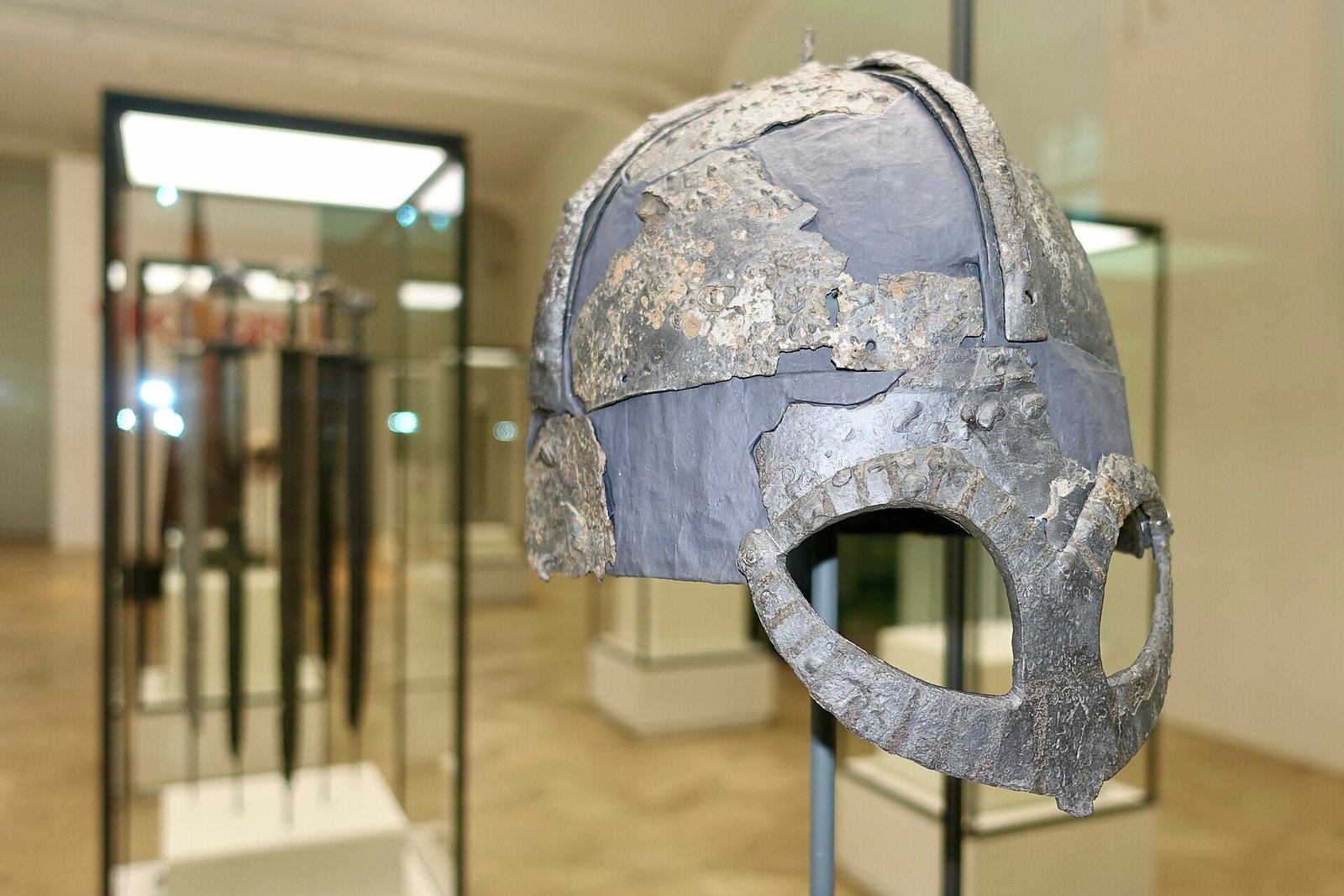
Here is the evidence on helmets. Viking Age helmet finds and written sources from the period do not support the idea that horned helmets were standard war gear.
One well-known find is the helmet from the Gjermundbu warrior grave, north of Oslo in Norway. It dates to the Viking Age. It has no horns.
So where did the image come from? The horned helmet became a symbol of the Vikings through drawings and popular images that spread in the late 19th century. It is a historically groundless icon. It says more about that century’s imagination than about Viking battlefields.
Could horns have had a ceremonial use?
Possibly. Horned headgear appears in a textile from the Oseberg grave. It may have been used in ceremonies or cult practice.
But the National Museum of Denmark is clear that such images do not prove Viking warriors generally wore horned helmets. A ritual image is not a battle uniform.
Ragnar Lodbrok: legend, not biography
Many readers arrive here after watching dramas about Viking kings. Keep one point in mind. Ragnar Lodbrok is a legendary Scandinavian king. The saga about him, Ragnars saga loðbrókar, survives in a form from the late 13th century.
That is roughly two centuries after the Viking Age ended. A story written down that late is a legend to be read with care.
Reaching America: L’Anse aux Meadows
Now the strongest claim. At the northern tip of Newfoundland, Canada, lies L’Anse aux Meadows. It is an archaeologically verified Norse camp in North America.
Parks Canada reports the remains of eight buildings in three groups. There are also timber-framed turf walls and boat-repair areas. This was a working site, not a rumour.
How the site was found
In 1960 a local resident, George Decker, showed Helge Ingstad some grass-covered mounds. Research on those mounds brought the remains to attention. In 1978 the site was added to the UNESCO World Heritage List.
The year 1021
A study published in 2021 examined worked wood from the site. It showed that three different trees had been cut in the year 1021.
That date is 471 years before Columbus’s Atlantic crossing in 1492.
The University of Groningen adds a caution. The year 1021 shows the Vikings were in Newfoundland for certain. It does not tell us how many voyages they made to America. It also does not tell us how long they stayed. Those questions are still open.
Is it Leif Erikson’s Vinland?
Some propose that L’Anse aux Meadows is the short-lived Vinland camp of Leif Erikson, described in the sagas. Parks Canada does not present this as established fact. Treat it as a strong idea, not a closed case.
Who was there first
The Norse were not the first people in the area. Indigenous communities lived around L’Anse aux Meadows at least four thousand years before the Norse arrived around the year 1000. The Vikings reached an inhabited continent.
Timeline
- Early 1st millennium BC: Viksø’s horned bronze helmets are made, long before the Vikings.
- 793 Vikings attack Lindisfarne monastery.
- 1021 The trees for three worked timbers at L’Anse aux Meadows are cut.
- 1066 Harald Hardrada is defeated at Stamford Bridge.
- Late 13th century The surviving form of the Ragnar Lodbrok saga dates to this period.
- 1492 Columbus crosses the Atlantic.
- Late 19th century The horned helmet becomes a popular Viking symbol.
- 1960 The Norse remains at L’Anse aux Meadows come to researchers’ attention.
- 1978 L’Anse aux Meadows joins the UNESCO World Heritage List.
- 2021 The study dating the wood to 1021 is published.
Details you won’t find in guidebooks
- Horns are older than the Vikings. The two-horned bronze helmets of Viksø in Denmark were made in the early 1st millennium BC. That is about two thousand years before the Viking Age.
- The date came from a cosmic-ray spike. The 1021 dating relied on a rise in carbon-14 recorded in tree rings for the year 993. Researchers counted the rings from that marker out to the outer ring.
- Small objects tell the story. Finds at L’Anse aux Meadows include traces of bog-iron working and broken nails left from boat repair.
- Some plants came from farther south. The site yielded butternuts and butternut wood. They are not native to Newfoundland and point to links with regions farther south.
- Grooming was part of daily life. Viking Age digs produced combs of bone and antler. At Birka, finds also include ear-cleaning spoons and tools read as tweezers. If you comb your hair or pluck a splinter this evening, you are doing something a Viking Age person also did.
FAQ
Where are the Vikings from?
Their homeland was Scandinavia, an area covering today’s Denmark, Norway and Sweden. They spoke Old Norse, a Germanic language. They were not a Turkic people.
Did Vikings really wear horned helmets?
No. Archaeological helmets and written sources from the Viking Age do not support horned helmets as standard battle gear. The Gjermundbu helmet from Norway has no horns.
Did the Vikings reach America before Columbus?
Yes. Worked wood from L’Anse aux Meadows in Newfoundland was cut in 1021. That is 471 years before Columbus crossed the Atlantic in 1492.
Is L’Anse aux Meadows the Vinland of the sagas?
It is suggested, but not settled. The site is linked to Leif Erikson’s short-lived Vinland camp, but Parks Canada does not present that as established fact.
When did the Viking Age begin and end?
The dates 800 to 1050 are commonly used. Tradition starts it with the 793 attack on Lindisfarne monastery in England. In England it is traditionally closed by the battle of Stamford Bridge in 1066.
Sources
- Wikipedia, Vikings en.wikipedia.org
- Vikipedi, Vikingler tr.wikipedia.org
- Metropolitan Museum of Art, The Vikings (780–1100) metmuseum.org
- Store norske leksikon, Vikingtiden snl.no
- Danmarkshistorien, Vikingerne i England, 793–1066 danmarkshistorien.lex.dk
- National Museum of Denmark, The people of the Viking Age en.natmus.dk
- Australian National Maritime Museum, Vikings and the Viking Age sea.museum
- Swedish History Museum, Free and Unfree in the Viking Age historiska.se
- National Museum of Denmark, Viking helmets en.natmus.dk
- National Museum of Denmark, The Viksø helmets en.natmus.dk
- National Museum of Denmark, Vinkler på vikingetiden natmus.dk
- Store norske leksikon, Ragnar Lodbrok snl.no
- Parks Canada, L’Anse aux Meadows National Historic Site of Canada pc.gc.ca
- Nature, Evidence for European presence in the Americas in AD 1021 nature.com
- University of Groningen, Europeans precisely 1000 years ago already in America rug.nl
- Parks Canada, L’Anse aux Meadows Management Plan 2019 publications.gc.ca
- Parks Canada, Culture and history parcs.canada.ca
- UNESCO, L’Anse aux Meadows National Historic Site whc.unesco.org
- Museum Nord, Hygiene in the Viking Age museumnord.no
Image: Cultural History (historisk) Museum Oslo. VIKINGR Norwegian Viking-Age Exhibition 08 Iron helmet from Gjermundbu (Gjermundbuhjelmen). Best-preserved viking helmet, grave find, destroyed in funeral. Equestrian warrior 950-1000. 4665.jpg — Wolfmann, CC BY-SA 4.0