Catherine the Great of Russia: who was she?
Catherine the Great ruled the Russian Empire for about 34 years. She was not Russian by birth. She was a German princess who married into the dynasty, then removed her own husband from the throne.
Her names can confuse you. Yekaterina II Alekseyevna and Yekaterina Velikaya are the same empress that English speakers call Catherine the Great.
Catherine the Great: where was she from?
She was born on 2 May 1729 in Stettin, Prussia. Today that city is Szczecin, inside Poland’s borders. Her birth name was Sophie Augusta Frederike.
In 1744 she came to Russia. She adopted Orthodoxy and took the name Yekaterina Alekseyevna. In 1745, at 16, she married the future Peter III.
So the answer is simple. She was a Prussian-born German princess. Russia was the country she joined, not the one she was born in.
How did she overthrow her husband?
Peter III took the throne on 5 January 1762. He backed Frederick II, King of Prussia. That support wore down his standing among Russian nobles.
Catherine used the moment. The Orlov brothers helped her carry out a palace coup in 1762. On 28 June 1762 by the Julian calendar, which is 9 July by the Gregorian one, the guards stood with her. She forced Peter to sign a document giving up the throne.
Peter died on 17 July 1762 at Ropsha. Some accounts say Aleksey Orlov killed him. The official explanation was colic and apoplexy. The exact mechanism of his death is unknown.
That date, 9 July 1762, starts her reign. It ran until 17 November 1796.
Timeline
- 2 May 1729: Sophie Augusta Frederike is born in Stettin.
- 1744: She arrives in Russia, adopts Orthodoxy and becomes Yekaterina Alekseyevna.
- 1745: She marries the future Peter III.
- 5 January 1762: Peter III takes the Russian throne.
- 9 July 1762 (Julian: 28 June): A coup backed by the guards brings Catherine to power.
- 17 July 1762: Peter III dies at Ropsha.
- 1764: She buys the paintings regarded as the start of the Hermitage collection.
- 1767: She prepares the Nakaz, her legislative instruction.
- 1768: She and her son Pavel receive variolation against smallpox.
- 1770: The Russian fleet burns the Ottoman fleet at Çeşme.
- 1772: First partition of the Polish-Lithuanian Commonwealth.
- 1773–1775: Pugachev’s Rebellion shakes her government.
- 21 July 1774: The Treaty of Küçük Kaynarca is signed.
- 1775: The provincial reform is issued.
- 1783: Russia annexes Crimea.
- 1785: The Charter to the Nobility secures noble privileges.
- 1793 and 1795: Second and third partitions of the Commonwealth.
- 17 November 1796: Catherine dies. Her son Paul I succeeds her.
Ideas on paper: the Nakaz and the Commission
In 1767 Catherine prepared the Nakaz. It was a legislative instruction. She drew on Enlightenment thinkers such as Beccaria, Montesquieu and Voltaire.
It never became a law that took direct effect. Still, translations into European languages and more than twenty editions spread her fame abroad.
She also gathered a Legislative Commission in Moscow. State institutions, landowners and various social groups were represented. The Commission was meant to feed the law-making effort.
Revolt and reform at home
The Pugachev Rebellion of 1773–1775 tested her rule. By January 1774, between 10,000 and 12,000 Bashkir fighters made up more than a third of the rebel forces. This was not a small uprising on the edge of the empire.
In 1775 she issued a provincial reform. It aimed to reorganize the empire’s administration through provinces and districts.
Then came the Charter to the Nobility in 1785. It gave legal protection to the nobles’ privileged status. It also secured their monopoly on owning serfs.
Here is the limit of her “enlightened” image. Despite her modernizing program, the Russian economy and the military recruitment system still rested on serfdom.
Why Turkey comes into the story
If you travel in Turkey, parts of this story are close to home. During the 1768–1774 Ottoman-Russian War, the Russian fleet burned the Ottoman fleet at Çeşme in 1770.
The Treaty of Küçük Kaynarca followed on 21 July 1774. It recognized the political independence of the Crimean Khanate. It also handed fortresses such as Kerch and Yenikale to Russia.
Nine years later, in 1783, her government annexed Crimea. The treaty’s recognition of independence did not last.
Further west, Russia took part in the partitions of the Polish-Lithuanian Commonwealth in 1772, 1793 and 1795. Her reign pushed the empire both south and west.
Art, furniture and the Hermitage
In 1764 Catherine bought paintings from Johann Ernst Gotzkowsky, a Berlin merchant. That purchase is regarded as the beginning of the Hermitage Museum.
You can still feel her taste today. If you visit a large museum and stand in front of a collection that began with one buyer’s order, you are seeing the same idea at work.
Her furniture orders are documented too. David Roentgen made five cabinets for her collection of engraved stones. Each held 100 drawers, spread over four sections.
Details you won’t find in guidebooks
- Nine days. Only nine days after her husband was overthrown, Catherine offered Diderot to print the Encyclopédie in Russia. It was banned in France at the time.
- Written to be heard. Some members of the Legislative Commission could not read. Catherine wrote the Nakaz in a style suited to being read aloud.
- Horses on standby. In 1768 the English physician Thomas Dimsdale gave Catherine and her son Pavel variolation against smallpox. She had fresh horses arranged along the route. If she died during the procedure, Dimsdale could escape safely. Think of that the next time you roll up your sleeve for a vaccine.
- An unpaid bill. On 22 June 1789 Roentgen sent a reminder. He was still owed 26,000 rubles for three cabinets she had bought.
What she left behind
Catherine died on 17 November 1796. Her son Paul I took the Russian throne.
Her record is mixed, and the facts show it. She expanded the empire through war and partition. She reorganized its administration. She built a museum collection and wrote an Enlightenment-inspired instruction for law-making.
But she also strengthened noble privilege, and serfdom stayed in place. A German princess who came to Russia as a teenager ended up ruling it for 34 years. The system that carried her did not change for the people at the bottom.
FAQ
Where was Catherine the Great from?
She was born on 2 May 1729 in Stettin, Prussia, today’s Szczecin in Poland. Her birth name was Sophie Augusta Frederike. She came to Russia in 1744.
Sources
- Wikipedia — Catherine the Great en.wikipedia.org
- Vikipedi — II. Katerina tr.wikipedia.org
- The Metropolitan Museum of Art — Saint Petersburg metmuseum.org
- Yale Law Library — The Nakaz in English library.law.yale.edu
- Yale Law Library — Catherine the Great’s Legislative Commission library.law.yale.edu
- Harvard Imperiia Project — Pugachev’s Rebellion in the Bashkir Lands imperiia.scalar.fas.harvard.edu
- State Historical Museum, Russia — Catherine II’s Charter to the Russian Nobility nav.shm.ru
- State Hermitage Museum — Hermitage Collections (1764–1852) hermitagemuseum.org
- The Metropolitan Museum of Art — Extravagant Inventions: The Princely Furniture of the Roentgens resources.metmuseum.org
- Royal College of Surgeons of England — SurgiCat, RCSIC/X 11 surgicat.rcseng.ac.uk
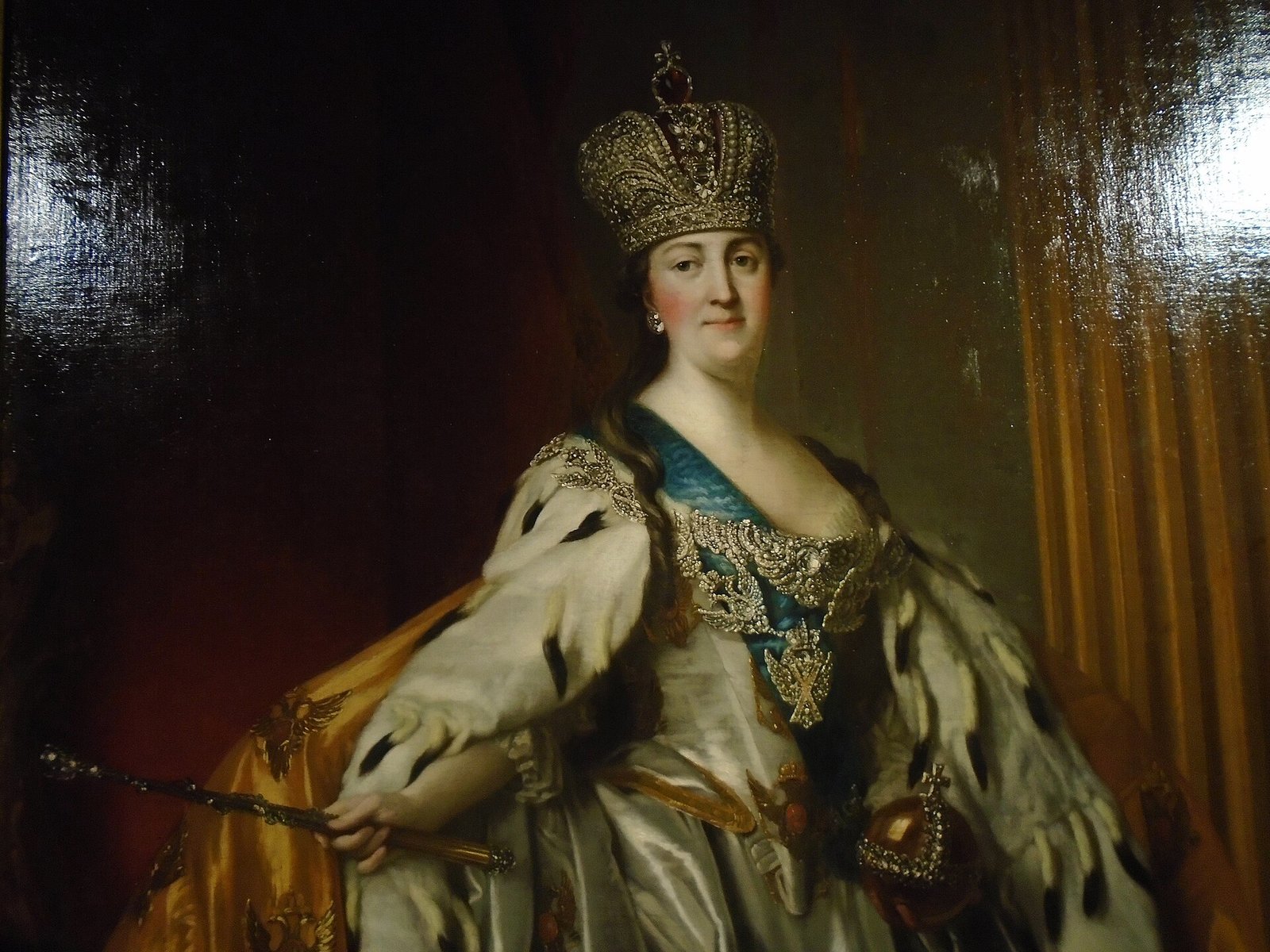
Image: Catherine II by Eriksen 2020-12-01 (2).jpg — Engelberthumperdink, CC BY-SA 4.0