How did the American Revolutionary War begin?
The American Revolutionary War began on 19 April 1775, when British troops and colonial militia fought at Lexington and Concord. General Thomas Gage had sent the British force to seize weapons and ammunition stored at Concord. That mission turned a dispute over taxation and government into armed war between Great Britain and the Thirteen Colonies in North America.
Independence came later. The colonies were already fighting when Congress adopted the Declaration of Independence on 4 July 1776. If you separate the start of combat from the declaration, the sequence becomes clearer: war began in 1775, independence was declared in 1776, and Britain formally recognized it in 1783.
Why did British taxes provoke colonial resistance?
The financial pressure began after the Seven Years’ War ended in 1763. Britain faced war expenses and the cost of keeping troops in America. Its government turned to new colonial taxes to help meet those costs. The argument that followed concerned both money and the authority to demand it.
The Stamp Act of 22 March 1765 taxed printed materials, including legal documents, newspapers, and playing cards. You can connect this dispute to everyday life through a newspaper purchase: an ordinary printed item became subject to a tax imposed by Parliament. Legal paperwork and leisure materials also fell within the act.
Resistance to the Townshend duties in 1767 sharpened the political question. Colonists argued that Parliament could not tax them without representation, even through customs duties. Britain removed most of those duties in 1770. It kept the tea tax to affirm its authority to tax the colonies.
The Library of Congress describes this disagreement over colonial government and Parliament’s taxing power as the majority interpretation of the Revolution’s origins. Other researchers have emphasized economic interests and class conflict. The political interpretation explains why retaining the tea tax mattered even after other duties disappeared.
How did Boston’s protests lead toward war?
On 5 March 1770, British soldiers fired into a crowd in Boston. The incident became known as the Boston Massacre. It formed part of the escalating confrontation that preceded the tea protests and the armed clashes of 1775.
On 16 December 1773, protesters threw 342 chests of tea from ships into Boston’s harbor. The Boston Tea Party challenged a policy whose significance extended beyond the price of tea. Colonists regarded the Tea Act as an attempt to secure acceptance of Britain’s taxing authority.
Parliament responded in 1774 with punitive measures known in the colonies as the Intolerable Acts. These closed Boston Harbor and restricted Massachusetts’s self-government. On 5 September 1774, the First Continental Congress met in Philadelphia to organize a common colonial response. Resistance now had a forum for collective action.
American Revolutionary War dates: when did independence follow?
After fighting began in April 1775, Congress created the Continental Army on 14 June. It appointed George Washington commander in chief the following day. The colonies thus established a common army before formally declaring their separation from Britain.
Thomas Paine’s political pamphlet Common Sense appeared in January 1776. It argued for independence and sold thousands of copies. On 6 April, Congress opened American ports to trade with other countries. This was another step in breaking the economic ties established through Britain’s Navigation Acts.
Congress approved independence on 2 July 1776 with the support of 12 colonies. New York did not participate in that vote. The Declaration adopted on 4 July announced that the Thirteen Colonies’ allegiance to the British Crown and their political connection with Great Britain had ended.
American Revolutionary War timeline
- 1763: The Seven Years’ War ended.
- 22 March 1765: Parliament passed the Stamp Act.
- 1767: The Townshend measures introduced new import duties.
- 5 March 1770: The Boston Massacre occurred.
- 16 December 1773: Protesters dumped 342 chests of tea into Boston Harbor.
- 1774: British punitive laws closed Boston Harbor and restricted Massachusetts’s self-government.
- 5 September 1774: The First Continental Congress met in Philadelphia.
- 19 April 1775: Fighting at Lexington and Concord began the war.
- 14–15 June 1775: Congress created the Continental Army and appointed Washington its commander.
- January 1776: Paine published Common Sense.
- 6 April 1776: Congress opened American ports to international trade.
- 2–4 July 1776: Congress approved independence and adopted the Declaration.
- 2 August 1776: Delegates began signing the parchment Declaration.
- 14 June 1777: Congress defined the American flag’s stars and stripes.
- 17 October 1777: Burgoyne’s army surrendered at Saratoga.
- 6 February 1778: France and the United States signed treaties establishing their alliance.
- 19 October 1781: Cornwallis surrendered at Yorktown.
- 3 September 1783: Britain recognized American independence through the Treaty of Paris.
- 1789: The United States Constitution replaced the Articles of Confederation.
American Revolutionary War map: where did it take place?
The conflict began in Britain’s Thirteen Colonies in North America. Lexington and Concord mark its opening clashes. Boston connects the earlier protests to the punitive measures of 1774. Philadelphia belongs to the political story as the meeting place of the First Continental Congress.
If you follow the war through its major named encounters, the route continues to Saratoga and Yorktown. These places represent different stages: the opening of hostilities, a surrender that helped secure French support, and the encirclement of Cornwallis’s forces. Paris marks the diplomatic settlement signed in 1783.
Which American Revolutionary War battles changed the outcome?
At the end of the Saratoga campaign, British General John Burgoyne surrendered his army to American forces on 17 October 1777. The victory helped persuade France to support the American cause. Treaties signed on 6 February 1778 established the French-American alliance and French recognition of American independence.
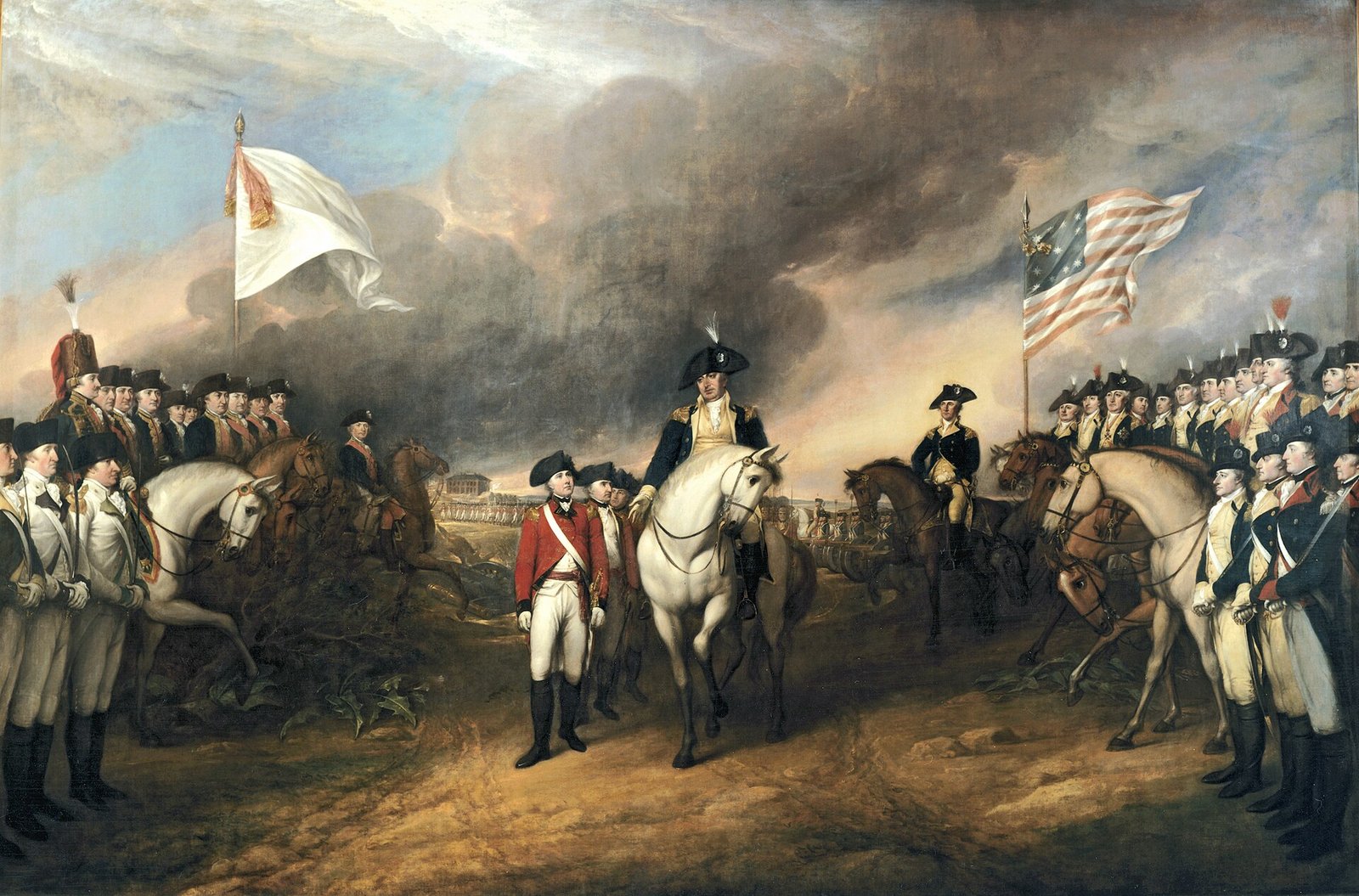
At Yorktown, American and French forces surrounded General Charles Cornwallis’s troops by land and sea. Cornwallis surrendered on 19 October 1781. The episode shows the military importance of the alliance: French and American forces acted together against a British army.
Yorktown did not formally end the war. That came with the Treaty of Paris, signed on 3 September 1783. Britain recognized the United States as an independent state. The treaty also established boundaries that would allow American expansion westward.
American Revolutionary War uniforms and flags
Congress designated blue as the Continental Army’s coat color in 1779. Dye shortages limited the rule’s practical effect. Many regiments continued wearing brown or green coats until the war ended. A regulation therefore does not describe every soldier’s appearance.
The flag resolution of 14 June 1777 specified 13 alternating red and white stripes. It also called for 13 white stars on a blue field. Congress did not prescribe the stars’ arrangement. The resolution established their number and colors while leaving that part of the design open.
American Revolutionary War casualties
Howard H. Peckham estimated American military deaths at 25,324. His estimate divided these into 6,824 deaths in combat and 18,500 from disease or other causes. These figures concern American military deaths; they are not a total for everyone affected by the war.
Disease also shaped Washington’s decisions. In 1777, he made smallpox inoculation compulsory for Continental Army soldiers. By the end of that year, the practice had become established and reduced the risk of a major outbreak.
Details you won’t find in guidebooks
The Tea Act of 1773 aimed to reduce tea prices. Colonists nevertheless viewed it as an attempt to make them accept British taxation. The Boston Tea Party therefore cannot be explained simply as anger over expensive tea. The authority behind the tax was central to the protest.
The Declaration’s parchment copy was not signed collectively on 4 July 1776. Delegates began signing it on 2 August. Adoption and signing were separate events, just as Congress’s independence vote on 2 July preceded adoption of the text on 4 July.
American Revolutionary War museum: what object connects you to Washington?
The Museum of the American Revolution preserves Washington’s original war tent, dated to 1777–1778. He used it as both a bedroom and a workspace. If you want an everyday connection to military command, this object brings sleeping and working into the same setting.
FAQ
What were the American Revolutionary War dates?
The war began on 19 April 1775 with fighting at Lexington and Concord. It formally ended with the Treaty of Paris on 3 September 1783.
Why did the American Revolutionary War begin?
British taxes after 1763 intensified disputes over Parliament’s authority and colonial representation. Punitive measures in 1774 deepened the crisis, and a British mission to seize military supplies at Concord led to fighting on 19 April 1775.
Did the war begin with the Declaration of Independence?
No. Fighting began in April 1775. Congress voted for independence on 2 July 1776 and adopted the Declaration of Independence on 4 July.
Which battles helped secure American independence?
Burgoyne’s surrender at Saratoga in October 1777 helped persuade France to enter an alliance with the United States. Cornwallis surrendered at Yorktown in October 1781 after American and French forces surrounded his troops by land and sea.
Sources
- National Park Service — Timeline of the Revolution nps.gov
- UK Parliament — Parliament and the War in the American Colonies 1767–83 parliament.uk
- National Park Service — Timeline of the War for Independence nps.gov
- Library of Congress — The American Revolution loc.gov
- U.S. Army — America’s First National Institution army.mil
- National Archives — The Declaration of Independence: A History archives.gov
- National Archives — Declaration of Independence (1776) archives.gov
- National Archives — Declaration of Independence archives.gov
- National Park Service — Burgoyne’s Campaign: June–October 1777 home.nps.gov
- National Archives — The Treaty of Alliance with France archives.gov
- National Park Service — Overview of the American Revolution home.nps.gov
- National Archives — Treaty of Paris (1783) archives.gov
- English Wikipedia — American Revolutionary War: Casualties and Losses en.wikipedia.org
- National Park Service — Smallpox, Inoculation, and the Revolutionary War nps.gov
- U.S. Army Center of Military History — The Continental Army history.army.mil
- Smithsonian National Postal Museum — Resolved, That the Flag of the United States postalmuseum.si.edu
- Museum of the American Revolution — Washington’s War Tent amrevmuseum.org
Image: Surrender of Lord Cornwallis.jpg — John Trumbull, Public domain