In 1936 a striped, dog-like marsupial died in a small zoo in Hobart. It was the last of its kind known to be alive in captivity. The story of why the Tasmanian tiger went extinct is a story of bounties, fear and a landscape that shrank. This article walks you through what the animal was, how people turned on it and what is still argued about today.
What was the thylacine?
The Tasmanian tiger, or thylacine, was a carnivorous marsupial. It was the last species of the family Thylacinidae to survive into modern times. Its scientific name is Thylacinus cynocephalus.
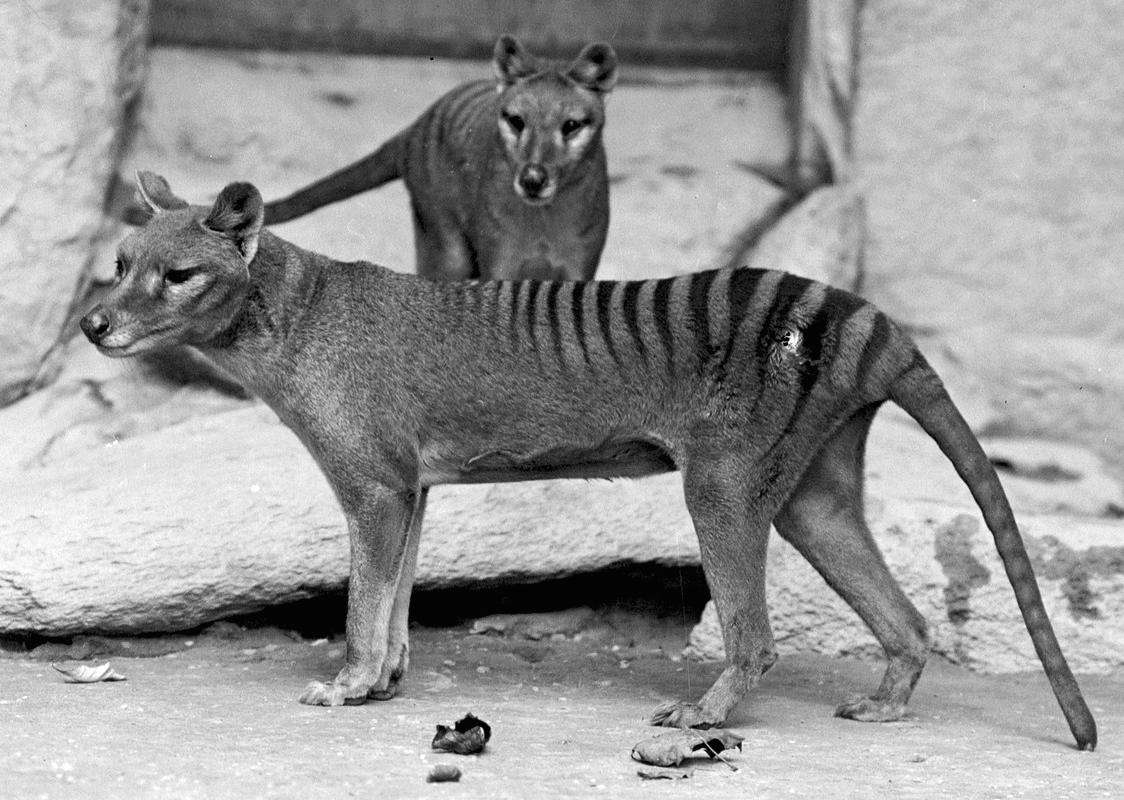
Its coat ranged from yellowish brown to grey. Across the back, from the shoulders to the tail, it carried 15 to 20 dark stripes. Those stripes gave it the tiger nickname. Its large jaws held 46 teeth.
If you have ever seen a striped tabby cat curled up on a sofa, you already know how stripes can make an animal look more fierce than it is. The thylacine’s stripes did the same for its reputation.
Thylacine meaning: what does the name say?
The Australian Museum explains the name Thylacinus cynocephalus as meaning dog-headed pouched dog. The name describes the animal plainly. It had a dog-like head, and it carried young in a pouch.
The animal is not a tiger and not a dog. It was a marsupial. The nicknames came from its stripes and its shape.
Where did the thylacine live?
The range was once much wider than Tasmania. Fossils and Aboriginal rock paintings show that the thylacine lived on the Australian mainland, in New Guinea and in Tasmania.
By the time Europeans settled Tasmania in 1803, the species was common on the island. It preferred dry eucalypt forest, wetlands and grassland.
How the animal lived and hunted
The thylacine hunted mostly at night or at dusk. It worked alone or in pairs. Wallabies were an important part of its diet, according to Tasmania’s nature conservation agency. It also took small animals and birds.
While hunting, it could make a double bark, repeated every few seconds, that sounded like a terrier.
Thylacine pouch: a detail that surprises people
A female carried her young in a pouch that opened backward. One litter could hold up to four young.
The male has a surprise too. Males also had a partial pouch that opened backward. It is a detail that general summaries skip.
Why the Tasmanian tiger went extinct
No single event wiped the species out. Several pressures stacked up over about a century.
Bounties. In 1830 the Van Diemen’s Land Company began paying rewards for killing thylacines. It viewed the animal as a threat to farm stock. In 1888 the Tasmanian government began paying 1 pound for an adult and 10 shillings for a pup. That government program ended in 1909. Over its life, 2,184 bounties were paid, according to Tasmania’s nature conservation agency.
Hunting beyond the bounties. The National Museum of Australia says hunters killed at least 3,500 thylacines between 1830 and the 1920s. Paid bounties therefore count only part of the killing.
Habitat loss. Tasmania’s conservation agency lists hunting and habitat destruction as the main causes. Together they split the population into isolated groups.
An exaggerated threat. Records of attacks on sheep and poultry exist. But the Australian Museum states that the damage blamed on the thylacine was greatly exaggerated. Think of a rumour about a neighbour’s dog that grows with every retelling until the whole street believes it. The same thing happened here, except that the rumour came with a cash reward.
Was disease involved?
One theory says a disease like canine distemper weakened the last population. Another line of work disagrees. A 2013 study led by the University of Adelaide ran models that included hunting and a decline in prey. These models produced extinction without adding any disease.
This does not prove disease played no part. It shows that hunting and shrinking prey were enough on their own.
Timeline
- 1803: European settlers arrive, and the thylacine is common on the island.
- 1830: The Van Diemen’s Land Company begins paying for dead thylacines.
- 1888: The Tasmanian government offers 1 pound for an adult and 10 shillings for a pup.
- 1909: The government bounty program ends.
- 1930: The last confirmed shooting of a wild thylacine is recorded.
- 1933: David Fleay films the thylacine at Beaumaris Zoo on silent film.
- 10 July 1936: The Tasmanian government protects the species.
- 7 September 1936: The last known captive thylacine dies at Beaumaris Zoo in Hobart.
- 1986: The species is declared extinct under international criteria.
- 2023: Competing studies on the identity of the last animal are published, and a separate model re-examines the date of extinction in the wild.
The last thylacine: Hobart, 1936
The timing is painful. Tasmania protected the species on 10 July 1936. The last known captive animal died 59 days later, on 7 September 1936, at Beaumaris Zoo in Hobart.
The last confirmed shooting of a wild animal had been recorded six years earlier, in 1930. By the time the law arrived, almost nothing was left to protect.
Who was the last thylacine?
Some of the best-known details about this animal are disputed.
The name Benjamin. Many sources call the last animal Benjamin. Robert Paddle examined the claim and says it traces back to a statement by Frank Darby that reached the press in 1968. Paddle considers it unreliable.
Female or male?
A 2023 paper by Robert Paddle and Kathryn Medlock argues that the last animal was an old female. They say her skin and skeleton were identified in the collection of the Tasmanian Museum and Art Gallery. A different 2023 study by Gareth Linnard and Stephen Sleightholme argues the opposite. They say the last animal was a male caught by Roy and Dan Delphin on 7 July 1930 at Penney’s Flats on the Arthur River.
Was it shut out in the cold?
A popular story says the animal died because it was not let into its night shelter. Linnard and Sleightholme argued in 2023 that there is not enough evidence to support this neglect story.
What is solid is the date and the place: 7 September 1936, Beaumaris Zoo, Hobart.
Thylacine extinct: the official date
The species was declared extinct under international criteria in 1986. That was 50 years after the last confirmed record in 1936.
Thylacine sightings, including 2026
People keep reporting sightings. Tasmania’s nature conservation agency says that despite hundreds of reports since 1936, no finding conclusively proves a living thylacine exists.
A 2023 model led by Barry Brook and colleagues used 1,237 sighting records. Depending on how the data were chosen, it estimated extinction at some point between 1940 and the 1970s, or between the late 1980s and the early 2000s. This is a statistical estimate. It is not a confirmed new sighting, and it should not be read as one.
If you read a headline about a sighting in 2026, the test is simple. Look for physical evidence that experts have verified. A blurry photograph or a witness account does not meet that standard.
Thylacine taxidermy and what remains
Physical remains are scarce, and a few survive in unusual forms.
The Queen Victoria Museum and Art Gallery holds the only known carriage rug made from the skins of several thylacines. It was donated in 2002. The National Museum of Australia keeps a thylacine preserved in fluid. Protein from its muscles and calcium carbonate from its teeth and skeleton had leached into the preserving fluid. For that reason the specimen was moved to a new tank that protects it from vibration.
The Tasmanian Museum and Art Gallery holds a skin and skeleton that Paddle and Medlock link to the last animal. That claim is contested, as described above.
Details you won’t find in guidebooks
- The film has no sound. David Fleay’s famous 1933 footage at Beaumaris Zoo was shot on silent film. No recording of the animal’s voice was made during it.
- A rug made of many animals. The 2002 donation to the Queen Victoria Museum and Art Gallery is the only known carriage rug made from several thylacine skins.
- Males had a pouch too. It was partial and opened backward.
- A museum specimen changes its own fluid. In the National Museum of Australia’s fluid-preserved thylacine, protein and calcium carbonate moved into the liquid, which is why the specimen needed a new tank.
- A public-domain photograph. The Australian Museum presents a photograph of a thylacine at Hobart Zoo from about 1928, attributed to Harry Burrell, as public domain.
FAQ
Why did the Tasmanian tiger go extinct?
Hunting, bounty schemes and habitat destruction broke the population into fragments. The damage the animal did to sheep and poultry was greatly exaggerated, and that belief encouraged the killing. Some researchers also point to disease, but a 2013 study led by the University of Adelaide produced extinction in models without it.
When did the last thylacine die?
The last known captive animal died on 7 September 1936 at Beaumaris Zoo in Hobart. The last confirmed shooting of a wild animal was recorded in 1930.
Where did the thylacine live?
Fossils and Aboriginal rock art show it once lived on the Australian mainland, in New Guinea and in Tasmania. By 1803 it was common on Tasmania, where it favoured dry eucalypt forest, wetlands and grassland.
Does the thylacine have a pouch?
Yes. Females had a backward-opening pouch that could carry up to four young. Males also had a partial, backward-opening pouch.
Are thylacine sightings real?
Tasmania’s nature conservation agency says hundreds of reports since 1936 have produced no finding that conclusively proves a living animal. A 2023 model using 1,237 records suggests extinction may have come later than 1936, but it is a statistical estimate and not a confirmed sighting.
Sources
- Australian Museum, Thylacine australian.museum
- Parks & Wildlife Service Tasmania, Tasmanian tiger parks.tas.gov.au
- NRE Tasmania, Tasmanian Tiger nre.tas.gov.au
- National Museum of Australia, The last thylacine digital-classroom.nma.gov.au
- National Museum of Australia, Extinction of thylacine nma.gov.au
- National Museum of Australia, Thylacine collection highlight nma.gov.au
- English Wikipedia, Thylacine en.wikipedia.org
- University of Adelaide, No need for disease digital.library.adelaide.edu.au
- ABC News, Stop calling the last thylacine Benjamin abc.net.au
- Australian Zoologist, The discovery of the remains of the last Tasmanian tiger openurl.ebsco.com
- Australian Zoologist, An exploration of the evidence surrounding the identity of the last captive Thylacine researchgate.net
- ABC News, New thylacine research project casts doubt on last captive Tasmanian tiger assertions abc.net.au
- Australian National University, Resolving when (and where) the Thylacine went extinct researchportalplus.anu.edu.au
- National Film and Sound Archive, Tasmanian Tiger Footage nfsa.gov.au
- Queen Victoria Museum and Art Gallery, Tasmanian Tiger: precious little remains qvmag.tas.gov.au
- Turkish Wikipedia, Tasmanya kaplanı tr.wikipedia.org
Image: Thylacinus cropped.png — E.J. Keller, Public domain