Who was Jacques Cartier, and where was he from?
Jacques Cartier was a French navigator and explorer born around 1491 in Saint-Malo, Brittany. He made three voyages to the lands of present-day Canada: in 1534, 1535–1536, and 1541–1542. His routes led through the Gulf of St. Lawrence and along the St. Lawrence River.
If you follow Cartier’s voyages, you encounter Indigenous guides, established settlements, territorial claims, and forced journeys to France. Stadaconé and Hochelaga were central to his river explorations. Donnacona, Taignoagny, and Domagaya were central to his dealings with the people who lived there.
Why did Cartier sail to Canada?
King Francis I of France commissioned Cartier in 1534 to search for gold and a passage to Asia. These aims shaped the expedition that left Saint-Malo on 20 April 1534. Cartier sailed with two ships and 61 men.
His first voyage explored around Newfoundland, the Strait of Belle Isle, the Gulf of St. Lawrence, and the coast of Prince Edward Island. The second took him upriver to Stadaconé and Hochelaga. During the third, he began building a settlement at Cap-Rouge.
Where did Jacques Cartier explore in 1534?
Cartier’s first Canadian voyage concentrated on coastal waters and the gulf. Newfoundland and the Strait of Belle Isle formed part of that route. He also reached Prince Edward Island’s shores, although he did not recognize that the land was an island.
At Gaspé on 24 July 1534, Cartier had a cross erected that stood about 30 feet high. It asserted a claim to the land for France. Donnacona, the leader of Stadaconé, objected. Cartier responded that the cross was merely a marker.
That exchange matters when you consider what the expedition represented. The cross expressed a French territorial claim, while Donnacona challenged its erection. Cartier’s explanation to Donnacona presented the structure as a marker, despite its role in asserting possession.
Donnacona’s sons, Taignoagny and Domagaya, went to France with Cartier in 1534. Historians differ over the circumstances. Some interpret their departure as kidnapping. Others describe permission given on condition that the French return with trade goods. That disagreement belongs specifically to the events of 1534.
How did Cartier reach Stadaconé and Hochelaga?
Cartier began his second voyage on 19 May 1535 with about 110 men. His three ships were Grande Hermine, Petite Hermine, and Émérillon. Domagaya and Taignoagny returned with him after learning French in France. They served as guides and interpreters.
Following the St. Lawrence River, Cartier reached Stadaconé, the settlement led by Donnacona. It stood in the area of present-day Québec City. His progress therefore depended partly on men whose knowledge connected the French expedition with the river and its communities.
The name Canada, as Cartier used it, derived from kanata, an Iroquoian word meaning village. If you associate Canada only with its modern geographical meaning, this village connection offers a more precise starting point for understanding the name in Cartier’s voyages.
On 2 October 1535, Cartier reached Hochelaga, an Iroquoian settlement in the area of present-day Montréal. His Indigenous hosts took him to a nearby hill. He named it Mont Royal. Rapids around Montréal Island prevented him from travelling farther west by river.
Stadaconé and Hochelaga mark two important points on this second journey. The first lay in the present-day Québec City area. The second lay in the present-day Montréal area. The rapids around Montréal Island set a practical limit on Cartier’s westward river exploration in 1535.
What happened during the winter of 1535–1536?
Cartier and his companions spent the winter near Stadaconé, around the Saint-Charles River. Scurvy struck the expedition. By February, only ten of the 110 men were well enough to help the others. The illness left very few able men caring for the rest.
Domagaya taught Cartier an Indigenous treatment made from a tree called annedda. It helped the crew recover from scurvy. His role extended beyond guiding and interpreting: he also shared knowledge that helped the expedition through its winter illness.
Cartier misunderstood what he saw when scurvy also appeared among Stadaconé’s inhabitants. He wrongly believed the illness was contagious and had passed from them to his men. His explanation of the outbreak was mistaken, even as Domagaya’s treatment helped the crew.
Why was Donnacona taken to France?
On 3 May 1536, Cartier had Donnacona, his two sons, and two other Indigenous people seized and taken to France. This was a forced removal. It followed the winter during which Domagaya had taught Cartier the treatment that helped his sick companions.
The seizure in 1536 should be distinguished from the disputed circumstances of the sons’ departure in 1534. Donnacona never returned to Stadaconé. He probably died in France in 1539. His story connects Cartier’s voyages with the lasting consequences of taking people away from their communities.
What happened on Cartier’s third voyage?
Cartier left Saint-Malo on 23 May 1541 with five ships. Roberval held overall command of this third expedition. By late August, Cartier had begun establishing Charlesbourg-Royal at Cap-Rouge. He ordered two forts built, one on the promontory and another below it.
The minerals Cartier carried home from this voyage seemed to promise the riches sought by the expedition. He believed he had gold and diamonds. They proved to be iron pyrite and quartz. The distinction between what he thought he possessed and what he actually brought back is central to the voyage’s outcome.
Cartier’s cargo provides the historical example: the supposed gold and diamonds were pyrite and quartz.
In June 1542, Cartier abandoned the colony. He encountered Roberval in Newfoundland, then departed from him at night and returned to France. Roberval renamed Charlesbourg-Royal France-Roy in 1542. The remaining settlers returned to France, and the colony was abandoned in 1543.
Timeline
- Around 1491: Cartier was born in Saint-Malo, Brittany.
- 20 April 1534: He departed with two ships and 61 men.
- 24 July 1534: He had a cross erected at Gaspé to assert a French claim.
- 19 May 1535: His second voyage began with three ships.
- 2 October 1535: He reached Hochelaga.
- Winter 1535–1536: His crew suffered scurvy near Stadaconé.
- 3 May 1536: Donnacona and his companions were seized.
- 23 May 1541: Cartier departed on his third voyage with five ships.
- Late August 1541: Construction began at Charlesbourg-Royal.
- June 1542: Cartier left the colony.
- 1543: The colony continued by Roberval was abandoned.
- 1 September 1557: Cartier died in Saint-Malo.
- 2005: Archaeological remains of the Cartier-Roberval colony were discovered.
Details you won’t find in guidebooks
Cartier reached Prince Edward Island in 1534 without recognizing it as an island. Reaching a coastline and understanding its full shape were different achievements. His voyage brought him to those shores, but his interpretation of the land remained incomplete.
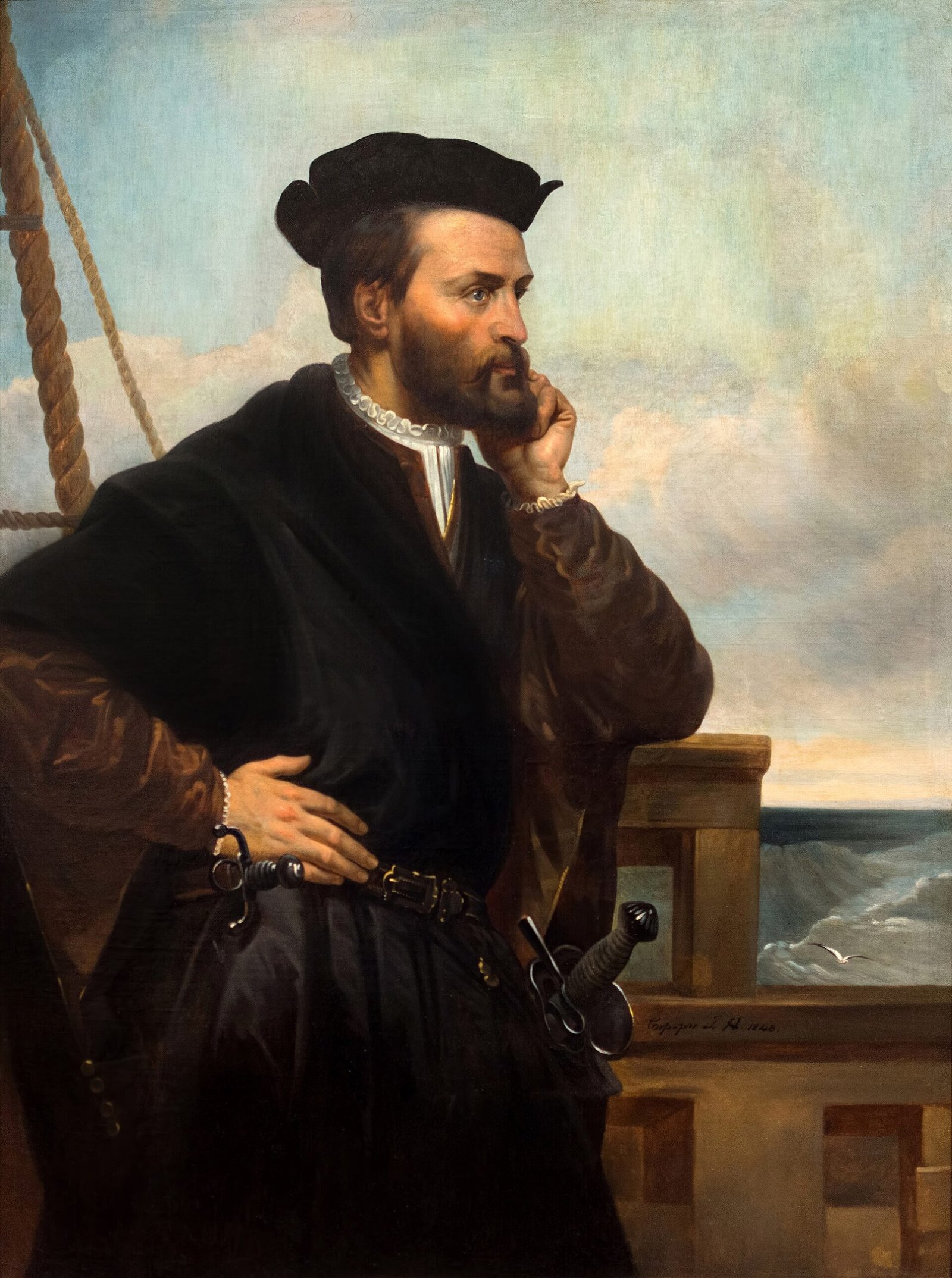
No portrait is securely known to have been made during Cartier’s lifetime. His birthplace and death date are established parts of his biography: Saint-Malo, around 1491, and Saint-Malo again on 1 September 1557. A securely identified contemporary likeness is another matter.
A fragment of Italian faience helped identify the Cartier-Roberval settlement. Yves Chrétien found it in 2005. Its decoration allowed it to be dated to the first half of the sixteenth century. A small piece of a vessel thus contributed to identifying the settlement’s remains.
Excavations from 2007 to 2010 uncovered about 6,000 artifacts and structural remains dating to 1541–1543. These finds connect the Cap-Rouge site with the period of Cartier’s settlement and Roberval’s continuation of it. They give the short-lived colony a substantial archaeological record.
FAQ
Where was Jacques Cartier from?
Cartier was born around 1491 in Saint-Malo, Brittany. He was a French navigator and explorer.
Where did Jacques Cartier explore?
He explored around Newfoundland, the Strait of Belle Isle, the Gulf of St. Lawrence, and the coast of Prince Edward Island. He also followed the St. Lawrence River to Stadaconé and Hochelaga.
Did Jacques Cartier find gold and diamonds?
The minerals he brought back from his third voyage, believing them to be gold and diamonds, proved to be iron pyrite and quartz.
Sources
- Dictionary of Canadian Biography — Jacques Cartier biographi.ca
- Wikipedia — Jacques Cartier en.wikipedia.org
- Québec Ministry of Culture and Communications — Cartier, Jacques patrimoine-culturel.gouv.qc.ca
- Canadian Museum of History — Jacques Cartier 1534–1542 historymuseum.ca
- Québec Ministry of Culture and Communications — Donnacona patrimoine-culturel.gouv.qc.ca
- Library of Congress — Original Account of the Voyage of Jacques Cartier to Canada in 1534 loc.gov
- Office of the Commissioner of Official Languages — Un premier Français débarque au Canada clo-ocol.gc.ca
- Parks Canada — Cartier-Brébeuf National Historic Site of Canada pc.gc.ca
- Canadian Museum of History — Health and Medicine historymuseum.ca
- Dictionary of Canadian Biography — Donnacona biographi.ca
- Québec Ministry of Culture and Communications — Site archéologique Cartier-Roberval patrimoine-culturel.gouv.qc.ca
- Québec National Capital Commission — Site archéologique Cartier-Roberval capitale.gouv.qc.ca
Image: Jacques Cartier 1851-1852.jpg — Théophile Hamel / After François Nicholas Riss, CC BY-SA 4.0