Where is Alara Han? Alara in Antalya
Alara Han stands beside the Alara River in Çakallar Mahallesi, around Okurcalar, in the Alanya district of Antalya. It is a caravanserai from the thirteenth-century Anatolian Seljuk period. If you are searching for Alara Han near Alanya, this riverside building is the historical site behind the name.
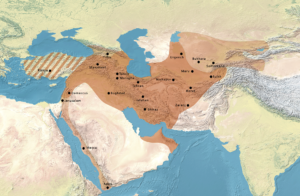
Its location connects the building to a wider story of movement. The north–south caravan route passing Alara Han linked the Seljuk capital, Konya, with the Mediterranean port of Alanya. Ayşıl Tükel’s research also places the han within accommodation routes extending towards Konya and Antalya. Its history therefore reaches beyond its immediate riverside setting.
What is Alara Han caravanserai?
Alara Han is the name of a caravanserai, rather than a person. The Turkish expression “Alara Han kervansarayı” refers to this same Seljuk accommodation building. Its rooms, iwans and galleries formed the architectural setting for a stopping place on historic caravan routes.
The building belongs to the group known as sultan hans because the sultan commissioned it directly. Its construction inscription names Alâeddin Keykubad I and gives the year as Hijri 629, corresponding to 1231–1232. The patron and date are recorded above the entrance itself, in an inscription arranged across six lines.
Alara Han’s place in this group does not mean its layout follows the arrangement of many other sultan hans. Here, open-courtyard and enclosed-shelter functions are interwoven around a single centre. That relationship between spaces is one of the main features to keep in mind when examining the building.
Who built Alara Han, and why here?
The construction of Alara Han in 1231–1232 was commissioned by Alâeddin Keykubad I.
Tükel’s route study treats the han as part of a caravan accommodation network serving the Antalya and Konya roads. This interpretation gives its location a practical meaning. The building stood within a system of journeys between inland centres and the coast, including the route connecting Konya with Alanya.
Another theory links its unusual plan to the sultan’s own journeys. According to this interpretation, Alara Han was designed as a resting place for Alâeddin Keykubad I and his entourage during travel to Alanya. This remains a proposed explanation for its arrangement. Tükel’s work instead emphasises its place in the caravan network.
Timeline
- 1231–1232: Alara Han was built on the sultan’s commission, according to its inscription.
- 1966–1967: Ayşıl Tükel’s research recorded the building through measurements and photography across three seasons.
Alara Han castle: are Alara and Alara Kalesi the same site?
Alara Han and Alara Kalesi, or Alara Castle, are separate buildings. Turkish Wikipedia describes the caravanserai as standing on level ground approximately 800 metres from the castle. The distinction matters when you identify the site: the han is the accommodation building beside the Alara River.
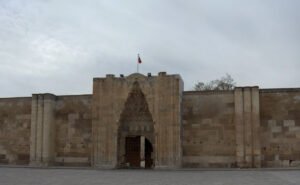
The caravanserai does have features that can explain the association with a castle. Its main entrance sits between two rectangular towers. Battlements run around the roofline and extend across the buttresses. These features belong to Alara Han itself, even though Alara Castle is a separate nearby structure.
When reading about “Alara Han castle,” keep the two names attached to their respective buildings. The six-line construction inscription, central accommodation spaces and lion-headed lamp supports described here all belong to the caravanserai.
How is Alara Han arranged inside?
The Antalya Provincial Directorate of Culture and Tourism gives Alara Han’s area as approximately 2,000 square metres. Tükel’s measurements record a northern side of 37.80 metres and a western side of 49.90 metres. These figures establish the scale of the building behind its compact exterior arrangement.
At the centre, rooms and iwans alternate around a narrow corridor. An iwan is the architectural form also identified at the fountain near the entrance. The repeated relationship between rooms, iwans and passage space is central to understanding how the accommodation section was organised.
Unlike many sultan hans, Alara Han brings open-courtyard and covered-shelter functions together around one centre. As you study its plan, follow the relationship between these spaces. The unusual arrangement is also the feature that prompted the theory of accommodation designed for the sultan and his entourage.
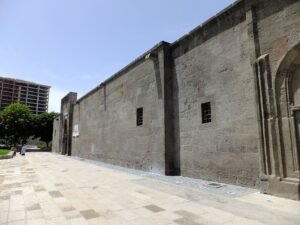
The main building material is dressed stone. Parts facing the hillside also use rubble stone. This difference is worth looking for alongside the plan: Alara Han’s construction includes both carefully cut blocks and sections made with less regular stone.
Alara Han photos: which architectural details matter?
The main entrance is on the northeastern façade. A low arch marks the doorway between the rectangular towers. Above it sits the construction inscription in six lines. A photograph showing the whole entrance can therefore bring together the building’s architectural framing and its written record of patronage.
Inside the entrance courtyard, the fountain iwan lies to the east. Its covering is a star vault. On the western side, the first room adjoining the courtyard wing is a prayer room covered by a pointed barrel vault. These are different spaces with different vault forms, both close to the entrance.
For exterior photographs, look at the roofline as well as the doorway. Battlements continue around the building and over its buttresses. For closer views, the stone surfaces offer another subject: some dressed blocks retain masons’ marks, while surviving plaster carries red zigzag decoration.
Alara Han also has a substantial photographic record from Tükel’s research. The building was documented with 178 photographic negatives during spring and summer 1966 and winter 1967. Those images belong to the same study that recorded its measurements.
Details you won’t find in guidebooks
The lion heads in the galleries had a practical role. These carved stone brackets supported lighting lamps. Their function offers an everyday-life connection: providing light was part of making the accommodation spaces usable. The animal forms were therefore attached to a specific task within the building.
Some details sit directly on the building’s surfaces. Masons’ marks survive on certain dressed stones, and red zigzags remain on patches of plaster. Together, they draw attention to both stoneworking and painted decoration. Alara Han’s surviving fabric includes more than the large forms of towers, arches and vaults.
A stone stair with seven steps leads from the fountain iwan to the eastern tower and the roof. This is a precise connection between the entrance courtyard’s fountain space and the upper parts of the building. It adds another layer to the arrangement visible in the main accommodation plan.
Tükel’s documentation also recorded alluvial deposits inside parts of the han. During the 1966–1967 survey, these reached a height of 1.5 metres in some interior areas. That observation belongs alongside the measurements and photographs when considering the condition recorded by the study.
Alara Han nerede and Alara Han yol tarifi: locating the building
For the Turkish search “Alara Han nerede,” the address given by the Culture Portal is Çakallar Mahallesi, Alanya, Antalya. The han stands around Okurcalar, beside the Alara River. These place names identify the caravanserai’s setting within Antalya’s Alanya district.
If you use coordinates to locate historical sites, the English Wikipedia list of Seljuk caravanserais gives approximately 36.6923° north, 31.7238° east for Alara Han. Match that location with the Çakallar Mahallesi address and the riverside setting. Remember that the caravanserai and nearby Alara Castle are separate destinations.
FAQ
Where is Alara Han?
Alara Han stands beside the Alara River in Çakallar Mahallesi, around Okurcalar, in the Alanya district of Antalya.
Who built Alara Han, and when?
Its inscription identifies Sultan Alâeddin Keykubad I as its patron and dates construction to Hijri 629, corresponding to 1231–1232.
Are Alara Han and Alara Castle the same building?
They are separate structures. Alara Han is a caravanserai on level ground approximately 800 metres from Alara Castle.
What should you look for in Alara Han photos?
Look for the entrance between rectangular towers, the six-line inscription, the fountain iwan’s star vault and the lion-headed stone supports used for lamps.
Sources
- Kültür Portalı — Alara Han kulturportali.gov.tr
- TDV İslâm Ansiklopedisi — Alara Hanı islamansiklopedisi.org.tr
- Belleten — Documentation and Comparative Study of Alara Han belleten.gov.tr
- Antalya İl Kültür ve Turizm Müdürlüğü — Diğer Tarihi Yerler antalya.ktb.gov.tr
- Vikipedi — Alara Han tr.wikipedia.org
- Wikipedia — List of Seljuk caravanserais in Turkey en.wikipedia.org