What are caravanserai?
A caravanserai was a roadside building for travelers, animals and goods. In Turkish it is a kervansaray or a han. According to the TDV Islamic Encyclopedia, it was an endowed (waqf) building. It stood on the main roads between cities and existed to keep caravans safe and give them a place to stay.
Think of a highway rest stop. Today you pull off for fuel, food and a short sleep. A caravan did the same, only the “fuel” was fodder and the “car” was a string of loaded animals. The difference is that a Seljuk founder often paid the bills.
Caravanserai meaning and pronunciation
The English word comes from Persian. It joins kārvān, “caravan,” with sarāy, which means a palace or a building around a courtyard. So the name literally describes a courtyard house for caravans.
One English pronunciation is given as /ˌkærəˈvænsəraɪ/. Say it as KA-ruh-VAN-suh-rye. The stress falls on the third syllable, “VAN.” You will hear the same word said many ways, and this is a standard one.
Caravanserai in Turkey: the Seljuk network
Turkey has a large group of Seljuk caravanserais along its old trade roads. Turkey sent the ones on the Denizli–Doğubayazıt route to UNESCO on 25 February 2000, for the World Heritage Tentative List. The nomination text counts about 40 hans on that route. About 10 of them are very well preserved.
That gives you a practical idea of what survives. Only a quarter of the hans on that route are described as very well preserved, so expect the others to be in poorer condition. A smaller number still stand with their gates, courtyards and vaults.
Seljuk caravanserais are usually sorted into three types:
- open-courtyard buildings
- closed (covered) buildings
- mixed types, where an open courtyard joins a covered section
Every 40 kilometers? What the sources say
The popular line is that Seljuk caravanserais stood every 40 kilometers. Turkish Wikipedia gives this figure and links it to nine hours of camel walking.
Other sources give a softer number:
- UNESCO’s Silk Roads program says caravanserais stood on average 30–40 kilometers apart in well-served regions. It does not present 40 kilometers as an exact rule for everywhere.
- Turkey’s UNESCO nomination for the Seljuk caravanserais describes an average day’s stage as about 30 kilometers. That is a normal six-hour journey.
So treat “every 40 kilometers” as a rounded figure for a day’s travel. The real spacing depended on the region and the terrain. A traveler could plan on one stop per day, and that was the point.
Three free days: how the system worked
The money side is the most surprising part. In endowed caravanserais built by Seljuk sultans and statesmen, travelers counted as the founder’s guests for three days. They were not charged.
Think of a hotel where the first three nights come free, paid for by a long-term endowment. That is close to how the service was meant to work.
The services went beyond a bed. According to the TDV Islamic Encyclopedia, a Seljuk caravanserai could provide:
- fodder for pack animals
- a farrier
- veterinary care
- cart repair
So a caravan could arrive with a lame animal or a broken wheel and leave with both fixed.
Five caravanserais you can look up
Sultan Han, Aksaray
This 13th-century caravanserai stands in the settlement of Sultanhanı on the Konya road. It was built in 1229 by order of Alâeddin Keykubad I. A fire later damaged it, and it was repaired and enlarged in 1278.
In the courtyard you find roofed bays set aside for carts. A small mosque stands in the middle, and the travelers’ rooms are around it. The layout shows who used the place: people, carts and prayer, all in one yard.
Sultanhanı, Kayseri
This one sits in the village of the same name on the Kayseri–Sivas road. The Culture Portal dates it to 1232–1236, in the reign of Alâeddin Keykubad I.
The numbers help you picture it. The covered section measures 32 × 45 meters. The open-courtyard section measures 46 × 53 meters. West of the courtyard there is a bath of four units. Three are domed, and one is covered with a pointed-arch vault.
The courtyard also has a small mosque on a platform. It rests on four piers and four arches.
Karatay Hanı
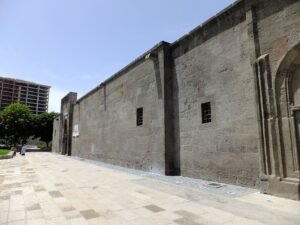
Karatay Hanı is in Karadayı village, in Kayseri’s Bünyan district. Celâleddin Karatay founded it. According to the inscription on its courtyard, it was finished in 1240–1241.
Obruk Hanı
Obruk Hanı is in Konya’s Karatay district, on the route that links Konya to Aksaray. It has an open courtyard and a covered section.
The entrance block has two floors. You climb a staircase from the courtyard to the upper rooms. The room at the far right is a mosque with a stone prayer niche.
Akhan, Denizli
Seyfeddin Karasungur bin Abdullah had Akhan built. Its covered section was finished in 1253 and its courtyard in 1254.
Timeline
- 1229: Aksaray Sultan Han is built on the order of Alâeddin Keykubad I.
- 1232–1236: Kayseri Sultanhanı is built, according to the Culture Portal.
- 1240–1241: The courtyard of Karatay Hanı is completed.
- 1253–1254: The covered section of Denizli Akhan is finished, then its courtyard.
- 1278: Aksaray Sultan Han is repaired and enlarged after a fire.
- 25 February 2000: Seljuk caravanserais on the Denizli–Doğubayazıt route go onto UNESCO’s Tentative List.
Details you won’t find in guidebooks
- Free shoes. Among the services of Seljuk caravanserais was free footwear for poor travelers.
- More than an inn. These buildings also housed armies on campaign and hosted foreign rulers. When needed, they could turn into a prison or a shelter.
- Dragons on the arches. At Kayseri Sultanhanı, the east and south arches under the small mosque carry relief dragons. They face each other, with scaly bodies and sharp teeth.
- Lion-head spouts. On the courtyard walls of the same building, near roof level, rainwater drains are carved as lion heads.
- Eighteen towers. The walls of Karatay Hanı are braced by 18 support towers. Six of them are at the corners.
How to use this when you travel
Aksaray and Kayseri Sultanhanıs are both on routes between big central Anatolian cities, so they fit into a road trip. Check the exact names before you set your map. Two buildings share the name “Sultan Han,” and they are in different provinces.
Look for the same features at each stop: the gate, the courtyard, the small mosque, the covered hall. Once you know what to look for, each han reads like a plan of one day on the road.
FAQ
What does caravanserai mean?
The word comes from Persian. It joins kārvān, meaning caravan, with sarāy, meaning palace or a building around a courtyard. In Turkish the building is called a kervansaray or han.
How do you pronounce caravanserai?
One English pronunciation is shown as /ˌkærəˈvænsəraɪ/. Say it as KA-ruh-VAN-suh-rye, with the main stress on the third syllable.
Were Seljuk caravanserais really 40 kilometers apart?
Only roughly. Turkish Wikipedia gives 40 kilometers, the distance of nine hours by camel. UNESCO’s Silk Roads program says 30–40 kilometers in well-served regions. Turkey’s UNESCO nomination gives about 30 kilometers, or six hours of normal travel, as an average day’s stage.
Was staying in a Seljuk caravanserai free?
In caravanserais founded as endowments by Seljuk sultans and statesmen, travelers counted as the founder’s guests for three days and paid nothing.
Which Seljuk caravanserais can you visit in Turkey?
Good starting points are Sultan Han near Aksaray, Sultanhanı near Kayseri, Karatay Hanı in Kayseri’s Bünyan district, Obruk Hanı near Konya and Akhan in Denizli.
Sources
- TDV İslâm Ansiklopedisi — Kervansaray islamansiklopedisi.org.tr
- TDV İslâm Ansiklopedisi — Karatay Hanı islamansiklopedisi.org.tr
- Wikipedia — Caravanserai en.wikipedia.org
- Vikipedi — Kervansaray tr.wikipedia.org
- UNESCO — About the Silk Roads unesco.org
- UNESCO World Heritage Centre — Seljuk Caravanserais whc.unesco.org
- Wikipedia — Sultan Han en.wikipedia.org
- Aksaray University e-Şehir Encyclopedia — Sultanhanı restoration e-sehir.aksaray.edu.tr
- Kültür Portalı — Sultanhanı Kervansarayı, Kayseri kulturportali.gov.tr
- Konya Provincial Directorate of Culture and Tourism — Karatay konya.ktb.gov.tr
- Denizli Provincial Directorate of Culture and Tourism — Historical Silk Road denizli.ktb.gov.tr
Image: Turkey.Aksaray014.jpg — Georges Jansoone (JoJan), CC BY 3.0