What was the Golden Horde? A short definition
The Golden Horde was a Turkic-Mongol state. It grew out of the inheritance of Jochi, a son of Genghis Khan, and expanded through the conquests of Batu Khan.
The label “Mongol” tells only half the story. Turkish historian İlyas Kemaloğlu calls it a Turkic-Islamic state. His reasons are the Kipchak and Volga Bulgar population and the official Islamization under Uzbek Khan. The ruling dynasty, in contrast, descended from Genghis Khan.
So you can read it two ways. It was a Genghisid dynasty ruling a largely Turkic society.
Golden Horde map: where was it?
Picture a belt of grassland. The core lay in the Deshti Kipchak steppe. It stretched from a centre in the lower Volga to the Kama basin, north of the Black Sea and to the banks of the Irtysh.
Two cities matter most on that map:
- Bolgar. UNESCO describes it as the first capital of the Golden Horde in the 13th century. It lies south of the point where the Volga and Kama meet.
- Sarai. The state’s main political centre grew in the lower Volga region, on trade routes.
The exact site of Sarai is still debated. An older view identifies Selitrennoye as Old Sarai. Newer archaeological and numismatic studies call it New Sarai. They suggest Tsarevskoye was probably Gulistan. If you visit the region, expect labels to differ from book to book.
Golden Horde flag: what do we really know?
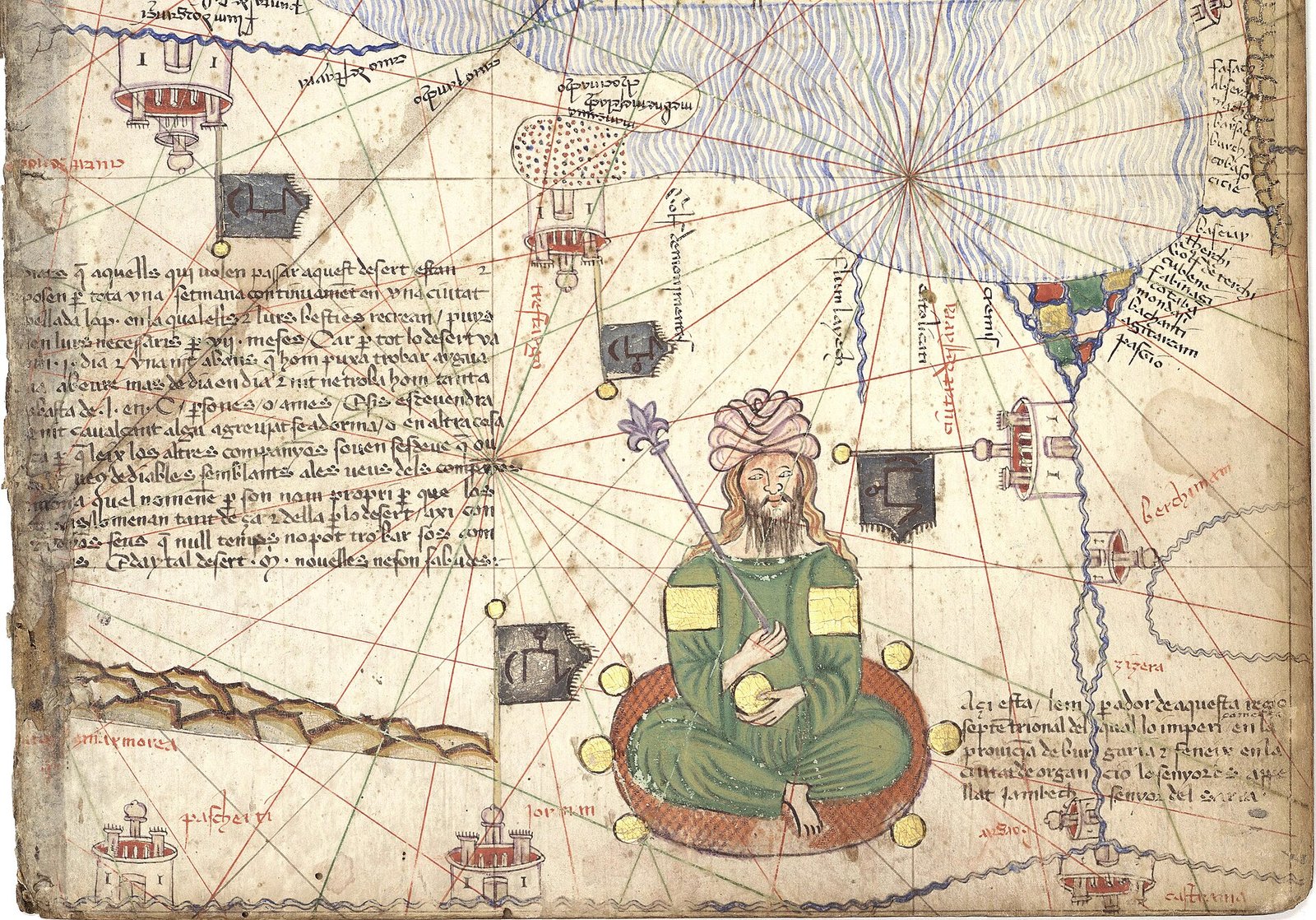
The red stamp and crescent on a white field that people attach to the Golden Horde is a modern redrawing. Wikimedia Commons presents it as a recreation of a flag on Angelino Dulcert’s 1339 map.
So treat any flag image as an interpretation of one map, not a surviving banner.
Why “Golden”? Three explanations
Historians do not agree. One theory points to Batu’s golden tent. Others stress the khan’s wealth, or say gold signalled imperial status.
There is a twist. English Wikipedia places the earliest known use of the name “Golden Horde” in the Kazan History of 1565. That was written after the state had ended.
When did it begin?
The start date depends on your yardstick. English Wikipedia dates the beginning of Jochi’s ulus to about 1225. The TDV Encyclopedia of Islam dates the founding of the khanate to 1241.
Neither is wrong. They measure different things: a family territory versus an established khanate.
Timeline
- About 1225: one of the dates given for the start of Jochi’s ulus.
- 1237–1241: Batu Khan’s campaigns spread across the Rus principalities.
- December 1240: Kiev is captured.
- 1241: the date the TDV Encyclopedia of Islam gives for the founding of the khanate.
- 1313: Uzbek Khan takes the throne; Islam becomes the state religion.
- 1360–1380: fierce struggles for the throne.
- 1380: Mamai is defeated at Kulikovo.
- 1382: Tokhtamysh sacks Moscow and restores Horde supremacy.
- 1395: Timur’s campaign destroys Sarai.
- Afterwards: the Horde breaks into separate khanates.
- 1471: the year a 2022 study gives for Moscow cutting off tribute completely.
- 1480: the Ugra standoff, the traditional end of Mongol rule.
- 1502: the Crimean Khanate removes the Horde’s last central remnant.
How the tribute system worked
Batu’s western campaigns ran from 1237 to 1241. They reached the Rus principalities, and Kiev fell in December 1240. After that, the khans built a system rather than just raiding.
In the 13th century, tribute from the Rus principalities was collected under the watch of Mongol officials called baskaks. Think of them as on-site supervisors.
The khans also issued charters called yarliks. These confirmed the rule of Rus princes. They also confirmed the grand prince of Vladimir, the senior figure among them. A prince ruled because the khan’s paper said so.
Kemaloğlu lists further ties. The khans ordered censuses in Rus lands. Rus troops joined the khans’ campaigns. Princes handed over their children as hostages.
Here is the everyday link. When you fill in a census form or receive a tax notice, you meet a small version of the same idea. A ruler counts people so he can collect from them. The Horde did this centuries ago, only with hostages attached.
Tribute was not the only income. The Horde’s revenue came from taxes on its own people, on dependent Rus principalities and on foreign merchants.
Golden Horde religion
Berke Khan was Muslim in the 13th century. Making Islam the state religion is tied to Uzbek Khan, who took the throne in 1313.
That is why historians like Kemaloğlu stress the Islamic character of the state. A shift in the official faith, plus a Kipchak and Volga Bulgar population, shaped how they classify it.
Who were the “members” of the Horde?
The state had layers:
- the Genghisid ruling house;
- the Kipchak and Volga Bulgar population;
- dependent Rus principalities that paid tribute;
- foreign merchants who paid taxes.
The Rus princes were not simply “inside” the state. They were bound to it by tribute, charters, hostages and military service.
Details you won’t find in guidebooks
- The Church paid nothing. The Rus Church was exempt from the Horde’s tribute.
- Bolgar minted first. According to the nomination file submitted to UNESCO, Bolgar was the first Golden Horde city to strike coins, in the 1240s–1250s.
- Bolgar had paved streets. The ICOMOS evaluation says paved roads, water facilities, bathhouses and drainage systems were built there in the Golden Horde period.
- Fourteen khans in twenty years. Between 1360 and 1380, according to the TDV Encyclopedia, fourteen khans held the throne during the succession struggles.
- The name came late. “Golden Horde” is first recorded in a text from 1565, after the state was gone.
Moscow’s rise inside the system
The tribute system also made winners. In the 14th century, Moscow’s princes rose by gradually taking over the collection of tribute destined for the Horde. Collecting for the khan became the road to power.
Did Kulikovo end the Horde’s rule?
No. In 1380 Moscow’s Prince Dmitri defeated Mamai at Kulikovo. Yet this did not end the bond. In 1382 Tokhtamysh sacked Moscow and restored Horde supremacy.
The Horde’s real decline came from several directions. Cambridge’s account blames plague, civil wars, Timur’s attacks and division into separate khanates. In 1395 Timur’s campaign destroyed Sarai, one of the heavy blows that sped the break-up.
Why “240 years” is only approximate
The headline number runs from the Kiev conquest in 1240 to the traditional end date of 1480. That is about 240 years.
But three cautions apply:
- The payers. Cambridge’s chapter treats Rus principalities, not modern Russia.
- Continuity. A 2022 study argues Moscow paid with long gaps in the 1440s–1460s. It says Moscow stopped completely in 1471.
- The end date. In 1480 the army of Ahmed, khan of the Great Horde, met the forces of Ivan III at the Ugra River. Cambridge says this marked the practical end of Mongol rule over Rus lands. Historian Charles J. Halperin argues that its importance as an end point was established only in the mid-16th century.
So “240 years of unbroken tribute” is a slogan, not a measurement.
How the Golden Horde finally ended
As the state broke up, the Kazan, Crimean, Astrakhan, Nogai and Sibir khanates emerged.
The final stroke did not come from Moscow. The 1502 blow that removed the remaining central state came from the Crimean Khanate.
FAQ
Did Russia pay tribute to the Golden Horde for exactly 240 years?
No. The number is a rough span from the fall of Kiev in 1240 to the traditional end date of 1480. A 2022 academic study says Moscow paid only with long gaps in the 1440s–1460s and stopped completely in 1471. Also, the payers were Rus principalities, not modern Russia.
Where was the Golden Horde?
Its core was the Deshti Kipchak steppe. That reached from the lower Volga across the Kama basin, north of the Black Sea and to the banks of the Irtysh. Its main political centre, Sarai, grew on trade routes in the lower Volga region.
What religion did the Golden Horde follow?
Berke Khan was already Muslim in the 13th century. Islam became the state religion under Uzbek Khan, who took the throne in 1313.
Who ended the Golden Horde?
Not Moscow. The blow of 1502 that removed its remaining central state came from the Crimean Khanate. By then Kazan, Crimea, Astrakhan, Nogai and Sibir had already split off.
Sources
- TDV İslâm Ansiklopedisi — Altın Orda Hanlığı islamansiklopedisi.org.tr
- İlyas Kemaloğlu — The Golden Horde in Soviet Historiography tdbb.org.tr
- Wikipedia — Golden Horde en.wikipedia.org
- Wikipedia — Sarai (city) en.wikipedia.org
- Türkçe Vikipedi — Altın Orda Devleti tr.wikipedia.org
- UNESCO — Bolgar Historical and Archaeological Complex whc.unesco.org
- UNESCO — Bolgar nomination file whc.unesco.org
- ICOMOS — Bolgar evaluation report whc.unesco.org
- Wikimedia Commons — Golden Horde flag 1339 commons.wikimedia.org
- Cambridge History of the Mongol Empire — The Rus′ Principalities cambridge.org
- University of Washington — Mongol Foundations of the Russian State jsis.washington.edu
- Herald of the Russian Academy of Sciences — The Agony of the “Yoke” link.springer.com
- Charles J. Halperin — The Place of Rus’ in the Golden Horde biblioteca-digitala.ro
Image: Golden Horde in the Catalan Atlas (1375).jpg — Cresques Abraham, Public domain