Who was Alp Arslan?
Alp Arslan was the second sultan of the Great Seljuk State. He came to the throne after Tuğrul Bey. Today he is remembered above all as the commander who won the Battle of Manzikert, known in Turkish as Malazgirt.
He was the son of Çağrı Bey, the ruler of Khorasan, and the nephew of Sultan Tuğrul Bey. Turkish Wikipedia lists Khwarazm as his birthplace.
If you arrived here after watching a drama about him, this article covers the real sultan, the sources and the dates historians use.
What does the name Alp Arslan mean?
The name has two parts. Alp means warrior or hero. Arslan means lion. Together they read as “hero lion”.
His Muslim name was Muhammad. Arab historians treat Alp Arslan as a Turkish nickname, not a birth name.
Think of a nickname you earned from friends or family. It often sticks harder than the name on your ID card. Alp Arslan’s nickname did the same: history remembers him by it.
Alp Arslan’s history: from prince to sultan
Early years and the Ghaznavid campaign
The year of his birth is disputed. Many sources give 1029. A 2024 study by Bilal Koç and Tunahan Şahin compares the sources and finds 1030 more reliable.
His military career began young. In 1043-1044 he commanded Seljuk forces against the Ghaznavids.
Melik of Khorasan
Çağrı Bey died in August 1059. After that, Alp Arslan became the melik, or prince-governor, of Khorasan.
From his Khorasan years on, he handed civil administration to his vizier Nizâmülmülk. That left the sultan free to focus on the army.
The fight for the throne
Tuğrul Bey died in 1063. His vizier Kündürî first proclaimed Alp Arslan’s brother Süleyman as sultan.
Alp Arslan did not accept that. In November-December 1063 he defeated the army of Kutalmış, his main rival for the Seljuk throne.
On 27 April 1064 the Abbasid caliph Kāim-Biemrillâh formally confirmed his sultanate.
How did Alp Arslan win Ani?
His army took the Byzantine-held city of Ani on 16 August 1064.
Afterward, Caliph Kāim gave him the title Ebü’l-feth. It means “father of conquests”.
In July 1066 he named his son Melikşah as heir. He also ordered that Melikşah’s name be read in the Friday sermons, the hutbe.
Why is Alp Arslan called the hero of Manzikert?
On Friday, 26 August 1071, Alp Arslan defeated the Byzantine army on the Plain of Manzikert (Malazgirt). The Byzantine emperor Romanos IV Diogenes was taken prisoner by Alp Arslan’s forces.
The victory opened the way for Turkish raids and settlement across Anatolia. That is why the date still matters in Turkey today.
After the battle, Alp Arslan and Romanos signed a peace treaty. The text of that treaty has not survived.
What was the campaign really about?
Historians do not agree on the aim of the 1070-1071 campaign. Some argue it targeted the Fatimid rulers of Egypt. Ali Sevim argues that Alp Arslan’s final goal was the conquest of Anatolia.
How did Alp Arslan die?
He did not die at Manzikert. His death came later, on another campaign.
In autumn 1072 he set out against the Karakhanid ruler Şemsülmülk Nasr, in the region of Transoxiana (Mâverâünnehir). According to the story told by the TDV Islamic Encyclopedia, the commander of Barzem Fortress, Yûsuf Hârizmî, was brought before the sultan. He had hidden a dagger in his boot and badly wounded Alp Arslan.
TDV records that he died four days later, on 24 November 1072.
Sources do not fully agree on the date. The chronicles that Iranica relays place his death in November-December 1072. Historian Claude Cahen argues for January 1073.
He was buried in Merv, in today’s Turkmenistan. His son Melikşah took the Seljuk throne.
Timeline
- 1029 or 1030: Alp Arslan is born. Sources disagree on the year.
- 1043-1044: He commands forces against the Ghaznavids.
- 1059: After Çağrı Bey’s death, he becomes melik of Khorasan.
- 1063: He defeats Kutalmış and gains the upper hand in the struggle for the sultanate.
- 27 April 1064: The Abbasid caliph confirms his sultanate.
- 16 August 1064: Ani is conquered.
- July 1066: Melikşah is named heir.
- 26 August 1071: He wins the Battle of Manzikert and Romanos IV Diogenes is captured.
- Autumn 1072: He sets out on the Transoxiana campaign against the Karakhanids.
- 24 November 1072: According to TDV, he dies of the dagger wound. Cahen proposes January 1073.
- 2026: Archaeological research on the Manzikert battlefield enters its seventh working season.
Details you won’t find in guidebooks
- A visit to his ancestor’s grave. On his eastern campaign of 1065, Alp Arslan visited the tomb of his ancestor Selçuk Bey at Jend, on the bank of the Syr Darya.
- He never entered Baghdad. Despite his dealings with the Abbasid caliph, Alp Arslan never went to Baghdad in person.
- Almost no documents survive. According to Iranica, nearly all primary documents from his reign are lost. What we know comes mostly from later Arab chronicles.
- The treaty text is gone. The peace treaty he signed with Romanos Diogenes after Manzikert has not come down to us.
- The battlefield is still being searched. An archaeological project to pinpoint the Manzikert battlefield began in 2020. In summer 2026 it entered its seventh working season, according to Muş Alparslan University.
What can you take away from his story?
Three things stand out.
First, he won his throne by force of arms. He beat Kutalmış in 1063, and the caliph confirmed him in 1064.
Second, he shared the work of ruling. Nizâmülmülk ran civil affairs, and the sultan commanded the army.
Third, his greatest victory came in 1071, and he was dead just over a year later. He died on campaign, not in battle with an emperor. His son Melikşah was already named heir and took the throne.
If you travel to the Malazgirt area, you will be standing near a plain that researchers are still studying. The search for the exact battlefield continues.
FAQ
Who was Alp Arslan?
Alp Arslan was the second sultan of the Great Seljuk State, after Tuğrul Bey. He won the Battle of Manzikert (Malazgirt) on 26 August 1071 and captured the Byzantine emperor Romanos IV Diogenes.
What does the name Alp Arslan mean?
Alp means warrior or hero, and arslan means lion. His Muslim name was Muhammad, and Arab historians treat Alp Arslan as a Turkish nickname.
How did Alp Arslan die?
Yûsuf Hârizmî, the commander of the fortress of Barzem, was brought before him and stabbed him with a dagger hidden in his boot. The TDV Islamic Encyclopedia says Alp Arslan died four days later, on 24 November 1072. Historian Claude Cahen proposes January 1073 instead.
Who ruled after Alp Arslan?
His son Melikşah took the Seljuk throne. Alp Arslan had named him heir in July 1066.
Where is Alp Arslan buried?
He was buried in Merv, which lies inside today’s Turkmenistan.
Sources
- TDV İslâm Ansiklopedisi — ALPARSLAN islamansiklopedisi.org.tr
- Encyclopaedia Iranica — ALP ARSLĀN iranicaonline.org
- English Wikipedia — Alp Arslan en.wikipedia.org
- Turkish Wikipedia — Alp Arslan tr.wikipedia.org
- Routledge — Dictionary of World Biography: The Middle Ages, Alp Arslan entry api.pageplace.de
- Ortaçağ Araştırmaları Dergisi — Alp Arslan’ın Şehzadelik Dönemi ve Doğum Tarihi Meselesi dergipark.org.tr
- Muş Alparslan Üniversitesi — Malazgirt Savaş Alanı Araştırmalarında Yedinci Yıl Başladı alparslan.edu.tr
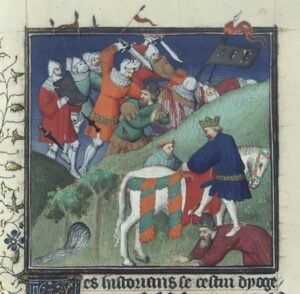
Image: Sultan Alp Arslan miniature.(Resîdü‟d-dîn, Cami‟ü‟t-Tevârih, TSMK, Hazine, nr. 1654, vr. 202).jpg — 1654 artist, Public domain