Sigiriya, Sri Lanka: where is the Lion Rock?
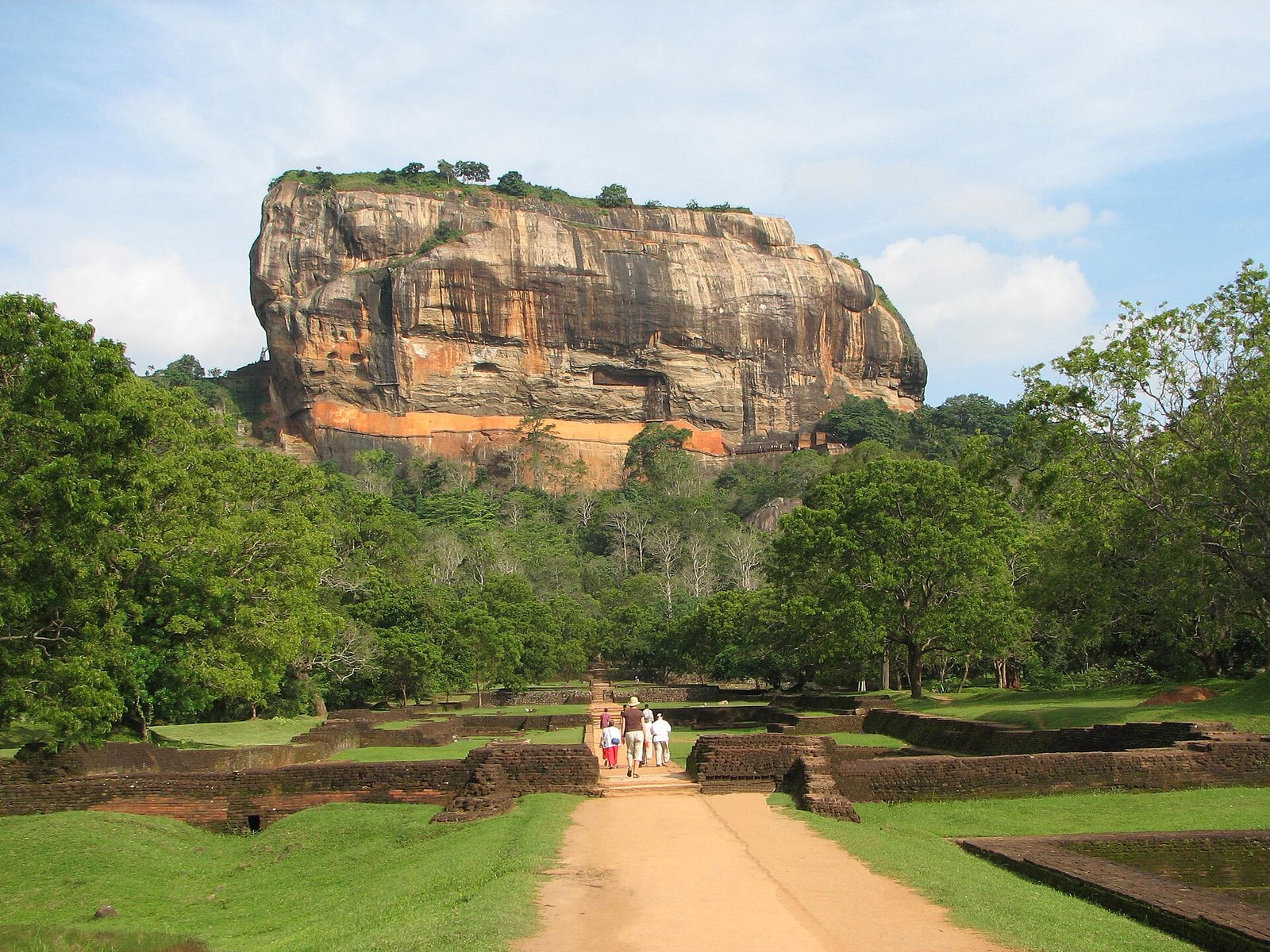
Sigiriya is an ancient rock fortress in the Matale district of Sri Lanka’s Central Province. It stands near Dambulla. NASA describes it as a granite inselberg. That means a single rock that rises alone from lower ground around it.
UNESCO says the granite rises about 180 metres above its surroundings. Seen from the plain, it looks like a stone tower dropped into a flat landscape. A king once chose this spot for his capital. That choice is the heart of the story.
Why is it called the Lion Rock?
The name Sinhagiri means ‘Lion Rock’. It is tied to the giant lion-shaped entrance that once stood on the rock. UNESCO describes the old route to the summit as galleries and staircases. They started from the mouth of a huge lion made of brick and plaster.
Most of that lion is gone. Two big paws remain, each about three metres long. If you stand beside them, you can judge how large the whole figure must have been. Visitors once walked through the animal to reach the top.
The Sigiriya rock fortress: what was built here
Sigiriya is not one building. It is a complex with three zones:
- an upper palace on the summit of the rock;
- a middle level with the Lion Gate and the Mirror Wall;
- palaces, moats and gardens at the foot of the rock.
The summit plateau covers about 1.6 hectares. The ruins there include water cisterns cut into the rock. Think of a rooftop with its own water tank. The builders solved the same problem, only in stone, about fifteen centuries ago.
Before the king: monks on the rock
The site was not empty before the palace. Brahmi inscriptions on the west side of Sigiriya show that Buddhist monks lived at the foot of the rock in the 2nd and 1st centuries BCE.
Excavations point the same way. They have found building phases from the 3rd–2nd centuries BCE up to the 12th–13th centuries CE. Sigiriya had a long life before and after its famous king.
Kashyapa’s story: a throne taken, a capital moved
The main written source is the Culavamsa chronicle. It says Kashyapa seized the throne in 477 by having his father, King Dhatusena, killed. His half-brother Moggallana fled to South India.
Kashyapa I then ruled from 477 to 495. In that time he moved his capital from Anuradhapura to Sigiriya. Another source says the Buddhist monks living at Sigiriya during his palace building were moved to Pidurangala. That hill lies about one kilometre north of Sigiriya.
This account comes from a chronicle, so treat it as the traditional version of events.
The gardens of Sigiriya
The palace sat inside a planned landscape. The gardens come in three main forms:
- water gardens;
- gardens that use large boulders;
- terraced gardens.
Moats and palaces surrounded the base of the rock.
The Mirror Wall
The Mirror Wall is on the middle level. Its surface is lime plaster, polished until it shone like a mirror.
The wall later became a notebook. Visitors scratched poems and thoughts into it. Some of these date to the 8th century. It is like names carved into a park bench, except that these ones survive after more than a thousand years. They show people were climbing Sigiriya as visitors long after Kashyapa’s death.
The women in the paintings
Two rock hollows hold the famous Sigiriya paintings. A 1999 record from the Claremont Colleges Digital Library documents 17 female figures in the first hollow and 5 in the second.
Who are these women? One reading is that they are heavenly nymphs called apsaras. Other readings say they are queens, the king’s consorts or goddesses. The question is still debated.
Another debated point is style. Some scholars suggest the paintings were influenced by the 5th-century Ajanta murals in India. That is a proposal, not a settled fact.
How the story ended
In 495, according to the chronicle, Moggallana defeated Kashyapa. Kashyapa ended his own life during the defeat.
Moggallana took the throne and moved the capital back to Anuradhapura. He gave the palace at Sigiriya to Buddhist monks as a monastery. The royal capital lasted only 18 years, from 477 to 495. The rock became a religious site again.
Damage and restoration
The paintings faced a modern threat. On 14 October 1967, paint was thrown on the frescoes and damaged them. A restoration that included Luciano Maranzi continued until 11 April 1968.
One fragile surface needed about six months of repair. Keep this in mind when you see the paintings today. They are old, and they have already been damaged once.
UNESCO listing
In 1982 the Ancient City of Sigiriya joined the UNESCO World Heritage List. It was listed under cultural criteria ii, iii and iv.
Timeline
- 3rd–2nd centuries BCE: early building phases revealed by excavations.
- 2nd–1st centuries BCE: Buddhist monks are documented by Brahmi inscriptions.
- 477: Kashyapa seizes the throne, according to the Culavamsa.
- 477–495: Kashyapa reigns and develops Sigiriya as the royal capital.
- 495: Moggallana wins and Kashyapa dies. The capital returns to Anuradhapura.
- 8th century: one of the periods when visitors wrote poems on the Mirror Wall.
- 12th–13th centuries: late building phases seen in excavations.
- 14 October 1967: paint is thrown on the frescoes.
- 11 April 1968: restoration work after the vandalism ends.
- 1982: UNESCO lists the Ancient City of Sigiriya.
Details you won’t find in guidebooks
- Some fountains still work. An underground water system about 1,500 years old feeds some of the fountains. They still run in the rainy season.
- A flower in her hand. One woman in the Claremont record holds a Plumeria flower in her right hand. In her left she holds three lotus flowers.
- The walls were rebuilt many times. Wall extensions and inner partitions in the rock shelters show at least five or six rebuilding phases. Like an old house that people kept altering, the site changed hands and uses across the centuries.
- The graffiti are old. Poems on the Mirror Wall include examples from the 8th century.
FAQ
Where is Sigiriya?
Sigiriya is in the Matale district of Sri Lanka’s Central Province, near Dambulla.
How high is the Sigiriya rock?
UNESCO says the granite rock rises about 180 metres above its surroundings. The summit plateau covers roughly 1.6 hectares.
Why is Sigiriya called the Lion Rock?
The name Sinhagiri means ‘Lion Rock’. It refers to the giant lion-shaped entrance on the rock. Two large paws, each about three metres long, survive from it.
When did Sigiriya become a World Heritage Site?
UNESCO listed the Ancient City of Sigiriya in 1982, under cultural criteria ii, iii and iv.
Sources
- Wikipedia — Sigiriya en.wikipedia.org
- Vikipedi — Sigiriya tr.wikipedia.org
- UNESCO — Ancient City of Sigiriya whc.unesco.org
- NASA Earth Observatory — Sri Lanka’s Granite Fortress science.nasa.gov
- Central Cultural Fund — Sigiriya Rock Fortress ccf.gov.lk
- Peradeniya University — Mahinda Somathilake, Buddhist affiliation at Sigiriya ir.lib.pdn.ac.lk
- Claremont Colleges Digital Library — Sigiriya paintings on rock depression: Cave 1 ccdl.claremont.edu
Image: Sigiriya.jpg — Bernard Gagnon, CC BY-SA 3.0