The Kingdom of Aksum rose in the highlands of the Horn of Africa. It ran a Red Sea trade network, minted its own gold coins and became a Christian state in the 4th century. Its stone obelisks still stand in the town of Aksum. This guide covers where the kingdom was, who ruled it, what people believed and what you can still see.
Where was the Kingdom of Aksum located?
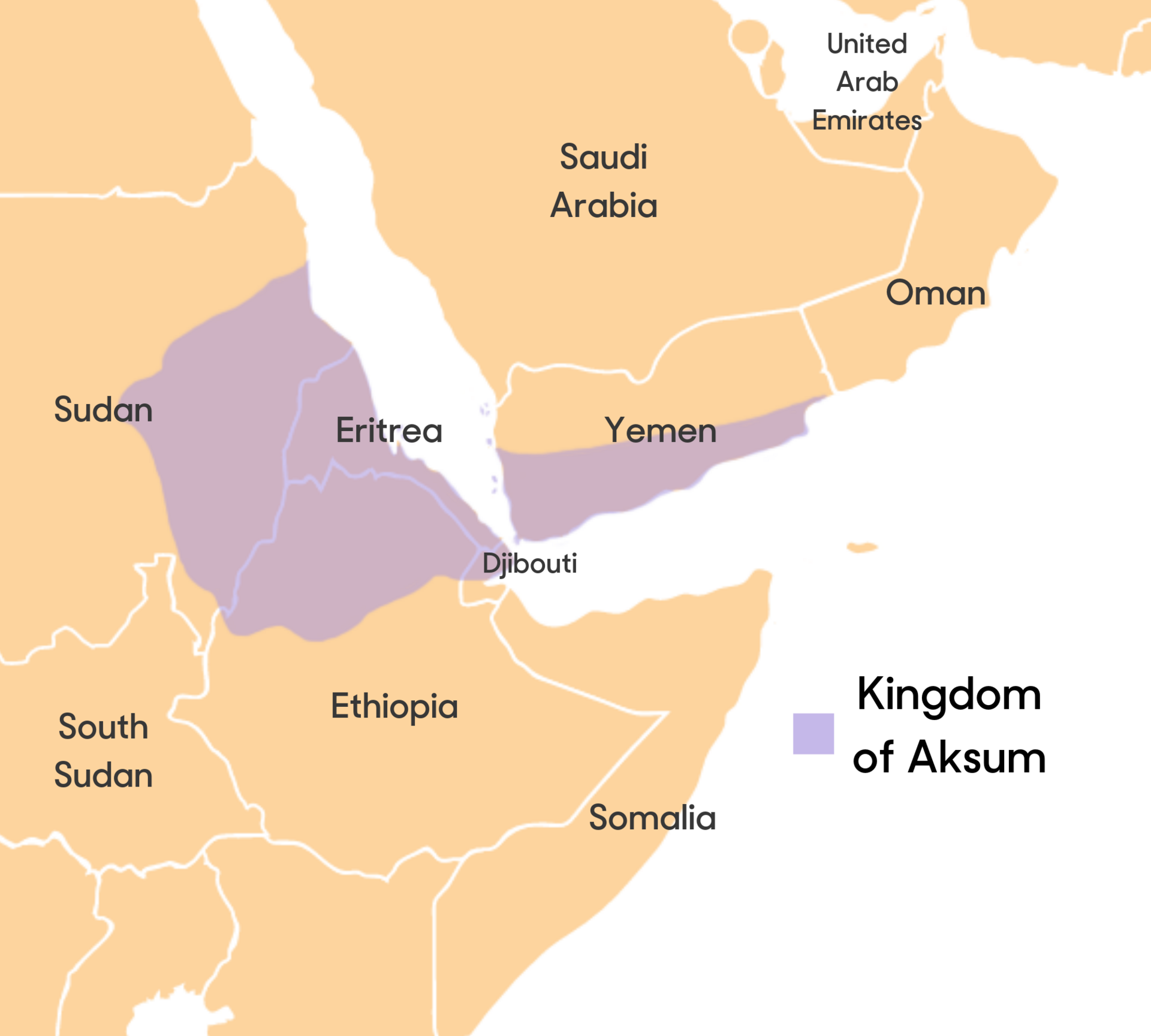
The core of the kingdom lay in the high country of today’s northern Ethiopia and Eritrea. At its strongest, its authority stretched across the Red Sea to southern Arabia.
The capital shared the kingdom’s name. Aksum is a town in Ethiopia’s Tigray region. If you search for a map, look for that region first. Then follow the Eritrean coast to the port of Adulis, which tied the highlands to the sea.
The answer to “where was the Kingdom of Aksum located in Africa” is therefore simple. It sat in the northeast, between the highland interior and the Red Sea.
Kingdom of Aksum history
UNESCO places the main development of Aksumite civilization between the 1st and 8th centuries AD. That is a span of about eight hundred years.
Trade drove the rise. Aksum reached the Red Sea through Adulis, a port on the coast of present-day Eritrea. It also controlled the trade in ivory that came from Sudan.
Coinage shows how confident the state was. The British Museum says Aksum was the only state in sub-Saharan Africa of its time to strike its own coins. That went on from the late 3rd century AD until the first quarter of the 7th century.
The kingdom later reached into Arabia. In AD 525 King Kaleb attacked Yusuf As’ar Yath’ar, the Himyarite ruler of Yemen. He is also known as Dhu Nuwas. The attack followed the persecution of Christians in Najran.
The story did not end neatly. A commander named Abraha took part in Aksum’s Yemen campaigns in the 6th century. He then overthrew Sumyafa Ashwa, the man Kaleb had appointed, and seized the Himyarite throne.
Aksum’s political decline became clear in the 10th century. Even so, Ethiopian emperors kept being crowned in the town.
Kingdom of Aksum government
Aksum was a monarchy. Turkish Wikipedia classifies it as a state headed by a negus, the ruler’s title.
Society had layers. The king and the nobles formed the upper class. Farmers, craftspeople and enslaved people took part in economic production.
Think of a modern state that prints its own banknotes. Aksum did something similar. The kings put their names and symbols on gold and copper coins. Check the symbols on a coin in your pocket and you are doing what a traveler in the Red Sea markets did.
Kingdom of Aksum people
The sources describe the Aksumites through their work and their rulers. Farmers, craftspeople and enslaved people took part in production. Craftspeople made goods and worked glass. Through the port of Adulis, the kingdom was tied to Red Sea trade.
The broken-glass detail below shows how skilled the workers were. At the top stood the king and the nobles, with the negus above them all.
Kingdom of Aksum religion
Before Christianity, the Aksumites held polytheistic beliefs. A priestly class served a state religion that was practised in temples and sacred places.
That system changed in the 4th century. The next section explains how.
Kingdom of Aksum Christianity
The turn came under King Ezana. The British Museum dates his conversion to about AD 340. The French Ministry of Culture gives about AD 330. It points to missionaries from Syria, and above all Frumentius, as a major influence.
The change shows up on coins. After Ezana’s conversion, the cross replaced the crescent and disc symbols that earlier coins had carried.
Scholars still argue about how the change spread. In a 2025 study in the journal Aethiopica, Aaron Michael Butts challenges the idea that Christianity was imposed from the court downward. He argues it spread from the bottom up. He also argues that Ezana presented the faith differently to different audiences, for political reasons.
This is a live debate. Whatever the mechanism, the result was lasting. Aksum’s Ge’ez language later became the church language of the Ethiopian Orthodox Church.
Kingdom of Aksum language
Aksum’s native language was Ge’ez. It belongs to the Semitic family. Later it became the liturgical language of the Ethiopian Orthodox Church.
The kingdom’s inscriptions were multilingual. Among Ezana’s 4th-century texts are trilingual examples in Greek, Sabaean and Ge’ez. Greek was a language of the wider Mediterranean world. Sabaean belonged to southern Arabia. One stone could therefore speak to several audiences.
Kingdom of Aksum flag
No flag design from Aksum is documented. What survives are symbols on coins. Early coins show the crescent and disc. After Ezana’s conversion, the cross took their place.
So if you want an image of Aksum’s identity, look at its coins, not a banner. Museums hold many. The Fitzwilliam Museum at Cambridge keeps a gold coin of King Endubis, dated to about AD 270–290. It weighs 2.66 grams and carries the number CM.2-2000.
Kingdom of Aksum architecture
Aksum is best known for its stelae, the tall carved stones that people also call obelisks. The main monumental stelae date to the 3rd and 4th centuries AD. They are linked to the royal cemetery.
The numbers are large:
- The tallest ancient stele still standing is more than 23 metres high.
- Its carved surface represents a building of nine storeys.
- The fallen Great Stele is given by UNESCO as about 33 metres long.
The Great Stele is a puzzle. UNESCO says it may have fallen while it was being raised. A 2015 review by the Metropolitan Museum of Art reports another reading. In that view it was deliberately toppled in the late 6th century.
If you visit, remember that you are looking at tomb markers. They stand in a royal burial area, not in a city square.
Details you won’t find in guidebooks
- The doors are fake. False doors and windows were carved into the stelae. Real palaces did not rise beyond two storeys. The stone monuments exaggerated the height of buildings.
- Recycled glass. Aksumite craftspeople reworked broken imported glass, or raw glass, into inlays. These went into mosaic panels in the Tomb of the Brick Arches.
- Gold leaf on copper. On some copper coins, crowns and other symbols were picked out in gold leaf.
- A coin found far away. The Ezana gold coin numbered 1915,0108.81 in the British Museum was found 300 kilometres north of Aden. It is 17 millimetres across and weighs 1.45 grams.
- A stele that came home. An Aksum stele was taken to Rome as war booty during the Italian occupation. Ethiopia got it back in 2005. It was raised again in Aksum in 2008.
Timeline
- 1st century AD: UNESCO’s dating places the start of Aksum’s main development period here.
- About AD 270–290: The period of King Endubis’s gold coin, now in the Fitzwilliam Museum.
- 3rd–4th centuries AD: The monumental stelae of the royal cemetery are made.
- 4th century AD: Christianity is adopted under Ezana, and the cross appears on coins.
- AD 525: Kaleb moves against the Himyarite kingdom in Yemen.
- 6th century AD: Abraha overthrows Aksum’s appointee and takes the Himyarite throne.
- 10th century AD: Aksum’s political decline becomes clear.
- 1980: Aksum is added to the UNESCO World Heritage List.
- 2005: The stele taken to Rome is returned to Ethiopia.
- 2008: The returned stele is raised again in Aksum.
Why Aksum still matters
Aksum was a trading power, a coin-minting state and an early Christian kingdom. It linked the African highlands to the Red Sea and to Arabia. UNESCO lists the archaeological site as World Heritage, and you can still walk among the stelae today.
The long afterlife is part of the story. Ethiopian emperors kept being crowned in the town after the political decline. The stele returned from Rome shows that the monuments still carry meaning for Ethiopia.
FAQ
Where was the Kingdom of Aksum located?
Its core lay in the highlands of today’s northern Ethiopia and Eritrea. The capital, also called Aksum, is a town in Ethiopia’s Tigray region. At its height the kingdom’s power reached southern Arabia.
When did Aksum become Christian?
It happened in the 4th century under King Ezana. The British Museum dates his conversion to about AD 340. The French Ministry of Culture gives about AD 330 and names the Syrian missionary Frumentius as a key influence.
What language did the Aksumites speak?
Their native language was Ge’ez, a Semitic language. It later became the liturgical language of the Ethiopian Orthodox Church. Some of Ezana’s inscriptions are written in Greek, Sabaean and Ge’ez.
How tall are the Aksum obelisks?
The tallest ancient stele still standing is more than 23 metres high. The fallen Great Stele is given by UNESCO as about 33 metres long.
Is Aksum a UNESCO World Heritage Site?
Yes. The Aksum archaeological site was added to the UNESCO World Heritage List in 1980.
Sources
- UNESCO World Heritage Centre — Aksum whc.unesco.org
- The Metropolitan Museum of Art — Monumental Architecture of the Aksumite Empire metmuseum.org
- French Ministry of Culture — The kingdom of Aksum archeologie.culture.gouv.fr
- French Ministry of Culture — Le règne d’Ezänâ archeologie.culture.gouv.fr
- British Museum — Aksumite britishmuseum.org
- British Museum — Ezanas britishmuseum.org
- British Museum — Gold coin of Ezanas, 1915,0108.81 britishmuseum.org
- British Museum / Smarthistory — Aksumite coins smarthistory.org
- Fitzwilliam Museum, University of Cambridge — Endubis gold unit data.fitzmuseum.cam.ac.uk
- OpenStax, Rice University — The Kingdoms of Aksum and Himyar openstax.org
- Aethiopica, Universität Hamburg — Ezana of Aksum: The First Christian African King journals.sub.uni-hamburg.de
- Wikipedia — Kingdom of Aksum en.wikipedia.org
- Wikipedia — Abraha en.wikipedia.org
- Vikipedi — Aksum Krallığı tr.wikipedia.org
Image: Kingdom of Aksum Map.png — Newslea Staff, CC BY-SA 4.0