What is the Lydian Hoard?
The Lydian Hoard is a group of artifacts taken illegally from burial mounds near Uşak, in western Türkiye, in the 1960s. Turkish sources call it the Karun Treasure, a name that links it to Croesus. Some call it the Croesus Treasure in English for the same reason.
The objects are older than most people expect. The Sardis Expedition publishes an assessment by archaeologist İlknur Özgen. She dates the hoard to the second half of the 6th century BC and describes the pieces as items used by local elites.
It is not only jewelry. The collection also includes a pair of marble sphinxes, tomb paintings, and gold and silver vessels. So when you read “treasure,” think of the contents of several rich tombs, not one chest of coins.
Where did the Lydian Hoard come from?
The tombs sit in the Güre area. The Ministry of Culture and Tourism places these Lydian mounds about 25 kilometers west of Uşak, on the road to İzmir.
The Sardis Expedition essay says the finds linked to the hoard came from at least five tumuli:
- Toptepe, in Güre
- İkiztepe, in Güre
- Aktepe I, in Güre
- Basmacı, in Güre
- Harta, near Manisa
A tumulus is a burial mound. Once the objects leave the chamber, the record of what lay where is gone.
How was the Lydian Hoard smuggled?
The Ministry’s chronology dates the looting of Toptepe to 1965. İkiztepe was plundered by illicit digging in 1966. The removal of objects from Aktepe I is placed in 1968.
The objects then moved through a dealer network. The Geneva University ArThemis case study names two people in the chain: Ali Bayırlar of İzmir and John Klejman, an art dealer in New York.
The buyer was the Metropolitan Museum of Art in New York. According to the same case study, the museum bought the collection in three lots between 1966 and 1970.
Here is an everyday comparison. Imagine buying a used car with no papers. All you have is the seller’s story. A museum that buys antiquities without a documented find-spot is in a similar position. The paperwork is what shows where the object came from.
The Lydian Hoard at the Met
In 1984 the Metropolitan Museum put some of the objects on permanent display. The Sardis Expedition essay notes how they were presented. The museum’s publication, Dietrich von Bothmer’s “A Greek and Roman Treasury,” labeled them “East Greek.” It gave no real find-spots. That label was misleading.
The same year, journalist Özgen Acar saw the objects in the museum’s catalog. He reported their Turkish origin to the Ministry of Culture. That report started the long dispute.
If you searched for “Lydian Hoard Met,” this is the answer. The Met held the collection for more than two decades. It bought it between 1966 and 1970, displayed part of it from 1984, and agreed to give it up in 1993.
How Türkiye won the case
The legal fight ran step by step:
- In 1986, Türkiye made a formal request for return. The Met rejected it.
- In 1987, Türkiye sued the museum. The Met argued that the time limit for bringing the case had passed.
- In 1990, the court rejected the Met’s request to dismiss the case on those grounds.
- In 1993, the Met agreed to an out-of-court settlement and the return of the hoard.
The process lasted six years. During the examinations, investigators found a telling match. The sizes of the wall paintings held in New York fit the gaps in the walls of one of the looted tombs.
Smithsonian reports that the Met accepted the deal in September 1993. The 363-piece collection reached Türkiye in October 1993.
Was it really Croesus’s treasure?
The name suggests so, but the claim is debated. The English Wikipedia article does not confirm that the objects belonged directly to King Croesus. Özgen describes the collection as grave goods of local elites. So the safest description is “Lydian-era tomb finds.”
A curse story also circulates. It says that seven people who took part in the illegal digs died or met disaster. English Wikipedia presents this as a legend, not as a proven cause and effect. Treat it as folklore.
The Winged Seahorse Brooch: stolen a second time
The story did not end in 1993. According to Mahmut Aydın’s academic study, the gold Winged Seahorse Brooch was stolen from the Uşak Museum at the end of 2005. A fake was left in its place.
The theft was discovered in 2006. The brooch was then searched for internationally through Interpol.
The object turned up in Hagen, Germany. Investigators had to prove it was the original. They used a portable X-ray fluorescence spectrometer, so no sample was taken from the object.
On 6 March 2013, German authorities handed the Winged Seahorse Brooch over in Berlin. Osman Murat Süslü, Director General of Cultural Heritage and Museums, received it, according to Anadolu Agency.
Where to see the Lydian Hoard today
The returned objects were first shown at the Museum of Anatolian Civilizations in Ankara. They were then sent to the Uşak Museum. The Karun Treasure’s display period at the Uşak Archaeology Museum began in 1996.
In 2018 the museum moved to a new building in the train station area. It has a separate floor for the Karun Treasures.
The Cultural Portal lists the address as Fatih Mahallesi, Orhan Dengiz Bulvarı 29/D, in central Uşak. The Karun Treasures and the Winged Seahorse Brooch are on show there.
A note on numbers: sources count the collection differently. Smithsonian reports 363 pieces for the 1993 return. A 21 May 2022 Anadolu Agency report gives 432 pieces for the museum’s Karun collection. The two figures cover different scopes.
Timeline
- Second half of the 6th century BC: the period of the grave goods, according to İlknur Özgen.
- 1965 Toptepe Tumulus is looted.
- 1966 İkiztepe Tumulus is looted by illicit digging.
- 1966–1970 the Met buys the collection in three lots.
- 1968 objects are taken from Aktepe I, per the Ministry chronology.
- 1984 the Met puts some pieces on permanent display, and Özgen Acar identifies them in the catalog.
- 1986 Türkiye’s formal request for return is rejected.
- 1987 Türkiye sues the Met.
- 1990 the Met’s time-limit motion is rejected.
- September 1993 the Met agrees to a settlement.
- October 1993 the returned objects reach Türkiye.
- 1996 the hoard goes on display at the Uşak Museum.
- End of 2005 the Winged Seahorse Brooch is stolen and replaced with a fake.
- 2006 the theft is discovered and an international search begins.
- 6 March 2013 Germany hands the brooch over in Berlin.
- 2018 the Uşak Museum moves to its new building.
Details you won’t find in guidebooks
- The hoard includes a pair of marble sphinxes, tomb paintings, and gold and silver vessels, not only jewelry.
- The Met’s 1984 publication used the phrase “East Greek” for the objects. It named no real find-spots.
- The Met’s wall paintings matched the measured gaps in the walls of a looted tomb.
- In the 2005 theft, the pendant stones were removed from the original brooch and fitted to the fake left in the museum.
- The brooch found in Germany was checked with a portable X-ray fluorescence spectrometer, without taking a sample.
FAQ
What is the Lydian Hoard?
It is a group of artifacts looted in the 1960s from Lydian burial mounds near Uşak. It is also called the Karun Treasure. Archaeologist İlknur Özgen dates the objects to the second half of the 6th century BC.
Did the Lydian Hoard belong to King Croesus?
That claim is disputed. Özgen describes the collection as grave goods of local elites. The English Wikipedia article does not confirm a direct link to Croesus.
Sources
- Sardis Expedition — Lydian Treasure (İlknur Özgen) sardisexpedition.org
- Ministry of Culture and Tourism — Lydia (Karun) Treasures ktb.gov.tr
- University of Geneva ArThemis — Lydian Hoard plone.unige.ch
- Smithsonian Magazine — Chasing the Lydian Hoard smithsonianmag.com
- Wikipedia — Karun Treasure / Lydian Hoard en.wikipedia.org
- Vikipedi — Karun Hazinesi tr.wikipedia.org
- Anadolu Agency — Karun hazinesinin en değerli parçası iade edildi aa.com.tr
- Directorate General of Cultural Heritage and Museums — Uşak Müze Müdürlüğü kvmgm.ktb.gov.tr
- Kültür Portalı — Uşak Arkeoloji Müzesi kulturportali.gov.tr
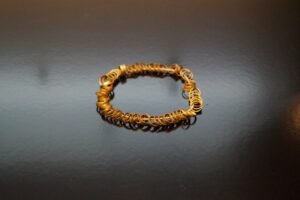
Image: Uşak Museum Karun Treasure gold bracelet 2162.jpg — Dosseman, CC BY-SA 4.0