Canada was founded as a federation on 1 July 1867. Three British colonies united under the name Dominion of Canada. They were the Province of Canada, Nova Scotia and New Brunswick. The Province of Canada split into Ontario and Quebec, giving the new federation four provinces.
If you want to understand how Canada was founded, keep two developments in view. Confederation created the federation in 1867. Independence developed through later constitutional changes, including the Statute of Westminster in 1931 and the constitutional settlement of 1982.
Canadian Confederation meaning: what happened in 1867?
Confederation meant bringing colonies together within a federal system. The 1867 arrangement divided powers between the federal Parliament and provincial legislatures. Union therefore created a shared political structure while retaining a provincial level of lawmaking.
You can connect this to everyday life through the idea of shared responsibilities in a household. Some decisions concern everyone; others belong to separate members. The constitutional fact behind that comparison is the division of powers between Canada’s federal and provincial institutions.
The new Dominion remained under the British monarch. Confederation was not a declaration of independence from Britain. That distinction explains why the story continues beyond the founding date and into the constitutional changes of 1931 and 1982.
Canadian Confederation history: why did the colonies unite?
Political deadlock in the Province of Canada helped strengthen the search for federal union. Trade also mattered. The United States ended the reciprocal trade agreement in 1866, adding another pressure behind the movement toward federation.
Britain had reasons to support the project. Concerns about colonial defence costs and the American threat helped shape London’s position. The proposed union therefore connected political problems within the colonies with British concerns about defence.
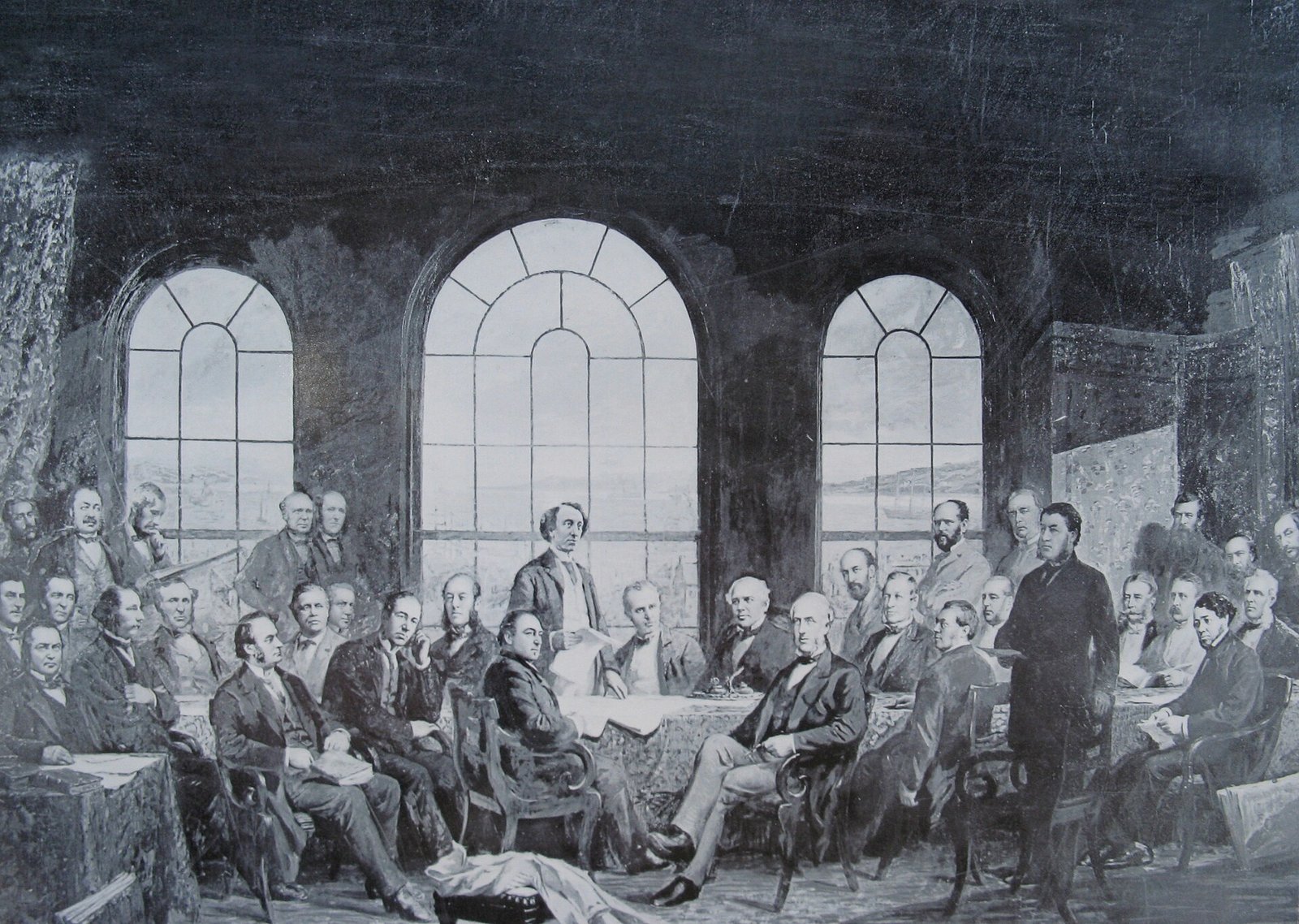
The negotiations began with a narrower proposal. The Charlottetown Conference opened on 1 September 1864 to discuss a union among Prince Edward Island, Nova Scotia and New Brunswick. Representatives from the Province of Canada joined the meeting. Their participation shifted attention toward a broader federation.
How did the conferences become a constitution?
The Charlottetown meetings took place in the Legislative Council chamber of the building now known as Province House. Delegates agreed on the principle of federal union. The conference nevertheless produced neither official minutes nor formal resolutions.
A second conference began in Quebec City on 10 October 1864. It brought together 33 delegates, including representatives from Newfoundland. Its 72 Resolutions supplied the constitutional foundation for the British North America Act.
In December 1866, representatives from the Province of Canada, New Brunswick and Nova Scotia met in London. They turned the resolutions into a bill for the British Parliament. John A. Macdonald, who had attended the Charlottetown discussions, became Canada’s first prime minister in 1867.
Canadian Confederation date: when was Canada founded?
The British North America Act received royal assent on 29 March 1867. It came into force on 1 July 1867. If you encounter both dates, they mark different stages: approval of the legislation and the beginning of the federation.
Federal institutions then began operating under the new arrangement. The House of Commons established in 1867 met for the first time in Ottawa on 6 November that year. Confederation thus involved both a constitutional law and the operation of a new Parliament.
Timeline
- 1 September 1864: The Charlottetown Conference opened, and discussions broadened toward federal union.
- 10 October 1864: The Quebec Conference began; its 72 Resolutions became the constitutional foundation for union.
- December 1866: The London Conference shaped the bill for the British Parliament.
- 29 March 1867: The British North America Act received royal assent.
- 1 July 1867: Ontario, Quebec, Nova Scotia and New Brunswick formed the Dominion of Canada.
- 1870: Manitoba was created; Rupert’s Land and the North-Western Territory joined Canada.
- 1871: British Columbia joined the federation.
- 1 July 1873: Prince Edward Island joined Canada.
- 1905: Alberta and Saskatchewan became provinces.
- 1926: The Balfour Declaration recognized the dominions’ equal status with Britain.
- 11 December 1931: The Statute of Westminster strengthened legislative autonomy.
- 10 September 1939: Canada declared war on Germany following its own parliamentary discussions.
- 1949: Newfoundland joined after two referendums.
- 15 February 1965: The maple leaf national flag was raised in Ottawa.
- 1967: Alex Colville’s coin designs marked Confederation’s centenary.
- 17 April 1982: Constitutional changes introduced amendment procedures within Canada.
Canadian Confederation map: which provinces joined when?
The founding map contained Ontario, Quebec, Nova Scotia and New Brunswick. It expanded in 1870 with the creation of Manitoba and the addition of Rupert’s Land and the North-Western Territory. British Columbia joined as a province in 1871.
Prince Edward Island entered in 1873. Alberta and Saskatchewan were created as provinces in 1905. Newfoundland joined in 1949 after two referendums. When you look at a map of Confederation, its date matters: the four-province federation of 1867 represents one stage in this expansion.
Canadian Confederation and PEI: why did the host join later?
Prince Edward Island hosted the opening conference but did not become a founding province in 1867. It joined on 1 July 1873. Hosting the negotiations and accepting membership were separate steps in the island’s relationship with Confederation.
Railway finances played an important role. The island’s 1871–1875 railway project generated debt of $3.25 million. Ottawa’s agreement to assume that debt helped bring Prince Edward Island into the federation in 1873.
The negotiations also excluded people whose land was involved. The Mi’kmaq, whose traditional territory includes Prince Edward Island, were excluded from the Confederation discussions that began in 1864. Their exclusion belongs alongside the account of conferences and agreements.
How did Canada move toward independence?
The 1926 Balfour Declaration described dominions such as Canada as equal in status to Britain. It stated that they were not subordinate to one another in domestic or external affairs. This marked a different constitutional relationship from the founding arrangement of 1867.
The Statute of Westminster followed on 11 December 1931. Section 2 prevented Canadian parliamentary laws from being declared invalid because they conflicted with British law. It strengthened Canada’s legislative autonomy through a specific legal change.
Canada’s decisions about war show the practical significance of greater autonomy. In 1914, Britain’s declaration of war automatically brought Canada into the conflict. On 10 September 1939, Canada declared war on Germany after its own parliamentary discussions.
Constitutional amendment remained a separate issue. The federal government and the provinces had not agreed on an amendment procedure. Section 7 of the Statute of Westminster therefore excluded amendments to the British North America Acts from its provisions.
The Constitution Act, 1982 took effect on 17 April 1982. It added the Charter of Rights and Freedoms and procedures for amending the Constitution within Canada. Section 2 of the Canada Act 1982 also barred subsequent British parliamentary laws from becoming part of Canadian law.
Canadian Confederation flag: was the maple leaf flag used in 1867?
The Union Jack was used in Canada before and after Confederation. The present red-and-white maple leaf national flag was ceremonially raised in Ottawa on 15 February 1965. Its introduction therefore belongs to a later chapter than the founding of the Dominion.
Canadian Confederation coin: what did the centennial series show?
Alex Colville designed the 1967 coin series for Confederation’s centenary. The animals were a dove on the one-cent coin, a rabbit on five cents, a mackerel on ten cents, a lynx on twenty-five cents, a wolf on fifty cents and a Canada goose on one dollar.
Details you won’t find in guidebooks
A circus affected accommodation at Charlottetown in September 1864. It was the first circus to visit in more than twenty years, and lodging filled up. Most delegates from the Province of Canada stayed aboard the SS Queen Victoria.
Charlottetown’s agreement on federal union left no official minutes or formal resolutions. The detailed constitutional foundation came from the Quebec Conference’s 72 Resolutions. The absence of a formal Charlottetown record distinguishes the opening agreement from the later drafting work.
The 1931 settlement also contained a consequential exception. Legislative autonomy advanced, but amendment of the British North America Acts remained outside the statute’s scope. Disagreement over a Canadian amendment procedure explains why 1982 remains a separate constitutional milestone.
FAQ
When was Canadian Confederation?
Canadian Confederation took effect on 1 July 1867. The British North America Act had received royal assent on 29 March 1867.
What were Canada’s first four provinces?
Ontario, Quebec, Nova Scotia and New Brunswick formed the federation in 1867. The former Province of Canada was divided into Ontario and Quebec.
Was Canada independent in 1867?
Confederation did not declare independence from Britain. The Dominion remained under the British monarch, while later constitutional changes in 1931 and 1982 strengthened Canadian autonomy.
Why did Prince Edward Island join later?
Prince Edward Island joined on 1 July 1873. Debt of $3.25 million associated with its railway project, and Ottawa’s agreement to assume that debt, played an important role.
Sources
- Wikipedia — Canadian Confederation en.wikipedia.org
- UK Parliament — British North America Act 1867 parliament.uk
- Legislative Assembly of British Columbia — The British North America Act, 1867 leg.bc.ca
- Government of Prince Edward Island — Confederation princeedwardisland.ca
- Parks Canada — Charlottetown and Québec Conferences of 1864 canada.ca
- House of Commons of Canada — Parliamentary Institutions: Introduction ourcommons.ca
- Government of Canada — Provinces and territories canada.ca
- Parks Canada — Construction of the Prince Edward Island Railway parks.canada.ca
- Government of Canada — The Statute of Westminster, 1931 canada.ca
- Department of Justice Canada — Statute of Westminster, 1931 canada.justice.gc.ca
- Canadian War Museum — Canada Goes to War warmuseum.ca
- Canadian Heritage — The history of the National Flag of Canada canada.ca
- Department of Justice Canada — The Constitution Acts 1867 to 1982 laws-lois.justice.gc.ca
Image: Fathers of Confederation by Robert Harris.jpg — Jcart1534 (original artist: Robert Harris, original photogra, Public domain