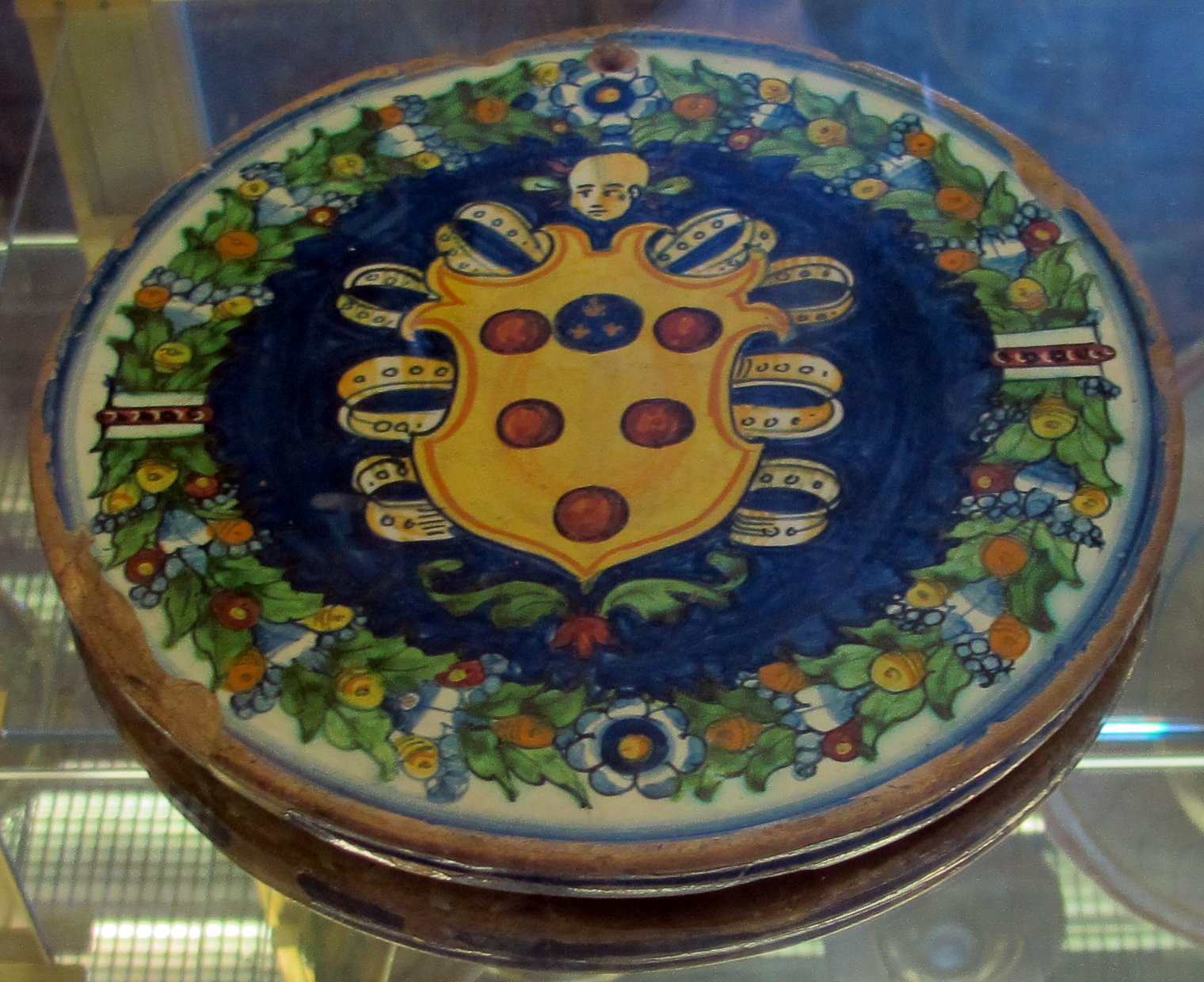
The House of Medici in short
The Medici were not born into the nobility. The family came from the Mugello region, north of Florence, with no noble status at the start. Within a few generations they ran a bank, governed a city, placed popes on the throne of Saint Peter and sent two queens to France.
Their money came from two sources: the wool trade and banking. Everything else, from palaces to paintings, was paid for by those two businesses. This article follows the money, the power and the art in order.
How the Medici Bank began
The story starts with Giovanni di Bicci de’ Medici. He worked in Rome for the banker Veri di Cambio. In 1397 he went back to Florence and founded his own banking company.
The bank did not stay small. In 1420 it took over the banking management of the Apostolic Camera, the financial office of the papacy. It held that role for 22 years.
The structure was unusual. The Medici Bank was not one company. It was a group of companies, and their partnership contracts were renewed about every three years. If you have ever signed a fixed-term contract that has to be renewed, you know the logic: each branch had to prove it was still worth keeping.
Cosimo the Elder takes Florence
Money led to politics. In 1433 Cosimo the Elder was sent into exile. A year later he came back and took over the real government of the city. He held no crown. He held influence.
Leadership of the family in Florence then passed in order: from Cosimo to his son Piero, and then to his grandson, Lorenzo the Magnificent. If you are building a Medici family tree, that three-generation line is the trunk.
Cosimo also spent money on buildings. He supported the architect Michelozzo, who designed the Palazzo Medici. Construction began in 1444. This is the answer to “where is the House of Medici” for most visitors: a family palace in the middle of Florence.
Lorenzo the Magnificent and the Pazzi conspiracy
Lorenzo de’ Medici led Florence after Piero. His rule met a violent test in 1478. In the Pazzi conspiracy, Lorenzo was wounded but survived. His brother Giuliano was killed.
That Giuliano should not be confused with a later Giuliano de’ Medici, the brother of Pope Leo X. The family reused names often. When you read about the Medici, always check which Giuliano, Cosimo or Lorenzo is meant.
The fall of 1494 and the end of the bank
The Medici did not rule smoothly. Piero de’ Medici made concessions to King Charles VIII of France. In November 1494 he lost his support in Florence and fled the city.
The same year, the bank’s commercial partnerships were wound up. Its large loans to rulers had always carried the risk of not being repaid. The bank was finished, but the family was not.
Popes, queens and dukes
The Medici returned and climbed higher. Three Florentine Medici became pope:
- Leo X, 1513–1521
- Clement VII, 1523–1534
- Leo XI, in 1605
The family’s documented religious tradition was Catholic, and it gave the Roman Catholic Church these popes.
Pope Pius IV came from a different family, the Medici of Milan. Family managers of the time accepted him as a relative, but historians have found no proof of a real blood link. Treat that claim with care.
Two Medici women became queens of France. Catherine de’ Medici was queen from 1547 to 1559. Marie de’ Medici was queen from 1600 to 1610.
Back in Tuscany, the family finally received a hereditary title. Alessandro de’ Medici became Duke of Florence in 1532. In 1537 his relative Lorenzino killed him, and Cosimo I took over the government. In 1569, under Cosimo I, the Grand Duchy of Tuscany was created. Medici rulers governed it until 1737.
Timeline
- 1397 Giovanni di Bicci founds his own bank in Florence.
- 1420 The Medici Bank takes over banking management for the Apostolic Camera.
- 1433 Cosimo the Elder is sent into exile.
- 1434 Cosimo returns and establishes his real power.
- 1444 Construction of the Palazzo Medici, designed by Michelozzo, begins.
- 1478 In the Pazzi conspiracy, Giuliano is killed and Lorenzo survives wounded.
- 1494 The Medici are removed from Florence and the bank’s partnerships are wound up.
- 1513 Giovanni de’ Medici becomes Pope Leo X. Leonardo moves to Rome.
- 1521 Leo X commissions the New Sacristy from Michelangelo.
- 1523 Giulio de’ Medici becomes Pope Clement VII.
- 1532 Alessandro de’ Medici becomes Duke of Florence.
- 1537 Alessandro is killed and Cosimo I takes over.
- 1569 The Grand Duchy of Tuscany is founded.
- 1610 Galileo names Jupiter’s moons for the Medici and dedicates the Sidereus Nuncius to Cosimo II.
- 1688 Bartolomeo Cristofori begins work at Ferdinando de’ Medici’s court.
- 1700 Cristofori’s early piano is recorded in the Medici instrument inventory.
- 1737 Gian Gastone dies and Medici rule ends. Anna Maria Luisa secures the collections with the Family Pact.
- 1743 Anna Maria Luisa dies and the grand-ducal branch ends.
What the Medici paid for
The Medici did not only collect art. They paid for work that still defines Florence and Rome.
In 1521 Pope Leo X commissioned the New Sacristy at San Lorenzo from Michelangelo. The work continued under Clement VII. In 1513 Leonardo da Vinci moved to Rome at the invitation of Giuliano de’ Medici, Leo X’s brother, and in December he received a workspace in the Vatican Belvedere.
Science got the same treatment. In 1610 Galileo named the Jupiter moons he had discovered the Medici Planets, after the family. His Sidereus Nuncius, published in Venice on 12 March 1610, was dedicated to Grand Duke Cosimo II de’ Medici.
Music belongs on the list too. In 1688 Ferdinando de’ Medici took Bartolomeo Cristofori into his court. Cristofori developed an early piano. If you have a piano or keyboard at home, its ancestor sat in a Medici household: the 1700 inventory of Medici instruments records it.
Details you won’t find in guidebooks
- Renewed about every three years. The Medici Bank was a network, not a single firm. Its partnership contracts were renewed roughly every three years.
- A Medici portrait, a different patron. Botticelli’s Adoration of the Magi (1470–1475) contains Medici portraits. Yet the person who commissioned it was a businessman named Gaspare del Lama, not the Medici.
- Names in the sky. Galileo’s “Medici Planets” were the moons of Jupiter. He chose the name to honor the family.
- A piano in the inventory. Cristofori’s early piano appears in the 1700 inventory of Medici instruments, twelve years after Ferdinando took him into service.
- A pope from Milan. The Milanese Medici who produced Pius IV were counted as relatives by the family’s managers, but no evidence of descent has been found.
Where to see the Medici today
If you travel to Tuscany, start in Florence. The Palazzo Medici is the family’s own house. At San Lorenzo you can see the setting of Michelangelo’s New Sacristy.
Beyond the city, UNESCO lists the Medici Villas and Gardens in Tuscany. The site consists of 12 villas and two gardens created between the 15th and 17th centuries.
The Uffizi Galleries also carry the Medici story. The reason is Anna Maria Luisa de’ Medici. Her Family Pact of 1737 kept the Medici collections protected, on condition that they never leave Florence and the grand-ducal lands. That is why so many of these works are still in the city.
The end of the line and the Medici today
The family’s rule over Tuscany ended in 1737, when Gian Gastone, the last Medici grand duke, died. Anna Maria Luisa, the last representative of the grand-ducal branch, died in Florence on 18 February 1743.
That is not quite the end of the name. The Ottajano and Tornaquinci di Castellina branches are recorded as continuing lines. So the answer to “does the House of Medici exist today” is nuanced: the ruling dynasty is gone, while side branches are on record.
Further reading
A 2020 Cambridge University Press book, Piero di Lorenzo de’ Medici and the Crisis of Renaissance Italy, covers the family’s Mugello roots and Giovanni di Bicci’s rise in banking. Its chapter “Family Backgrounds” is a good starting point if you want a scholarly view of how the family began.
FAQ
Where is the House of Medici?
The family’s base was Florence. You can still see the Palazzo Medici, designed by Michelozzo and begun in 1444, and the Medici chapel complex at San Lorenzo, where Michelangelo worked on the New Sacristy. UNESCO also protects 12 Medici villas and two gardens across Tuscany.
Who was Lorenzo the Magnificent?
Lorenzo de’ Medici led the family in Florence after his grandfather Cosimo the Elder and his father Piero. He survived the Pazzi conspiracy of 1478, in which his brother Giuliano was killed.
Does the House of Medici still exist today?
The ruling line ended. Gian Gastone, the last Medici grand duke, died in 1737, and Anna Maria Luisa, the last of the grand-ducal branch, died on 18 February 1743. The Ottajano and Tornaquinci di Castellina side branches are recorded as continuing.
How did the Medici family tree produce popes and queens?
Florentine Medici became Pope Leo X (1513–1521), Clement VII (1523–1534) and Leo XI (1605). Catherine de’ Medici was queen of France from 1547 to 1559, and Marie de’ Medici from 1600 to 1610.
What happened to the Medici Bank?
The bank ran the papal finances from 1420 for 22 years. Large loans to rulers carried the risk of never being repaid, and its commercial partnerships were wound up in 1494.
Sources
- Cambridge University Press — Family Backgrounds cambridge.org
- National Gallery — Medici family nationalgallery.org.uk
- Oxford Academic — Medici Bank academic.oup.com
- Wikipedia — House of Medici en.wikipedia.org
- Vikipedi — Medici Hanedanı tr.wikipedia.org
- The Metropolitan Museum of Art — Florence and Central Italy, 1400–1600 A.D 82nd-and-fifth.metmuseum.org
- Musei del Bargello — Michelangelo: the Bloom of Renaissance Art bargellomusei.it
- Uffizi Galleries — Adoration of the Magi uffizi.it
- Museo Galileo — Cronologia di Leonardo da Vinci brunelleschi.imss.fi.it
- Museo Galileo — Vita museogalileo.it
- The Metropolitan Museum of Art — The Pianofortes of Bartolomeo Cristofori metmuseum.org
- UNESCO World Heritage Centre — Medici Villas and Gardens in Tuscany whc.unesco.org
- MUS.E Firenze — Anna Maria Luisa de’ Medici e il Patto di famiglia musefirenze.it
- Uffizi Galleries — About us uffizi.it
Image: Area fiorentina, targa murale di proprietà con stemma medici, 1525-1550 ca..JPG — sailko, CC BY-SA 3.0