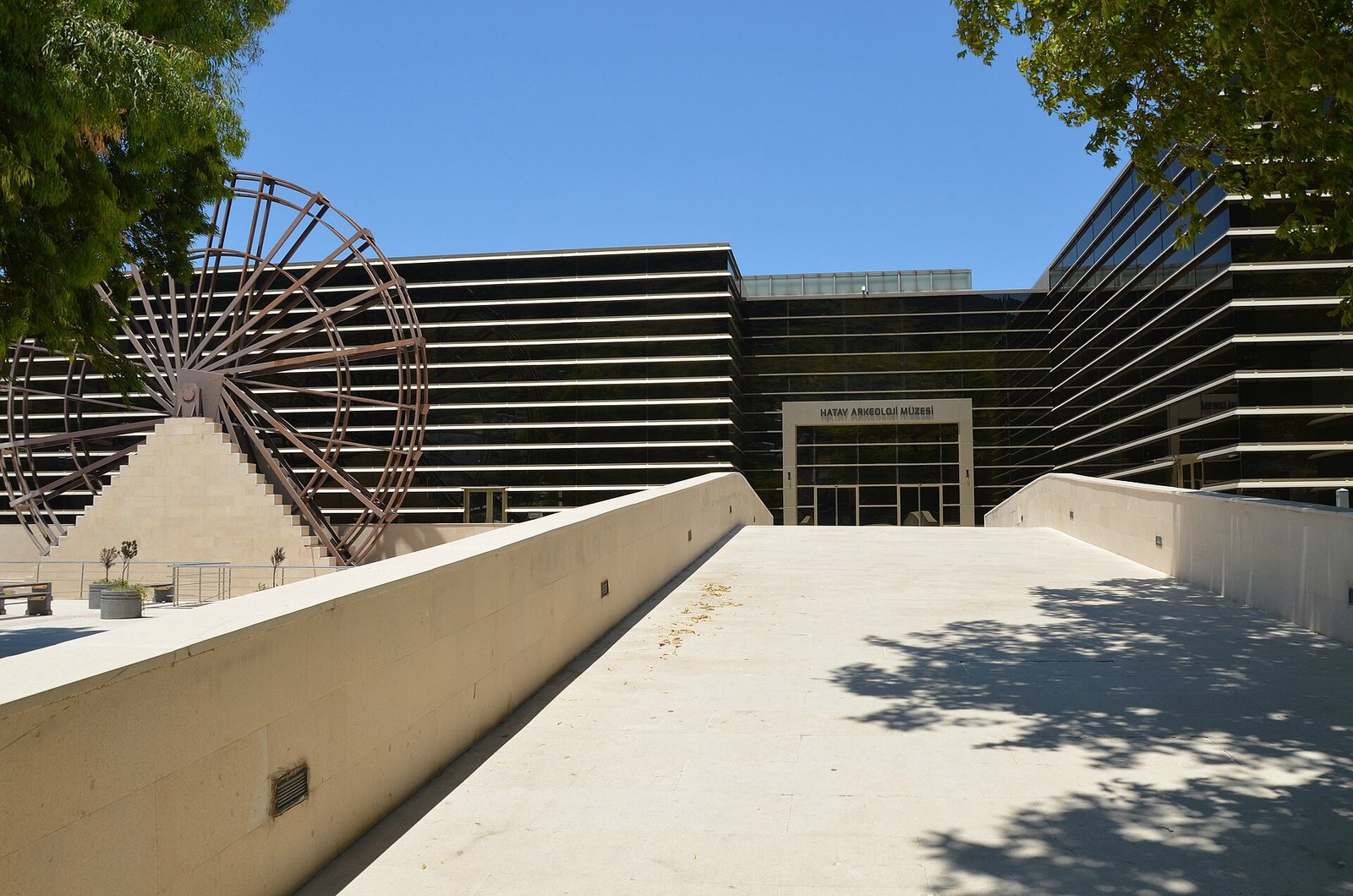
Hatay Archaeology Museum: one of the world’s great mosaic collections
Hatay Archaeology Museum in Antakya brings together Roman and Eastern Roman mosaics on an exceptional scale. The Ministry of Culture and Tourism reports 3,250 square metres of mosaics on display. Yet the collection reaches far beyond decorated surfaces. Sculpture, inscriptions and other objects extend its scope from the Paleolithic to the Ottoman period.
The museum’s Turkish name is Hatay Arkeoloji Müzesi. Its present building stands in Maşuklu, in Antakya district. As of 25 October 2026, ministry records listed it as closed for maintenance and repairs. You can still explore sections of the collection through the ministry’s virtual tour, including Daphne Houses and Mosaic Road.
What makes the Hatay Archaeology Museum mosaic collection important?
Princeton University’s excavations in Antakya and its surroundings between 1932 and 1939 helped form the museum’s principal mosaic collection. These excavations connect the museum’s displays directly to the archaeological investigation of the surrounding area. The collection’s history therefore begins before the museum first welcomed visitors in 1948.
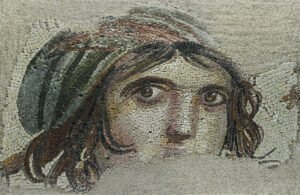
The named highlights include Abandoned Ariadne, Yakto, Satyr and Hermaphroditos, Seasons, Birth of Venus, Artemis and Skeleton. These titles give you several starting points for exploring the collection. They also show why treating the mosaics as a single decorative category would overlook the different subjects represented among the museum’s major works.
The scale requires careful wording. The ministry’s museum page reports 3,250 square metres of displayed mosaics. The official museum brochure gives 3,500 square metres for mosaic exhibition space. These figures describe different measures. They should not be substituted for one another or presented as two competing measurements of the same thing.
Hatay belongs among the world’s great mosaic collections, especially for its Roman and Eastern Roman material. That description is more useful than turning its mosaic holdings into a claim about the world’s largest archaeological museum. The building’s total enclosed area, its exhibition space and the area occupied by displayed mosaics are separate figures.
What should you look for in the Yakto Mosaic?
The Yakto Mosaic was found in Defne and dates to the fifth century AD. Its central female figure represents Megalopsykhia, meaning Great Soul. This gives the composition a named focal point. Start with that figure, then follow the surrounding imagery towards the edges.
Scenes of city life run along all four sides. Between the centre and the border, Greek names accompany the hunting heroes. You can therefore examine Yakto at several levels: its central personification, its named hunters and its scenes of urban life. The border deserves attention alongside the central figure.
Those city scenes offer an everyday-life connection. Much as you might notice the edges of a familiar street photograph, you can look beyond Yakto’s centre to examine its representations of urban activity. The mosaic places those scenes around Megalopsykhia and the hunters, making the surrounding city part of the work’s visual structure.
The Soteria Mosaic provides another connection to daily surroundings. It came from the frigidarium, or cold room, of a bath in Antakya. That origin gives the object a specific setting. Its museum identity includes both the mosaic itself and the part of the bath from which it came.
Beyond mosaics: sculpture and the Antakya Sarcophagus
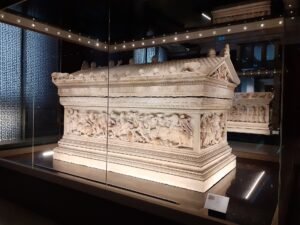
The museum’s major objects also include the Şuppiluliuma Statue, Arsuz Stelae, Tyche Statue, Antakya Sarcophagus and Double Lion Column Base. These works broaden the collection beyond mosaics. The Antakya Sarcophagus also has its own section within the ministry’s virtual museum tour.
The upper body of the Şuppiluliuma Statue was discovered at Tell Tayinat in 2012. It was transferred to Hatay Archaeology Museum during the same excavation season. According to the University of Toronto’s announcement that year, the surviving head and torso stand approximately 1.5 metres high.
The statue’s original height was estimated at 3.5 to 4 metres. That estimate needs to remain distinct from the height of the surviving fragment. Even the preserved head and torso represent only part of the original sculpture. The discovery date and transfer also connect this major display object to a specific excavation season.
Hatay Archaeology Museum in Antakya: buildings and location
The first museum building stood near Cumhuriyet Alanı in Antakya. Construction began in 1934 following a proposal by the French archaeologist and antiquities inspector M. Prost. The building was completed in 1938. The museum first opened to visitors on 23 July 1948, then reopened after renovation and expansion in 1975.
Construction of the new Maşuklu building began in May 2011. Architect Kemal Nalbant designed it with funding from the Ministry of Culture and Tourism and Hatay Governorship. The first phase opened on 28 December 2014. The second followed on 2 March 2019.
The new museum was designed on a 53,500-square-metre site. Its enclosed area measures 32,754.14 square metres, with 10,700 square metres allocated to exhibitions. Its 19 exhibition halls combine chronological and thematic arrangements. These building measurements describe the museum as a whole, rather than the mosaics alone.
For location searches, the provincial museum authority places the building on Atatürk Caddesi in Maşuklu. The Culture Portal supplies the directions address as Maşuklu, Antakya–Reyhanlı Yolu No:117. Both identify the museum with Maşuklu, rather than the earlier building near Cumhuriyet Alanı.
Timeline
- 1932: Excavations began in Antakya and its surroundings that would help form the collection.
- 1934: Construction of the old museum building began.
- 1938: The old building was completed.
- 23 July 1948: Hatay Archaeology Museum opened to visitors.
- 1975: The old museum reopened following renovation and expansion.
- May 2011: Construction of the new Maşuklu museum began.
- 2012: The Şuppiluliuma Statue was transferred from Tell Tayinat to the museum.
- 28 December 2014: The new museum’s first phase opened.
- 2 March 2019: Its second phase opened.
- 6 February 2023: Ministry records date the maintenance and repair closure from this day.
- 22 February 2026: A phased reopening at the end of 2026 was announced as a target.
- 25 October 2026: The ministry still listed the museum as closed pending completion of the work.
Details you won’t find in guidebooks
Mosaics from early excavations around Antakya were dispersed among approximately 20 museums and private collections. Their destinations included Princeton University Art Museum, Worcester Art Museum and the Louvre. Hatay’s collection therefore belongs to a wider history of objects excavated around Antakya and subsequently held in different collections.
The Şuppiluliuma Statue rewards attention to its materials and inscription. Its eyes contain white limestone and black dolomite inlays. A Luwian hieroglyphic inscription on its back describes the king’s achievements. The front and back preserve different kinds of information about the same sculpture.
The exhibition route in the new museum begins with a reconstruction of Üçağızlı Cave. The cave is in Meydan village in Samandağ. This opening places the route’s starting point beyond Antakya itself. It also introduces the earlier periods represented in a collection extending through the Seljuk and Ottoman eras.
Among the museum’s less familiar finds are pointed skulls dating to the Middle Chalcolithic period. They belong within a collection that also includes Neolithic, Bronze Age, Hittite and Hellenistic objects. The Roman and Eastern Roman mosaics form a major part of a much longer chronological span.
Hatay Archaeology Museum photos and virtual viewing
For readers searching for Hatay Archaeology Museum photos or “fotos,” the ministry’s virtual tour offers a way to explore named sections. These include Cave, Amuk, Daphne Houses, Antakya Sarcophagus and Mosaic Road. You can use those sections to move between different parts of the collection while the physical museum remains listed as closed.
When examining images of Yakto, look for its four borders as well as Megalopsykhia at the centre. The city scenes and Greek names are specific details to seek out. For the Şuppiluliuma Statue, the contrasting eye materials provide another focused viewing task.
Hatay Archaeology Museum tickets and reopening
As of 25 October 2026, the ministry’s temporary closures list recorded Hatay Archaeology Museum as closed for general maintenance and repairs. The closure was dated from 6 February 2023. Reopening remained dependent on completion of the work.
An İHA report published on 22 February 2026 quoted Hatay MP Hüseyin Yayman announcing a target of phased reopening at the end of 2026. That target was not a confirmed opening day. The ministry’s museum page also displayed the museum as closed and stated that Müzekart was valid for citizens of the Republic of Türkiye.
FAQ
Where is Hatay Archaeology Museum?
The museum is in Maşuklu, in Antakya district. The provincial museum authority places it on Atatürk Caddesi, while the Culture Portal gives the directions address as Maşuklu, Antakya–Reyhanlı Yolu No:117.
Is Hatay Archaeology Museum open?
As of 25 October 2026, the ministry listed it as closed for maintenance and repairs. A phased reopening at the end of 2026 had been announced as a target, without a confirmed opening day.
Which mosaics are highlights of the collection?
Highlights include Yakto, Abandoned Ariadne, Satyr and Hermaphroditos, Seasons, Birth of Venus, Artemis and Skeleton. The fifth-century Yakto Mosaic includes a central figure representing Megalopsykhia, or Great Soul.
Can you explore Hatay Archaeology Museum online?
The ministry’s virtual museum platform offers a tour with sections including Cave, Amuk, Daphne Houses, Antakya Sarcophagus and Mosaic Road.
Sources
- Directorate General of Cultural Heritage and Museums — Hatay Museum Directorate kvmgm.ktb.gov.tr
- Culture Portal — Hatay Archaeology Museum kulturportali.gov.tr
- Hatay Provincial Directorate of Culture and Tourism — Museum Brochure hatay.ktb.gov.tr
- Hatay Governorship — Hatay Archaeology Museum hatay.gov.tr
- Ministry of Culture and Tourism — Hatay Archaeology Museum muze.gov.tr
- Ministry of Culture and Tourism, DÖSİMM — Hatay dosim.ktb.gov.tr
- Turkish Journal of Archaeology and Ethnography — 2022/1, Issue 83 taed.ktb.gov.tr
- University of Toronto, Tayinat Archaeological Project — King Suppiluliuma tayinat.artsci.utoronto.ca
- University of Toronto via EurekAlert — 2012 Excavation Announcement eurekalert.org
- Directorate General of Cultural Heritage and Museums — Temporarily Closed Museums kvmgm.ktb.gov.tr
- Karar, reporting İHA — Hatay Archaeology Museum Reopening Target karar.com
- Ministry of Culture and Tourism — Hatay Archaeology Museum Virtual Tour sanalmuze.gov.tr
- Wikipedia — Hatay Archaeology Museum en.wikipedia.org
Image: Hatay Archaeology Museum, Antakya, Turkey (35454860543).jpg — Carole Raddato from FRANKFURT, Germany, CC BY-SA 2.0