Imagine a country where reading and writing belong to people who have spent years memorizing a large set of foreign characters. Everyone else must stay silent on paper. That was the problem King Sejong set out to solve in fifteenth-century Korea. His answer was a new alphabet. Today it is called Hangul.
This article explains who Sejong was, why he built the script, how its letters were designed, who tried to stop him, and how the founding book survived.
The Hangul alphabet in brief
Hangul is the writing system of the Korean language. Its inventor, Sejong, was the fourth king of the Joseon Dynasty. He ruled from 1418 to 1450.
The first version had 28 letters. Of these, 17 were consonants and 11 were vowels. Today’s alphabet is smaller. It uses 24 basic letters: 14 consonants and 10 vowels.
The letters do not stand in a line like the Latin alphabet. They are grouped into syllable blocks. Each block holds an initial consonant, a vowel, and a final consonant when the syllable has one.
Why Sejong created Hangul
Before Hangul, Koreans used Chinese characters, known as Hanja. They had two problems.
First, Hanja were inadequate for writing down the sound structure of Korean. Second, they were hard to learn. That difficulty limited literacy.
Sejong explained his motive himself. In the preface to Hunminjeongeum, he wrote that he created the 28 new letters for people who could not express their thoughts in writing. He wanted them to learn the letters easily and use them in daily life.
Think about your own childhood. You probably learned your first alphabet in a short time. A script built on a large set of foreign characters asks for far more. Sejong wanted a system that ordinary people could pick up without years of study.
What Hangul means and what the name says
The name has two layers.
The alphabet’s first name was Hunminjeongeum. In English, it can be roughly rendered as “the correct sounds for instructing the people.” The name points to the purpose. It is about teaching the people, not impressing scholars.
The modern name is 한글. English-language Wikipedia links it to the elements Han, from the name of Korea, and geul, meaning writing. So the name means roughly “Korean script.”
The National Museum of Hangeul adds a small detail. The name Hangeul in use today appears in records only from the early 1910s. Sejong never called his alphabet by that name.
Hangul in Korean and in English letters
Written in Korean, the name is 한글. English writers spell it two ways: Hangul and Hangeul. They are the same word. South Korea’s revised romanization system uses Hangeul. Both spellings are correct, and you will meet both in books and on signs.
If you are searching for Hangul “to English,” note one point. Hangul is not a translation tool. It is a writing system for Korean sounds. Each block tells you how to pronounce a syllable.
How the letters were designed
The logic of Hangul is its most striking feature. The shapes were not random.
The five basic consonants are ㄱ, ㄴ, ㅁ, ㅅ and ㅇ. They copy the shapes of the speech organs used to make the sounds. For example, ㄴ shows the tip of the tongue touching the upper gum. The letter ㅁ shows the shape of the mouth or lips.
The designers then built more letters from these five. Adding strokes to a basic consonant produced a related sound, one made with a stronger flow of air. This was one of the main methods for making new letters.
The vowels follow a different idea. Their three basic elements are ㆍ, ㅡ and ㅣ. They were designed to stand for heaven, earth and human being, in that order. Few guidebooks mention this. Yet it explains why vowel shapes look so simple.
Here is how the pieces fit together in writing:
- A consonant opens the syllable.
- A vowel follows.
- A final consonant closes it, if there is one.
One modern detail surprises many learners. The letter ㅇ makes no sound at the start of a syllable. It works as a silent placeholder. The word 우유 shows this. Both of its syllables begin with a silent ㅇ.
Counting combined letters, the modern system has 19 consonants that can begin a syllable. It has 21 vowels that can sit in the middle.
Timeline
- 1418: Sejong became the fourth king of the Joseon Dynasty.
- 1443, twelfth month of the traditional calendar: The royal annals recorded that Sejong had created 28 letters.
- 1444, second month, 20th day: Choe Malli and other officials presented a petition against the new script.
- 1446, ninth month of the traditional calendar: By UNESCO’s dating, the explanatory edition of Hunminjeongeum was published.
- 1459: A Korean-language explanation of Hunminjeongeum appeared at the start of Worinseokbo.
- Early 1910s: The name Hangeul began to appear in written records.
- 1940: A copy of Hunminjeongeum Haerye was found again.
- 1997: Hunminjeongeum Haerye was entered in UNESCO’s Memory of the World Register.
The 1444 objection
Not everyone welcomed the new letters. The annals for the 20th day of the second month of 1444 record a petition. Choe Malli and other officials presented it to the king.
Their argument had two parts. A separate script, they said, would harm cultural ties with China. It would also weaken the study of classical Chinese.
Sejong answered directly. He defended the project by saying that the purpose of the new script was to bring ease to the people. The record shows a king who did not drop his plan when scholars pushed back.
The book behind the alphabet
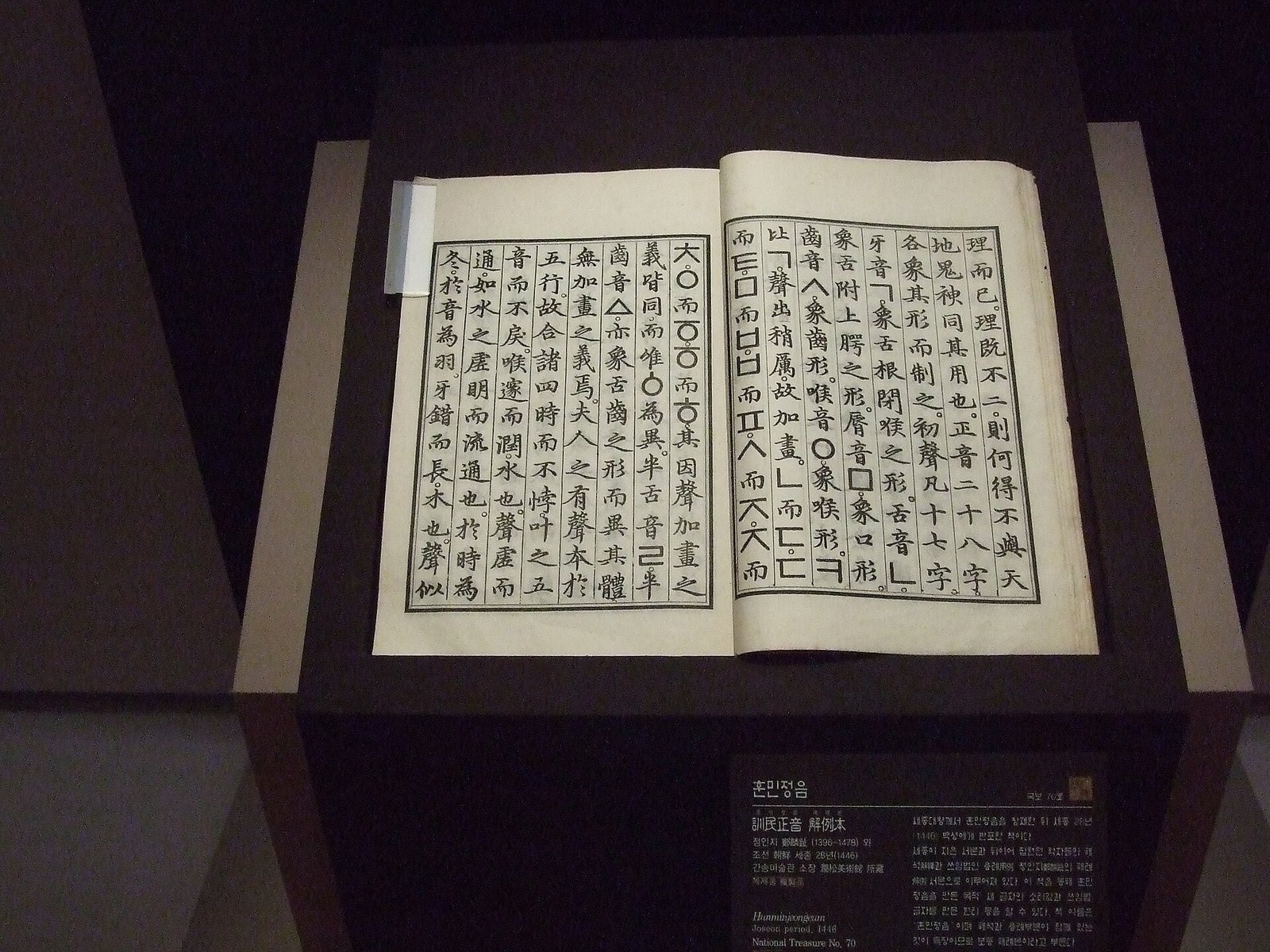
The word Hunminjeongeum has two meanings. It names the alphabet. It also names the 1446 book that explains how the letters were made and how to use them.
UNESCO records that the annotated edition, called Haerye, came out in the ninth month of 1446. It contains Sejong’s own text. It also holds explanations by scholars of the Hall of Worthies and an afterword by Jeong In-ji.
One detail rarely appears in popular books. The book explaining the new Korean alphabet was first printed as a Chinese-language text, using wooden blocks. The alphabet for ordinary Koreans was introduced in the scholars’ own language first.
A Korean explanation followed later. In 1459, it appeared at the beginning of the first volume of Worinseokbo.
Details you won’t find in guidebooks
- The book is Chinese-language. The first Haerye edition was a Chinese text printed with wooden blocks.
- Heaven, earth and human. The three basic vowel elements stand for these three things.
- A silent letter. Modern ㅇ makes no sound at the start of a syllable. In 우유, it opens both syllables silently.
- A late rediscovery. A copy of Hunminjeongeum Haerye was found again in 1940. That was centuries after it was printed.
- A young name. The word Hangeul appears in records only from the early 1910s.
- A scholarly dispute. Experts disagree about what the 1446 record means. The National Institute of the Korean Language says it reports the completion of the book. It says no formal proclamation ceremony is documented. UNESCO instead describes 1446 as the publication of a text containing the proclamation of the alphabet.
Hangul Day
In South Korea, Hangul Day falls on 9 October each year. It commemorates the creation of the alphabet.
Recognition by UNESCO
In 1997, the Hunminjeongeum Haerye copy was entered in UNESCO’s Memory of the World Register. The listing recognizes the book that records the principles of the alphabet. The book is the reason we know how the letters were meant to work.
FAQ
Who invented Hangul?
King Sejong, the fourth ruler of the Joseon Dynasty, who reigned from 1418 to 1450. The royal annals record that he created 28 letters, in the twelfth month of 1443 by the traditional calendar.
Why was Hangul created?
In the preface to Hunminjeongeum, Sejong said he made the letters so that people who could not express their thoughts in writing could learn them easily and use them in daily life. Chinese characters (Hanja) were poorly suited to Korean sounds and hard to learn, which limited literacy.
How many letters does Hangul have today?
Modern Hangul uses 24 basic letters: 14 consonants and 10 vowels. Counting combined letters, there are 19 consonants that can start a syllable and 21 vowels that can sit in the middle. Sejong’s original set had 28 letters: 17 consonants and 11 vowels.
When is Hangul Day?
In South Korea, Hangul Day is celebrated every year on 9 October to commemorate the creation of the alphabet.
Is it Hangul or Hangeul?
Both are Latin-letter spellings of the same name, 한글. South Korea’s revised romanization system uses Hangeul.
Sources
- UNESCO — Hunminjeongum Manuscript unesco.org
- Wikipedia — Hangul en.wikipedia.org
- KCI — Research on translations of the preface to Sejong’s Hunminjeongeum, 2008 kci.go.kr
- National Hangeul Museum — About the Hangeul m.hangeul.go.kr
- National Institute of Korean History — The creation of Hangeul and Hunminjeongeum contents.history.go.kr
- Korea Tourism Organization — Hangeul english1.visitkorea.or.kr
- National Institute of the Korean Language — Principle of Hangeul korean.go.kr
- Veritable Records of the Joseon Dynasty — Sejong, vol. 103 sillok.history.go.kr
- National Institute of the Korean Language — Origin of Hangeul korean.go.kr
Image: Hunminjeongeumhaerye.jpg — Kbarends at English Wikipedia, Public domain