You read printed pages every day. Menus, tickets, forms, signs. This guide follows the man who joined reusable metal letters, oil-based ink and a screw press into one working system in Europe: Johannes Gutenberg of Mainz.
The story is well documented in parts and unclear in others. We will separate the two as we go.
Where was Johannes Gutenberg born, and where was he from?
Gutenberg was born around 1400 in Mainz, a city in the Holy Roman Empire. He was a German inventor and craftsman.
The date is not certain. The Mainz celebrations of 1900 used the year 1400 as a symbolic birth year. Treat it as a round number, not a record.
His full name is given as Johann Gensfleisch zur Laden zum Gutenberg. The name Gutenberg comes from a house his family owned in Mainz. So the name you know is a house name.
His father, Friele Gensfleisch, was a citizen of Mainz with a connection to the city mint.
Some scholars have suggested that Gutenberg was the student listed as Johannes de Altavilla in the registers of Erfurt University. Mainz’s official chronology says this identification cannot be confirmed. If you read that he studied at Erfurt, remember it is a theory.
Years in Strasbourg
Documents confirm that Gutenberg was in Strasbourg in 1434. His last record in that city dates from 1444. So we can follow him there for about ten years.
A lawsuit from 1439 tells us something odd. According to the court papers, Gutenberg took part in an attempt to make religious mirrors. They were meant to be sold to pilgrims travelling to Aachen.
Some researchers think the 1439 documents point to early printing experiments. The Library of Congress notes that the same wording could just as well describe the mechanisms used in making pilgrim mirrors. Nobody can say for sure which it was.
In 1448 he was back in Mainz. On 17 October of that year he borrowed 150 gulden from Arnold Gelthus.
Did Gutenberg invent the printing press?
Not in the simple sense. Printing with movable type was already used in China and Korea before Gutenberg. The Korean Buddhist work Jikji was printed with movable metal type in July 1377. That is about two decades before his supposed birth year.
What Gutenberg did in Europe was put several parts together. Think of it as a production line, not a single gadget. The system had three main parts:
- reusable metal letters,
- oil-based ink,
- a screw press adapted to printing.
The key was that the parts worked together. That is why historians describe his achievement as a system.
What did Gutenberg invent? How the system worked
The official technical description from the city of Mainz explains the core of it. Gutenberg used a hand-casting instrument. It could quickly produce many metal letters of the same height. Equal height matters. Letters of the same height make an even printing surface.
The letters were cast as mirror images. Then they were arranged into words, lines and pages. When the page was inked and pressed onto paper, the mirror image came out the right way round.
Here is an everyday link. When you stamp a rubber stamp on a hotel registration card or a visa form, the letters on the stamp are backwards. The print is correct. Gutenberg’s letters worked on the same principle, only they were metal, reusable and built into a full alphabet.
After a page was printed, the letters could be taken apart and used again. That reuse is what made the system efficient.
What is Gutenberg famous for?
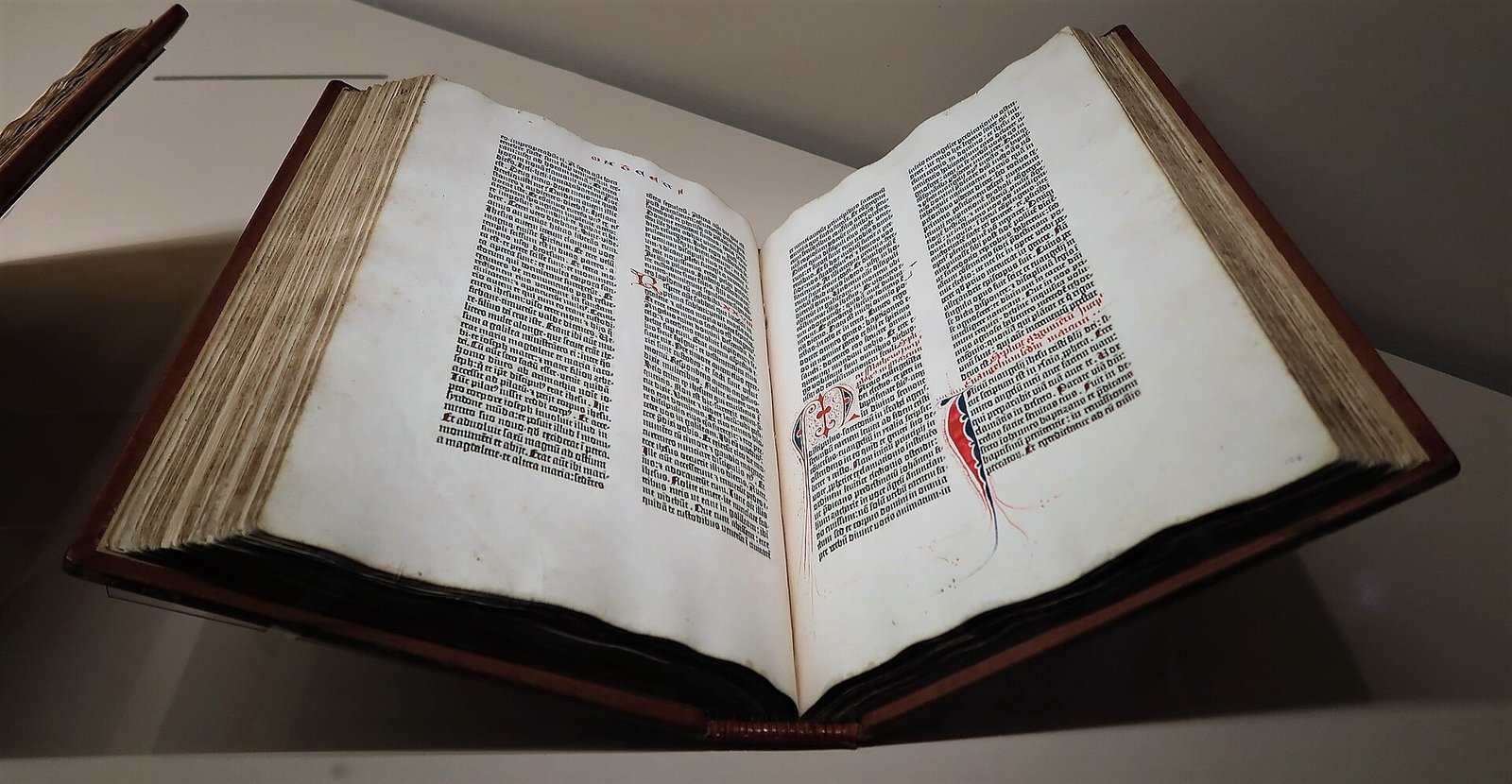
He is famous for the Gutenberg Bible. It was produced in Mainz around 1454–1455 by Gutenberg and his partner Johannes Fust. It is one of the first large typographic books in Europe.
Here are the facts you can check:
- It contains the Latin Vulgate text.
- Its common name, B42, comes from the 42 lines in each of the two columns on a page.
- According to Mainz, it is a two-volume work of 1,282 pages, made with the help of about 20 workers.
- The total print run is estimated at about 180 copies.
- Copies were printed on both paper and parchment.
An early outside witness exists. In a letter of 1455, Aeneas Silvius Piccolomini, who later became Pope Pius II, described the printing of the Bible sheets that were offered for sale. He called it clean and easy to read.
Money, partners and a lawsuit
Printing at this scale needed capital. Johannes Fust financed Gutenberg’s printing venture twice, 800 gulden each time.
Then the partnership broke down. The main contemporary record of Fust demanding repayment of the loans and interest is a notarial document by Ulrich Helmasperger, dated 6 November 1455.
Many books say Gutenberg lost his Bibles and most of his workshop in this case. That is one historical interpretation. Mainz’s official chronology stresses that the outcome of the case is not recorded with certainty. So the safe statement is this: we know a dispute over money existed, and we do not know exactly how it ended.
Fust went on working with Peter Schöffer. Their workshop published the Mainz Psalter in August 1457. Unlike the Bible, it carries the printers’ names and a date.
The 1454–1455 Mainz indulgence documents are also early printed forms. They left blank spaces for a name and a date. Think of a modern boarding pass or a customs form with blank lines. A printed text with empty fields that someone fills in by hand is the same idea, more than five centuries earlier.
Gutenberg’s last years and death
In 1465, Archbishop Adolf von Nassau of Mainz took Gutenberg into court service. The benefits included wine, grain, clothing and exemption from taxes.
Gutenberg died in Mainz in 1468. The date 3 February is often given, and the city of Mainz uses it. The Deutschlandmuseum says the exact day is doubtful. Mainz’s chronology records the death but gives no cause.
He was buried in the Franciscan church in Mainz. The church and its cemetery have disappeared, so his grave cannot be located today.
Timeline
- 1377: Jikji is printed in Korea with movable metal type.
- About 1400: Johannes Gutenberg is born in Mainz.
- 1434–1444: Gutenberg’s life in Strasbourg can be traced in documents.
- 1439: The mirror-for-pilgrims venture appears in court records.
- 1448: Back in Mainz, Gutenberg borrows 150 gulden from Arnold Gelthus.
- About 1454–1455: The Gutenberg Bible is printed in Mainz.
- 6 November 1455: The Helmasperger document records the financial dispute between Fust and Gutenberg.
- 1457: Fust and Schöffer publish the Mainz Psalter.
- 1465: Archbishop Adolf von Nassau gives Gutenberg court status and privileges.
- 1468: Gutenberg dies in Mainz. The date 3 February is not certain.
- 2001: The Göttingen Gutenberg Bible and related documents enter the UNESCO Memory of the World Register.
Details you won’t find in guidebooks
- The pilgrim mirrors. In 1439 court papers, Gutenberg appears in a venture to make religious mirrors for pilgrims going to Aachen.
- 290 special characters. For the Bible’s typesetting, Gutenberg cast 290 different character forms that were not simple alphabet letters.
- Colour added by hand. The coloured initials and decorations in the Bible were added after printing, by hand.
- No printer’s name. The Gutenberg Bible does not state the printers’ names, the place of printing or the date.
- No verified portrait. No portrait showing what Gutenberg really looked like has survived. The famous images are later imaginings.
- A world-register copy. The parchment Gutenberg Bible kept in Göttingen, with related documents from the time, was added to the UNESCO Memory of the World Register in 2001.
FAQ
Where was Johannes Gutenberg born?
He was born in Mainz, in the Holy Roman Empire, around 1400. The exact date is unknown. The year 1400 was used symbolically at the Mainz celebrations of 1900.
Did Gutenberg invent movable type?
No. Printing with movable type was used in China and Korea before him. The Korean Buddhist work Jikji was printed with movable metal type in July 1377. Gutenberg’s contribution in Europe was a system that combined metal letters, oil-based ink and a screw press adapted for printing.
Why is the Gutenberg Bible called the B42?
The name comes from its layout. Each page has two columns, and each column has 42 lines. The text is the Latin Vulgate.
Where is Gutenberg buried?
He was buried in the Franciscan church in Mainz. The church and its cemetery no longer exist, so the location of his grave is unknown today.
Sources
- Library of Congress — Johannes Gutenberg guides.loc.gov
- Library of Congress — Introduction guides.loc.gov
- Library of Congress — Frequently Asked Questions guides.loc.gov
- City of Mainz — Gutenberg und seine Zeit in Daten gutenberg.de
- City of Mainz — Die Erfindung Gutenbergs gutenberg.de
- City of Mainz — Gutenberg-Bibel gutenberg.de
- Morgan Library & Museum — Who was Gutenberg? themorgan.org
- Morgan Library & Museum — The Invention of Printing themorgan.org
- ASME — Inventor Gutenberg and His Movable Type Printing Press asme.org
- German Commission for UNESCO — Gutenberg-Bibel unesco.de
- German National Library, Museum of Books and Writing — Letters of indulgence mediengeschichte.dnb.de
- German National Library, Museum of Books and Writing — Johannes Gutenberg mediengeschichte.dnb.de
- Deutschlandmuseum — Johannes Gutenberg dies in Mainz deutschlandmuseum.de
- Wikipedia — Johannes Gutenberg en.wikipedia.org
- Vikipedi — Johannes Gutenberg tr.wikipedia.org
Image: Bible de Gutenberg, copie de la BNF Res A71-(2).jpg — Zythème, CC0