Atahualpa and Pizarro: what actually happened
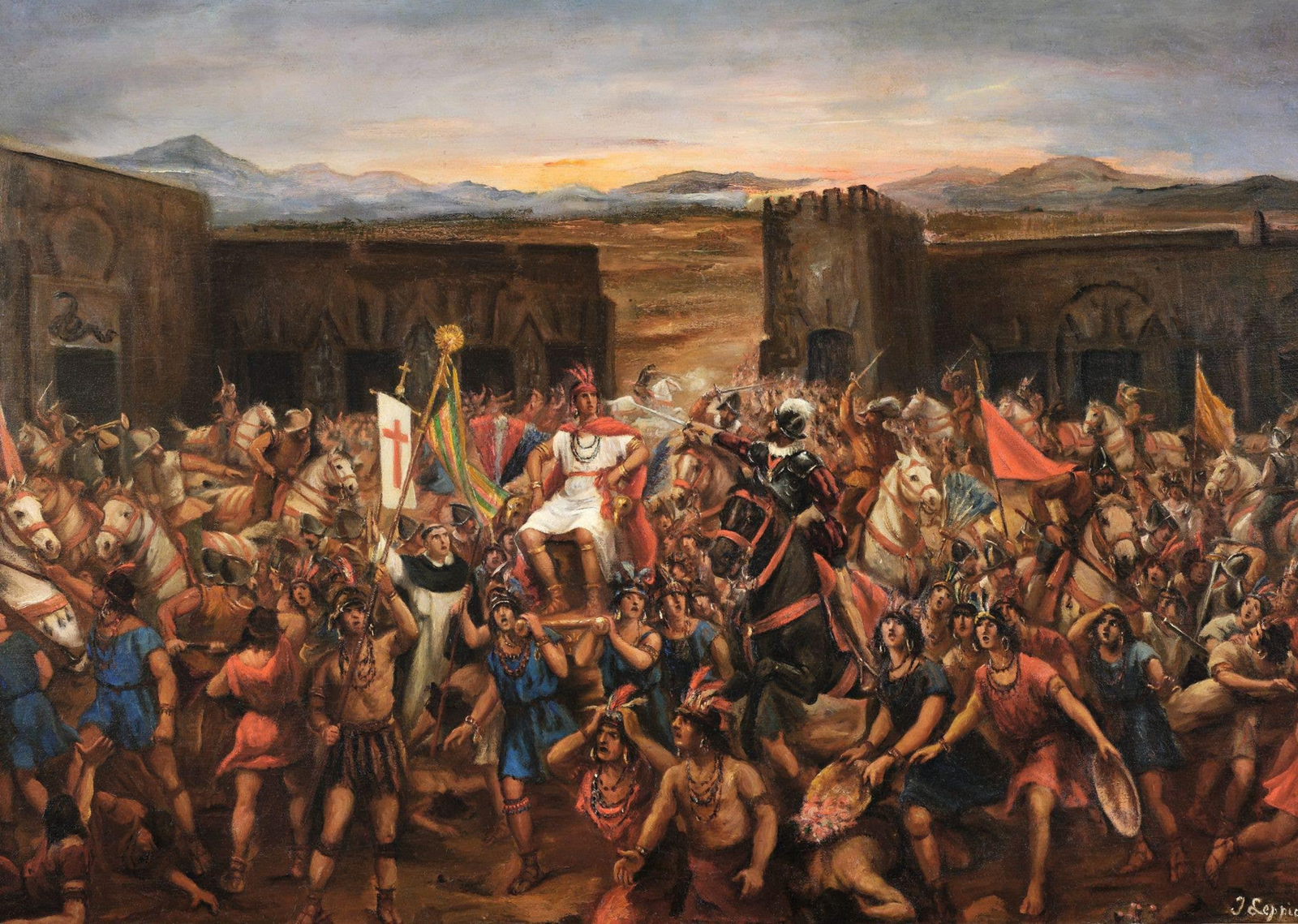
The popular version says 168 Spaniards captured an empire in one room. The record is a little different. Francisco Pizarro’s group seized Atahualpa in the open plaza of Cajamarca on 16 November 1532. The room came later, as the place where he was held and where he offered his ransom.
The core of the story is still striking. A small group took a ruler alive, and an empire lost its head. Here is how it happened.
Who was Atahualpa? The Inca leader of 1532–1533
Atahualpa was the Sapa Inca who ruled in 1532–1533. He is described as the last effectively independent ruler of the Inca Empire. If a crossword asks who ruled the Inca at the time of the Spanish arrival, this is the name.
The Getty Research Institute records him as living from about 1502 to 1533. It lists him as the 13th ruler of the Manco Capac line.
His father, Huayna Capac, died of smallpox. The disease reached the Andes before the Spanish troops did.
Where was Atahualpa from?
Historians disagree. Cieza de León and Betanzos say he was born in Cusco. Other historians argue for Quito or Caranqui.
So a single birthplace cannot be stated with confidence. You will see all three in books, and each has a source behind it.
Atahualpa and Huáscar: the civil war
Atahualpa and his half-brother Huáscar fought a civil war over the Inca throne from 1529 to 1532. Inca succession did not pass automatically to the eldest son. Sons born to the ruler’s different wives could all be candidates. That rule made a contest between brothers possible.
In 1532, Atahualpa’s generals Quizquiz and Chalcuchímac defeated Huáscar’s army at Quipaipán and took Huáscar prisoner.
The timing matters. The war had barely ended when Pizarro’s group arrived. The empire had just been through years of conflict between two claimants.
Atahualpa pronunciation and meaning
The Classical Quechua form of the name is Ataw Wallpa. Its pronunciation is given as [ˈataw ˈwaʎpa].
The meaning is debated. The traditional explanation connects the name to a rooster. Two other theories exist. One says the bird took its name from the ruler. The other says the name comes from Puquina roots.
The Cajamarca ambush, 15–16 November 1532
Pizarro’s group reached Cajamarca on 15 November 1532. The next day, Atahualpa was captured.
According to Kris Lane’s review in Oxford Bibliographies, the Spanish party at Cajamarca on 16 November numbered 168 people. Sixty-two of them were mounted.
The Spaniards prepared the plaza in advance. They placed cannon on the ceremonial platform. They hid their cavalry in the buildings that surrounded the square.
Atahualpa came to the plaza with a ceremonial retinue. His experienced main forces were not with him. A large part of his soldiers waited in a camp outside the city.
Eyewitness accounts summarized in the Oxford review describe a meeting. The priest Vicente de Valverde and an interpreter named Felipe presented Atahualpa with a prayer book.
Then the attack began. Firearms and cavalry struck the retinue. Pizarro’s infantry went for the men carrying Atahualpa’s litter, and they took him alive.
The cost to the Inca side was heavy. The Oxford review says hundreds, probably thousands, of Incas were killed or crushed against the plaza’s surrounding walls.
Why did it work?
Several things came together:
- A divided empire. The civil war between Atahualpa and Huáscar had just ended.
- Absent troops. The experienced main units were in the camp outside the city, not in the plaza.
- Surprise. Cavalry stayed out of sight until the attack began.
- Firepower. Cannon and firearms were set up in advance.
- A clear target. The infantry aimed at the litter bearers and took the ruler alive.
None of this required a large army. It required a ruler standing in the wrong place, with his best troops somewhere else.
The ransom and the Ransom Room
Atahualpa offered to fill a room once with gold and twice with silver in return for his freedom.
Think of it as a hostage deal with a fixed price. He named the price himself.
UNESCO’s nomination file for Cajamarca describes the surviving Ransom Room (El Cuarto del Rescate) as the structure where Atahualpa was held and where he proposed the gold-and-silver ransom.
According to the ministry’s inventory, the room is 11.80 metres long, 7.30 metres wide and about 3.10 metres high.
Atahualpa’s death
The ransom did not buy his freedom. Pizarro did not release him even though the ransom was delivered. Pizarro ordered his death in 1533.
The Spaniards accused Atahualpa of preparing an attack with his generals. Historian R. Alan Covey stresses that the evidence for this charge is weak.
He was sentenced to be burned. Then he accepted baptism, and the sentence was changed to strangulation by garrote.
The date is disputed. Peru’s tourism ministry uses 26 July 1533 and counts his captivity as eight months and ten days. The Turkish Wikipedia gives 29 August 1533. The notes of the English Wikipedia article say later research has rejected that traditional date.
After his death, Pizarro chose another Inca prince to take the throne in his place.
Did the conquest end Inca resistance?
No. The Cajamarca raid did not end all Inca resistance. An independent Inca state north of Cusco lasted until 1572.
So the capture of one ruler was a turning point, not the final chapter.
Timeline
- About 1502: Atahualpa is born. The birthplace is disputed.
- 1529–1532: Atahualpa and Huáscar fight over the throne.
- 1532: Atahualpa’s generals defeat Huáscar at Quipaipán and capture him.
- 15 November 1532: Pizarro’s group reaches Cajamarca.
- 16 November 1532: The Spaniards capture Atahualpa in the plaza raid.
- 1532–1533: Gold and silver are gathered for his ransom.
- 26 July 1533: Atahualpa is executed by garrote, according to the Peruvian tourism ministry. Some older accounts give 29 August.
- 1572: The independent Inca state north of Cusco comes to an end.
Details you won’t find in guidebooks
- The drink. Before the meeting, Atahualpa offered the Spanish envoys maize beer. The gesture expressed a relationship between rulers. Think of a host handing you a drink before a serious conversation. It signals the terms of the meeting.
- A ruler in captivity. While held at Cajamarca, Atahualpa reassembled his court around him. He kept giving orders as ruler.
- A modern roof. The Ransom Room’s present roof is modern. The three openings in its front wall are later alterations.
- Ten niches. Inside the room there are ten trapezoidal wall niches: two on the south, three on the west, four on the north and one on the east.
If you visit, use these details. Count the niches. Look at the roof. The building you see has been changed since 1532.
FAQ
Was Atahualpa captured in a room?
No. The Spaniards seized him on 16 November 1532 in a raid on the Cajamarca plaza. The room belongs to the next part of the story: his captivity and the ransom he offered.
How many Spaniards were at Cajamarca?
According to Kris Lane’s Oxford Bibliographies review, there were 168 Spaniards on 16 November 1532. Of them, 62 were mounted.
How did Atahualpa die?
He was sentenced to burning, but after he accepted baptism the sentence was changed to strangulation by garrote. The Peruvian tourism ministry gives 26 July 1533 as the date.
What does the name Atahualpa mean?
The meaning is debated. The traditional explanation links it to a rooster, but other theories say the bird took its name from the ruler, or that the name comes from Puquina roots.
Did the fall of Cajamarca end the Inca state?
No. An independent Inca state north of Cusco survived until 1572.
Sources
- Wikipedia — Atahualpa en.wikipedia.org
- Getty Research Institute — Atahualpa getty.edu
- Encyclopedia of Latin American History and Culture — Atahualpa encyclopedia.com
- Oxford Bibliographies — Conquest of Peru (Kris Lane) academic.oup.com
- University of Texas — Reading between the Lines at Cajamarca sites.utexas.edu
- Peru Ministry of Foreign Trade and Tourism — El Cuarto del Rescate consultasenlinea.mincetur.gob.pe
- UNESCO — The Historic Centre of Cajamarca whc.unesco.org
Image: La Captura de Atahualpa – Juan Lepiani 1920s.png — Juan Lepiani, Public domain