Singapore fell to Japan on 15 February 1942, after an island battle that had begun on 8 February. Britain’s main regional base surrendered within that period. The defeat followed a Japanese advance through Malaya that had already weakened the troops defending the island.
If you picture Britain’s base relying on heavy guns, the outcome needs explanation. Most of its 15-inch coastal guns could turn north. The deeper problems included dispersed defenders, inadequate reserves, lost supplies and a collapsing water system.
Why did the Battle of Singapore happen?
Singapore stood at the centre of a British strategy built around naval reinforcement. From 1920, British governments told Australia that a battle fleet could reach Singapore within six weeks if Japan advanced south. The base’s security therefore depended partly on ships arriving when needed.
Japan began the land campaign towards Singapore on 8 December 1941. Its troops landed at Kota Bharu in northern Malaya and at Songkhla and Pattani in Thailand.
On 10 December, Japanese aircraft sank the battleship HMS Prince of Wales and the battlecruiser HMS Repulse off Malaya. These losses struck at the naval foundation of the Singapore strategy while Japanese forces continued advancing overland.
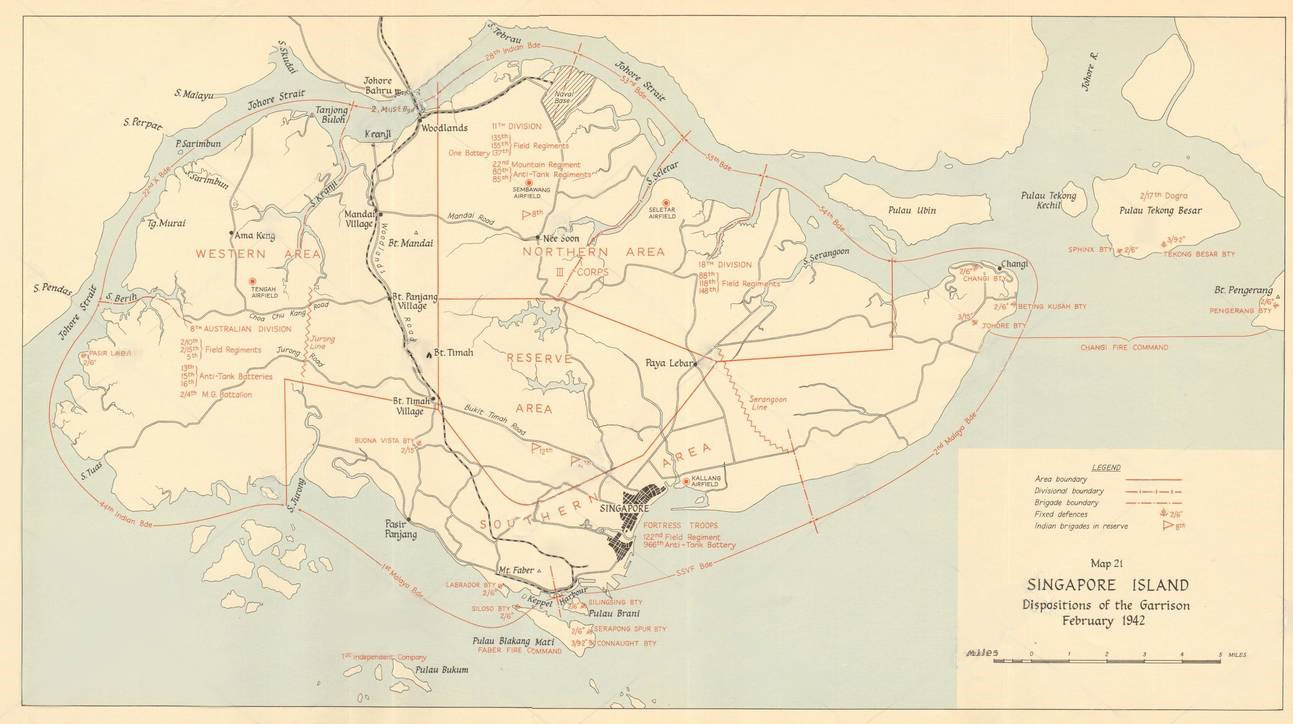
Where was the Battle of Singapore? Reading the map
The island battle took place on Singapore Island, following the campaign down Malaya. The last British troops withdrew from the mainland on 31 January 1942. They destroyed the causeway connecting it to the island.
When you follow the battle on a map, start with the northwestern coast. Japanese troops crossed there on the night of 8 February. Kranji became another crossing point, while Bukit Timah contained fuel and supply depots that the attackers captured on 11 February.
The final defensive area lay around Singapore city. By 13 February, British forces had been compressed into a perimeter of about 45 kilometres. The Ford factory on Upper Bukit Timah Road became the setting for the surrender two days later.
Battle of Singapore order of battle: who fought?
By 5 February, Singapore held about 85,000 Allied troops. Around 15,000 served in base, administrative or other non-combat roles. The total therefore gives an incomplete picture of the force available to defend the coastline.
The defending infantry included 21 British Indian Army battalions, 13 British battalions and six Australian battalions. There were also three Straits Settlements volunteer battalions and two Malay battalions. Lieutenant-General Arthur Percival commanded the island’s defence.
General Tomoyuki Yamashita commanded Japan’s 25th Army. Its principal formations for the attack were Takuma Nishimura’s Imperial Guards Division, Takuro Matsui’s 5th Division and Renya Mutaguchi’s 18th Division.
Percival tried to defend the whole coastline. This left insufficient reserves and depth behind the coastal positions. He assigned the critical northwestern sector to the 8th Australian Division, which had already been weakened by fighting in Malaya.
How did Japan break through in February 1942?
On the night of 8 February, Japan landed 16 infantry battalions on the northwestern coast. The attackers used collapsible boats, small landing craft and pontoons. Their landing struck the sector held by the 22nd Australian Infantry Brigade.
British high command interpreted the initial northwestern landings as a diversion concealing the main attack. The Australian defenders consequently received inadequate reinforcements and artillery support. That assessment compounded the weakness created by spreading troops around the island.
The coastal guns offer a more complicated story than the familiar claim that they faced the wrong way. Most of the 15-inch guns could turn north, and they fired against Japanese troops on land. Their ability to turn did not make them equally effective against every target.
Much of their ammunition was armour-piercing, designed to penetrate warship hulls. That limited its effect against infantry. The relevant distinction is between where a gun could aim and what its ammunition could do after it arrived.
Japanese troops captured the petrol, oil and supply depots at Bukit Timah on 11 February. By 13 February, the defenders were confined around the city. The loss of these supply points tightened the pressure on a force already struggling to contain the landings.
Timeline
- 8 December 1941: Japanese troops landed in Malaya and Thailand.
- 10 December 1941: Japanese aircraft sank HMS Prince of Wales and HMS Repulse off Malaya.
- 31 January 1942: The last British troops withdrew to Singapore Island and destroyed the causeway.
- 8 February 1942: Japanese forces landed on the northwestern coast at night, beginning the island battle.
- 9 February 1942: Japanese troops attempted a crossing in the Kranji sector at night.
- 11 February 1942: Japanese troops captured important fuel and supply depots at Bukit Timah.
- 13 February 1942: Japan established its headquarters at the Ford factory. The defenders were compressed around the city.
- 15 February 1942: Percival surrendered unconditionally at the Ford factory. The order to lay down arms took effect at 20:30.
- 12 September 1945: The Japanese forces’ surrender document was signed in Singapore.
Why did Percival surrender?
In the battle’s final days, water provision was breaking down. Ammunition was running low, petrol was nearing exhaustion and civilian casualties were heavy. These conditions were decisive in Percival’s decision to surrender.
You encounter the importance of water whenever you turn on a tap: ordinary routines depend on a working supply. In Singapore, the collapse of that supply became part of a military crisis. It added another urgent pressure alongside dwindling ammunition and fuel.
Japanese forces had made the Ford factory their headquarters on 13 February. In its boardroom on 15 February, Percival surrendered unconditionally to Yamashita. All Allied troops in Singapore were ordered to lay down their arms at 20:30.
Battle of Singapore casualties: which figures apply?
Casualty totals differ according to the geographical scope being counted. English Wikipedia gives approximately 5,000 Allied troops killed or wounded and 80,000 captured for the Singapore Island battle. Those figures concern the island fighting.
The National Army Museum gives a broader total for Malaya and Singapore together. It records about 9,000 British, Indian and other Commonwealth troops killed or wounded, with 130,000 captured. Combining this campaign total with the island total would count overlapping losses.
Australia’s Department of Veterans’ Affairs records about 1,800 Australians killed and more than 1,300 wounded across the Malaya campaign and Battle of Singapore. More than 15,000 Australians became prisoners when Singapore fell.
Captured troops were initially held at Changi. Some prisoners were subsequently sent elsewhere in Southeast and East Asia, including Japan. For those soldiers, surrender began a period of captivity extending beyond the island.
Details you won’t find in guidebooks
Japanese infantry used bicycles to increase their speed through Malaya. Japanese forces also employed tanks effectively, despite British assumptions that dense jungle made them unsuitable. Both details help explain the pace of the advance towards Singapore.
At Kranji on the night of 9 February, burning oil spread across the strait. It had been released from storage near Sungei Mandai Kechil and set alight. The burning fuel caused casualties among the Japanese troops attempting the crossing.
The Ford factory had moved to Upper Bukit Timah Road in October 1941. Before it hosted the surrender talks, the Royal Air Force used it to assemble fighter aircraft during the Malaya campaign. Its wartime role had already changed before the Japanese headquarters arrived.
On the final day of fighting, a shell struck St Andrew’s Cathedral, which was filled with wounded people. It killed 16 people. Another eight later died from their wounds, giving the final day’s suffering a specific location and toll.
During the Japanese occupation, Nissan took over the Ford factory and used it to assemble military vehicles. The building associated with Percival’s surrender therefore continued serving a military purpose after the battle ended.
What followed the fall, and what happened in 1945?
Japan renamed Singapore Syonan-To after capturing it in February 1942. Winston Churchill described the defeat as the worst disaster and largest surrender in British history. The loss encompassed both the regional base and the troops taken prisoner there.
The decisive Singapore event in 1945 was a Japanese surrender. On 12 September, Seishiro Itagaki signed the surrender document before Louis Mountbatten. If you are sorting the dates, the British surrender belongs to February 1942; this Japanese surrender belongs to September 1945.
FAQ
When was the Battle of Singapore?
The island battle lasted from 8 to 15 February 1942. The Japanese campaign through Malaya had begun on 8 December 1941.
Where was the Battle of Singapore fought?
It was fought on Singapore Island. Japanese troops landed on the northwestern coast, then advanced towards key supplies at Bukit Timah and the remaining defences around Singapore city.
Did Singapore’s coastal guns face the wrong way?
Most of the 15-inch guns could turn north and fired at Japanese land forces. Their mainly armour-piercing ammunition limited their effectiveness against infantry.
What happened in Singapore in 1945?
On 12 September 1945, Seishiro Itagaki signed the Japanese forces’ surrender document before Louis Mountbatten in Singapore.
Sources
- Türkçe Vikipedi — Singapur Savaşı tr.wikipedia.org
- Royal Australian Navy — The Singapore Strategy and the fall of Singapore navy.gov.au
- National Army Museum — The Far East campaign nam.ac.uk
- Department of Veterans’ Affairs, Anzac Portal — Fall of Singapore 1942 anzacportal.dva.gov.au
- English Wikipedia — Fall of Singapore en.wikipedia.org
- Australian War Memorial — Battle for Singapore awm.gov.au
- National Heritage Board, Roots — Battle at Kranji Beach roots.gov.sg
- National Heritage Board, Roots — World War Two roots.gov.sg
- Department of Veterans’ Affairs — Fall of Singapore dva.gov.au
- National Archives of Singapore — About Former Ford Factory corporate.nas.gov.sg
Image: Dispositions of the Garrison February-1942.png — Her Majesty’s Stationery Office, Public domain