Abdul Hamid II was the 34th sultan of the Ottoman Empire. He took the throne on 31 August 1876 and lost it on 27 April 1909. That comes to 32 years, 7 months and 27 days. The ’33 years’ you see in headlines is a rounding, not a count.
His reign contained the first Ottoman constitution, the first Ottoman parliament, a 30-year autocracy, foreign control over state revenues, a school-building program and the massacres of 1894-1896. No other label fits all of that, which is why Turkey still argues about him. This guide sticks to what the sources record.
Who was Abdul Hamid II?
He was born in Istanbul in 1842. The sources disagree on the day and the palace. Turkish Wikipedia gives 21 September 1842 at Topkapı Palace. The Türk Dünyası Ansiklopedisi gives 22 September 1842 at Çırağan Palace. If you see two different birthdays online, both have a source behind them.
His father was Sultan Abdülmecid. His mother was Tirimüjgan Kadınefendi. She died when he was 11. On his father’s orders, Piristû Kadınefendi, who had no children of her own, raised him as a mother would.
In 1867, still a prince, he joined his uncle Sultan Abdülaziz on a tour of Europe. He saw Paris, London and Vienna. The trip is often left out of short biographies.
Abdul Hamid II’s siblings
Abdul Hamid II was the brother of Murad V. He was also the older brother of two men who followed him on the throne: Mehmed V Reşad, who succeeded him in 1909, and Mehmed VI Vahdeddin.
So one family produced four sultans, including the two who came after him. When you read about the last decades of the empire, you are reading about one set of brothers.
How many wives did Abdul Hamid II have?
Turkish Wikipedia lists Nâzikedâ, Bedrifelek, Bidâr and Müşfika Kadınefendi among his wives. The word ‘among’ matters. The source presents these as part of a list, not as a complete count. This article therefore gives names, not a total.
Abdul Hamid II’s children and grandchildren
English Wikipedia names several of his children: Mehmed Selim, Mehmed Abdülkadir, Mehmed Burhaneddin, Zekiye, Naime, Şadiye and Ayşe Sultan.
The best-documented grandchild is Ertuğrul Osman. He was the son of Mehmed Burhaneddin Efendi. He was born on 18 August 1912, three years after his grandfather was deposed, and died on 23 September 2009. His life ran from the late Ottoman Empire into the twenty-first century.
The reign: a constitution, a parliament, then 30 years of control
The first Ottoman constitution, the Kānûn-ı Esâsî, was proclaimed on 23 December 1876, less than four months into his reign.
The first Ottoman parliament opened on 19 March 1877. It had 141 members: 115 deputies and 26 senators.
In 1878 Abdul Hamid II suspended constitutional rule. For roughly 30 years after that he governed autocratically. The system rested on censorship and a wide secret police network, according to the Brigham Young University Library biography.
Money was the other constraint. The Decree of Muharrem of 20 December 1881 gave representatives of creditors the right to set up the Düyûn-ı Umûmiyye, the Ottoman Public Debt Administration. That body collected specific Ottoman state revenues to pay the empire’s debts.
Education grew in the same decades. The Dârülfünûn-ı Şâhâne, the imperial university, opened in 1900. A network of vocational, secondary and military schools expanded across the empire. Supporters of the sultan point to these schools first.
The Armenian massacres of 1894-1896
Between 1894 and 1896, widespread massacres targeted Armenians in Anatolia. Academic literature studies them as the Abdülhamid II massacres. A scholarly volume on the massacres, missions and relief efforts is accessible through the Library of Congress.
These events are the origin of the label ‘Red Sultan’, which is tied to the killings of the 1890s. The opposite tradition calls him ‘Ulu Hakan’, the Great Khan. Necip Fazıl Kısakürek’s 1965 book Ulu Hakan II. Abdülhamid Han is the best-known example of the positive reading. Critics answer by citing the closure of parliament, the exile of Midhat Pasha and the loss of territory. Modern favorable assessments stress his investment in schools and public works.
If you travel in Turkey, you will hear both names. They describe the same man and the same years.
1908, 1909 and the end of the reign
On 23 July 1908 Abdul Hamid II announced that the Kānûn-ı Esâsî was back in force. The constitution he had set aside in 1878 returned after 30 years.
The following spring brought the 31 March Incident. After it was put down, he was deposed on 27 April 1909. His brother Mehmed V took the throne.
The former sultan was sent to the Alâtini Mansion in Salonica. On 1 November 1912 he was brought back to Istanbul and settled in Beylerbeyi Palace.
How Abdul Hamid II died
Abdul Hamid II died on 10 February 1918 at Beylerbeyi Palace in Istanbul. He was 75 years old. Turkish Wikipedia records the cause of death as heart failure.
He had lived at Beylerbeyi for more than five years after his return from Salonica. He died nearly nine years after losing the throne.
Where is Abdul Hamid II buried? The grave
He was buried on 11 February 1918, the day after his death. His grave is in the Tomb of Mahmud II on Divanyolu in Istanbul.
Divanyolu runs through the old city of Istanbul. If you walk it, this is the one place connected to Abdul Hamid II that you can stand in front of.
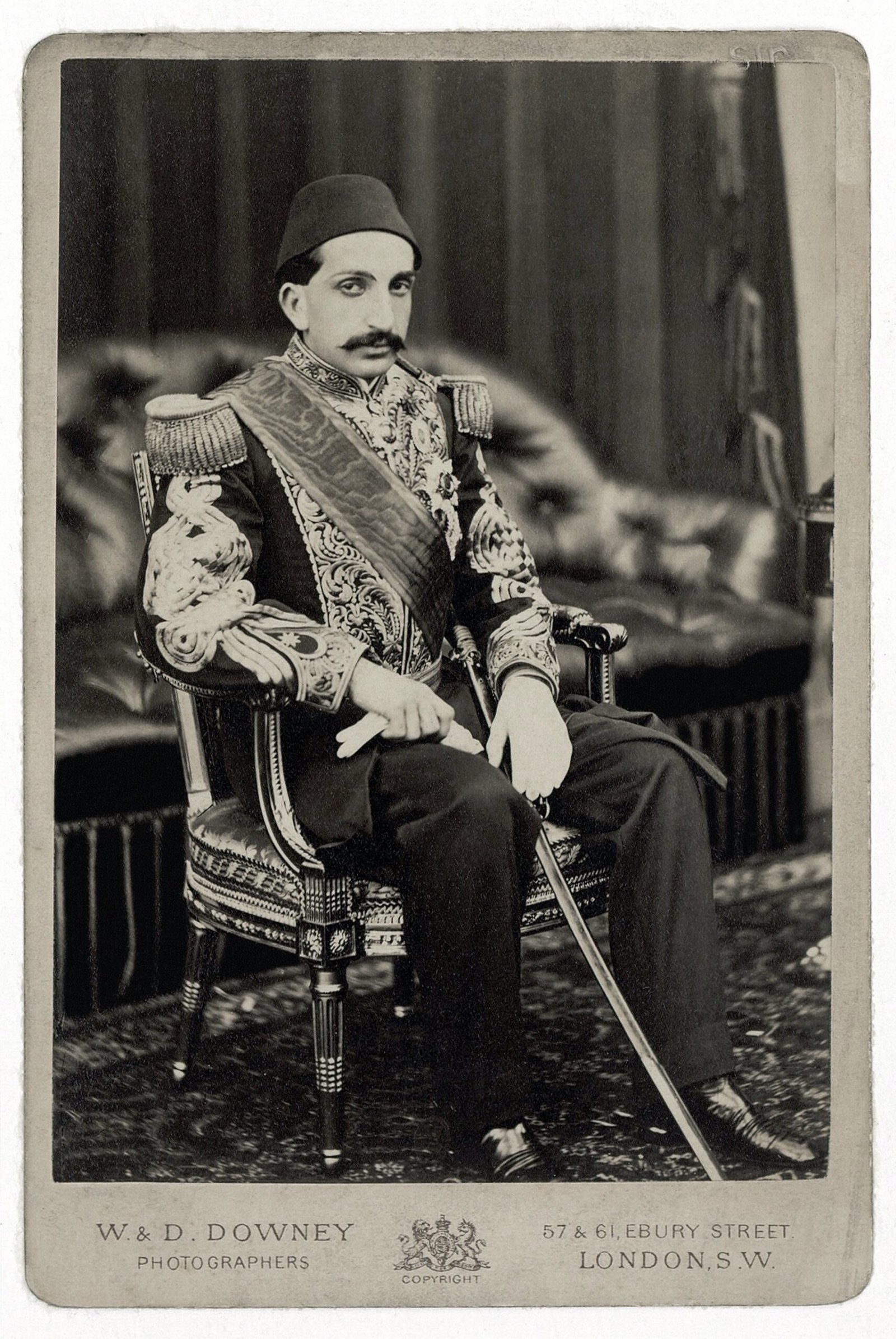
Abdul Hamid II’s real photo
There is no shortage of real photographs. The Abdul Hamid II Collection at the Library of Congress in Washington holds 1,819 photographs in 51 albums. They date from roughly 1880 to 1893. The sultan sent the albums as a gift. Alongside them he sent 402 volumes of books in Turkish and Arabic.
The portrait of him you most often see online dates from about 1890. The version on Wikimedia Commons comes from the Library of Congress, specifically the George Grantham Bain Collection, catalog record 2002699768. If you want the original scan rather than a re-upload, that number is the one to search.
The Abdul Hamid II series
The TRT historical drama Payitaht Abdülhamid tells his story on screen.
Timeline
- 1842 Born in Istanbul; sources differ on the day and the palace.
- 1867 Joined Abdülaziz’s tour of Europe.
- 31 August 1876 Became Ottoman sultan.
- 23 December 1876 The Kānûn-ı Esâsî was proclaimed.
- 19 March 1877 The first Ottoman parliament opened.
- 1878 Parliamentary rule was suspended.
- 20 December 1881 The Decree of Muharrem set up the Düyûn-ı Umûmiyye.
- 1894-1896 Widespread massacres of Armenians in Anatolia.
- 1900 The Dârülfünûn-ı Şâhâne opened.
- 23 July 1908 The constitution was declared back in force.
- 27 April 1909 Deposed; sent to Salonica.
- 1 November 1912 Brought to Istanbul and settled in Beylerbeyi Palace.
- 10 February 1918 Died at Beylerbeyi Palace.
- 11 February 1918 Buried in the Tomb of Mahmud II.
Details you won’t find in guidebooks
- The reign was shorter than 33 years. The exact length is 32 years, 7 months and 27 days.
- A stepmother raised him. After his mother died when he was 11, Piristû Kadınefendi, who had no children, cared for him on Sultan Abdülmecid’s orders.
- He saw Paris, London and Vienna before he ruled. He traveled with his uncle Abdülaziz in 1867.
- His birthday is disputed. One source says 21 September at Topkapı, another says 22 September at Çırağan.
- He sent a library to Washington. The 51 albums with 1,819 photographs came with 402 volumes of Turkish and Arabic books.
- Parliament had exactly 141 members. The 1877 chamber held 115 deputies and 26 senators.
FAQ
How long did Abdul Hamid II actually rule?
From 31 August 1876 to 27 April 1909, which is 32 years, 7 months and 27 days. The common ’33 years’ figure is a rounding.
How did Abdul Hamid II die?
He died on 10 February 1918 at Beylerbeyi Palace in Istanbul at the age of 75. Turkish Wikipedia gives heart failure as the cause.
Where is Abdul Hamid II buried?
He was buried on 11 February 1918 in the Tomb of Mahmud II on Divanyolu in Istanbul.
Did Abdul Hamid II have grandchildren?
Yes. Ertuğrul Osman, son of his son Mehmed Burhaneddin Efendi, was born on 18 August 1912 and died on 23 September 2009.
Sources
- Türkçe Vikipedi, II. Abdülhamid tr.wikipedia.org
- Türk Dünyası Ansiklopedisi, Abdulhamit Kırmızı, II. Abdülhamid (1842-1918) turkdunyasiansiklopedisi.gov.tr
- TDV İslâm Ansiklopedisi, Cevdet Küçük, ABDÜLHAMİD II islamansiklopedisi.org.tr
- English Wikipedia, Abdul Hamid II en.wikipedia.org
- Yapı Kredi Yayınları, Ertuğrul Osman biography kitap.ykykultur.com.tr
- Brigham Young University Library, Abdülhamid II biography archives.lib.byu.edu
- Library of Congress, Abdul Hamid II Collection, About this collection loc.gov
- Library of Congress, Abdul-Hamid II collection catalog record loc.gov
- Wikimedia Commons, Abdulhamit II, Sultan of the Turks, 1842-1918, LCCN2002699768 commons.wikimedia.org
- Library of Congress, The Abdülhamid II Massacres, Missions, and Relief tile.loc.gov
Image: Abdul Hamid II BNF Gallica.jpg — “W.&D. DOWNEY photographers, 57 & 61 Ebury Street, L, Public domain