The Bell Beaker culture was an archaeological tradition that appeared around 2800 BCE, named after drinking vessels shaped like an inverted bell. Its pottery, weapons, and burial practices spread across much of Europe and reached the northwestern African coast. Ancient DNA shows that this spread involved both cultural transmission and migration, with migration producing a major genetic transformation in Britain.
How could similar cups accompany such different population histories? If you follow the pottery alongside the genetic evidence, the contrast becomes clear: Iberia and Central Europe show limited genetic affinity between Beaker-associated people, while Britain experienced approximately 90 percent replacement of its gene pool over several centuries. The 2026 Lower Rhine–Meuse study adds a likely source region for Britain’s principal Beaker migration.
When and where did the Bell Beaker culture appear?
The Bell Beaker tradition appeared around 2800 BCE. Early maritime-style vessels from Portugal’s Tagus estuary have radiocarbon dates around the twenty-eighth century BCE. These finds provide an early geographical anchor for a phenomenon that later covered a much wider area.
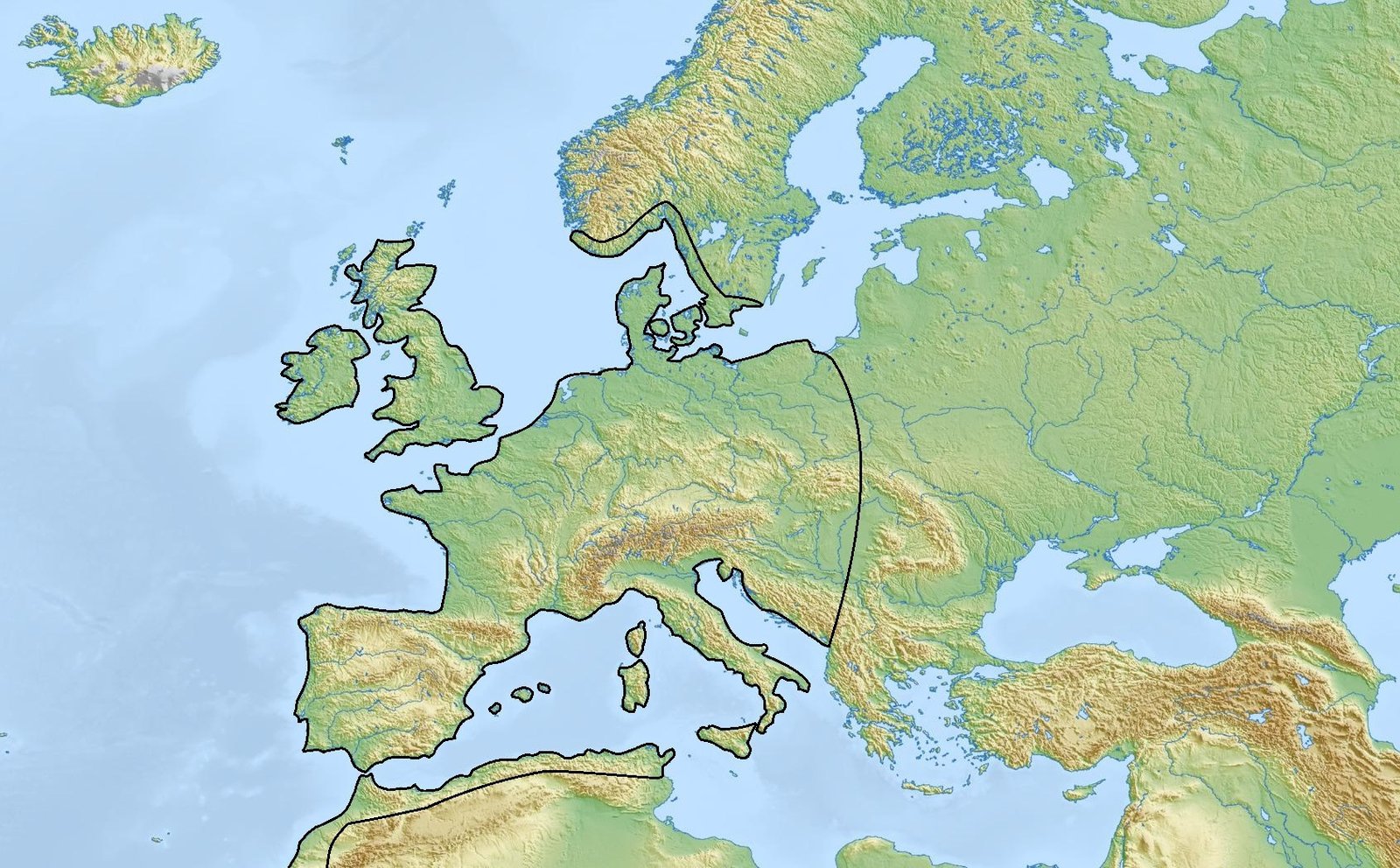
Beaker finds extend from the Iberian Peninsula to the Danube plains. They also occur in Britain, Ireland, Sardinia, Sicily, and along the northwestern African coast. This distribution describes the reach of associated objects and practices. It does not establish that everyone within it shared the same ancestry.
In Britain, the Beaker tradition became prominent around 2450 BCE and continued until about 1800 BCE. It therefore spans the transition from the Late Neolithic into the Early Bronze Age. You need to keep this British sequence separate from the earlier appearance of vessels in the Tagus estuary.
Timeline
- Around 2800 BCE: Early maritime-style Bell Beaker vessels appear in the Tagus estuary.
- Around 2450 BCE: Beaker vessels and associated burial practices become prominent in Britain.
- Around 2300 BCE: The Amesbury Archer is buried with rich grave goods.
- Around 1800 BCE: Britain’s Beaker pottery tradition ends.
- 3 May 2002: The Amesbury Archer’s grave is discovered.
- 2018: Nature publishes the Beaker genome study examining 400 ancient individuals.
- 2021: The Natural History Museum presents an interpretation emphasizing cultural interaction and gradual change in Britain.
- 2026: Nature publishes the Lower Rhine–Meuse study, examining the region’s demographic role in Beaker expansion.
What shared features characterize its pottery, weapons, and burials?
The characteristic drinking vessels carried linear geometric designs arranged in panels. Potters used comb impressions and twisted-cord impressions among their decorative techniques. Shape and decoration make these vessels recognizable across a distribution that includes communities with different genetic histories.
The British examples described by the Ashmolean Museum were built from joined rings of clay. Their clay mixtures included stone fragments or crushed older pottery. These details connect the finished vessels to choices made during manufacture, beyond their visible patterns.
Beaker material culture could also include copper daggers, flint arrowheads, stone wrist guards, buttons with V-shaped perforations, and goldwork. These objects form a recognizable archaeological grouping. Their association with genetically heterogeneous individuals, established in the 2018 study, limits what they can reveal about a shared population identity.
Individual graves containing vessels and weapons became widespread. Yet collective burial, the reuse of older Neolithic tombs, and cremation also occurred in parts of the Beaker world. Burial practice therefore varied within the wider tradition.
The Fryston Wood burial offers a concrete example. Dated to 2210–2030 BCE, it contained a man aged 40–50, placed in a contracted position on his left side. A bronze dagger lay at his hands, with remains of a Beaker vessel at his feet.
Why does an archaeological culture not necessarily represent one people or ethnicity?
The 2018 Nature study by Iñigo Olalde and colleagues examined genome data from 400 individuals at 136 archaeological sites. Of these, 226 came from contexts associated with Beaker finds. People linked to the same material tradition proved genetically heterogeneous.
That result separates an archaeological label from a biological population or ethnic identity. You can recognize a Beaker vessel without establishing the ancestry of its maker or owner. In everyday terms, think of the distinction between sharing a style of drinking cup and sharing a family history: the Beaker evidence shows why those questions require different evidence.
The Natural History Museum’s 2018 account emphasized both human movement and the transmission of objects, technologies, and ideas. Together, these mechanisms explain why recognizable material practices could spread among populations whose genetic relationships differed from region to region.
How does ancient DNA distinguish its spread in Britain from continental Europe?
The 2018 study found limited genetic affinity between Beaker-associated individuals in Iberia and Central Europe. This supported the conclusion that large-scale migration was not the principal mechanism of transmission between those two regions. The presence of related objects did not correspond to a matching population movement.
Britain showed a different pattern. Beaker expansion there was associated with migrants carrying high levels of steppe-related ancestry. Over several centuries, approximately 90 percent of the gene pool changed. The scale of this transformation makes migration central to the British story.
The timing and social character of that change require care. Research presented by the Natural History Museum in 2021 argued for a process potentially spread across about 500 years. It highlighted the scarcity of widespread evidence for violence in skeletons and structures, challenging an interpretation based on a sudden, violent invasion.
Cultural continuity also appears around Stonehenge. A related group examined in 2021 lacked ancestry linked to the monument’s builders, yet used the surroundings of older monuments as prestigious burial places. A change in ancestry could therefore coexist with the continued importance of an older landscape.
What did the 2026 Lower Rhine–Meuse study add to earlier findings?
The 2026 Nature study examined genome data from 112 people dating between 8500 and 1700 BCE. Its geographical scope covered the Netherlands, Belgium, and western Germany. This longer regional sequence provided a comparison for understanding the people associated with later Beaker expansion.
In the Lower Rhine–Meuse wetlands, approximately 50 percent hunter-gatherer ancestry persisted about 3,000 years longer than in most of Europe. Individuals from western Netherlands settlements that adopted Corded Ware pottery carried almost no steppe ancestry. Here, a change in ceramics clearly did not require a corresponding change in population.
The study’s models described Lower Rhine–Meuse Beaker communities as a mixture of Corded Ware-associated migrants of both sexes and a local genetic contribution of 13–18 percent. This finding distinguishes the earlier adoption of pottery from the later formation of Beaker populations in the region.
Genetic similarities identified the Lower Rhine–Meuse as a likely source of the main Beaker migration to Britain. The principal British Beaker genetic group could be modeled without requiring local Neolithic ancestry. That is a model-based explanation of the sampled group, rather than a single biography for every Beaker-associated person.
Four outlying individuals, including the Amesbury Archer, left room for local ancestry or different migration streams. The 2026 study also argued for relatively rapid genetic transformation, challenging the prolonged coexistence interpretation presented in 2021. Nevertheless, it recognized local cultural continuity in both regions between 2450 and 2200 BCE.
Details you won’t find in guidebooks
Thin-section analysis of the vessels discussed by the Ashmolean Museum showed that they were made from local clays where they were found. A recognizable Beaker style could therefore be produced locally. Similar-looking pottery need not represent finished vessels carried from a distant workshop.
The Fryston Wood wrist guard tells a different material story. Its stone came from Langdale in the Lake District, rather than Yorkshire, where the grave was found. Wakefield Museums also suggests that its shape and holes may fit a status object better than practical protection for an archer. That remains an interpretation of the object.
The Amesbury Archer’s grave contained five vessels, 16 flint arrowheads, three copper cutting tools, two wrist guards, and two gold hair ornaments. Oxygen isotopes in his tooth enamel indicate a childhood outside Britain, most probably in the Alpine region of Central Europe. His grave combines an unusually detailed set of objects with evidence for individual mobility.
Cremation affects the visibility of Britain’s earlier population. Some communities before 2500 BCE cremated their dead, while DNA-bearing burials can make newcomers more visible. This imbalance could make population change appear more abrupt.
FAQ
What gave the Bell Beaker culture its name?
Its name comes from drinking vessels shaped like an inverted bell. These vessels appeared around 2800 BCE and became part of a widely distributed archaeological tradition.
Were all Bell Beaker communities one people?
No. The 2018 ancient DNA study found genetically diverse people associated with Beaker objects. Shared pottery and burial practices do not establish a single biological population or ethnic identity.
How much did migration change Britain’s population?
The 2018 study associated Beaker migration with approximately 90 percent replacement of Britain’s gene pool over several centuries. That genetic result alone does not establish a violent invasion.
Where did the main Beaker migration to Britain probably originate?
The 2026 study identified the Lower Rhine–Meuse as a likely source region through genetic comparisons. Its models also allowed different histories for four outlying individuals, including the Amesbury Archer.
Sources
- Vikipedi — Çan biçimli çömlek kültürü tr.wikipedia.org
- Wikipedia — Bell Beaker culture en.wikipedia.org
- Ashmolean Museum, University of Oxford — Beaker Pottery britisharchaeology.ashmus.ox.ac.uk
- Wakefield Museums and Castles — Bronze Age wrist guard museumsandcastles.wakefield.gov.uk
- Olalde and colleagues, Nature, 2018 — Beaker genome study nature.com
- Natural History Museum — The Beaker people, 2018 nhm.ac.uk
- Natural History Museum — Ancient burials near Stonehenge, 2021 nhm.ac.uk
- Nature, 2026 — Lower Rhine–Meuse study pmc.ncbi.nlm.nih.gov
- Wessex Archaeology — The Amesbury Archer: 20 Years On wessexarch.co.uk
- Wessex Archaeology — The Amesbury Archer Revisited wessexarch.co.uk
Image: Bell Beaker culture.jpg — Krakkos, CC BY-SA 4.0