Who was Pythagoras?
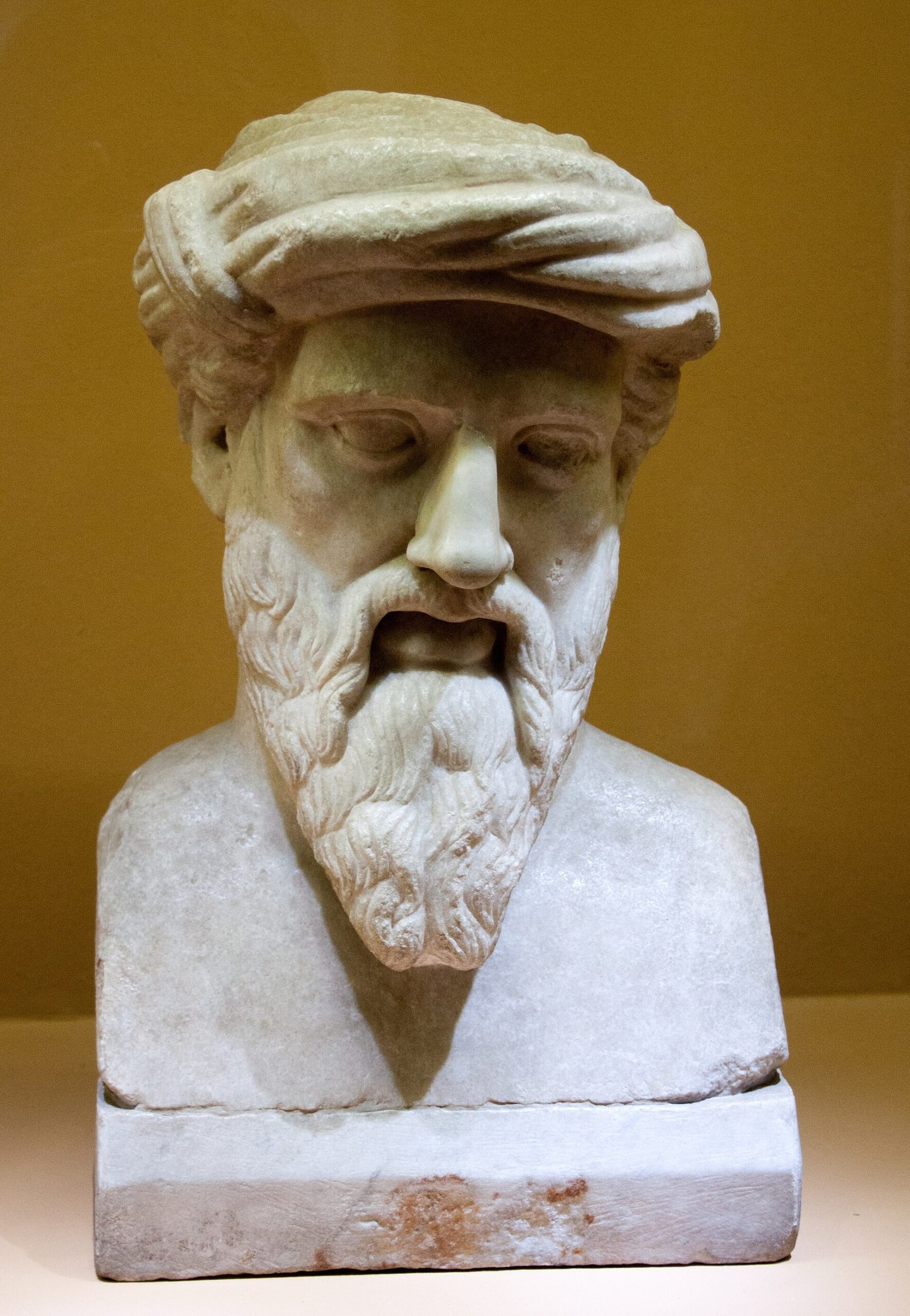
Pythagoras was an ancient Greek thinker born around 570 BCE on Samos, an island in the Aegean Sea. He founded the tradition known as Pythagoreanism. Its religious and philosophical teachings spread through Greek cities in southern Italy. The right-triangle theorem bearing his name is only part of this history.
His community in Croton combined philosophical inquiry with religious rules and shared living. Its interests included the soul, numbers and musical harmony. If you know Pythagoras mainly through a classroom formula, this community gives you a broader picture of the thinker behind the name.
Where was Pythagoras born, and where did he live?
Pythagoras was born on Samos. According to Aristoxenus, he left the island at about forty because he could no longer tolerate the rule of Polycrates. He settled in Croton around 530 BCE.
Croton is now Crotone in southern Italy. This was where Pythagoras established his school and developed a community around his teachings. His life therefore connects an Aegean birthplace with a Greek city in southern Italy. Samos and Croton mark different stages of that life.
Accounts also connect him with Egypt, although scholars disagree about these journeys. Herodotus and Isocrates support the tradition of an Egyptian visit. Historian Leonid Zhmud rejects the eastern travels attributed to Pythagoras. These journeys belong to the disputed parts of his biography.
What was Pythagoras’s school like?
The school at Croton was a community with religious rules and practices of shared living. Philosophical investigation formed part of its activities. Both men and women were admitted.
A central teaching associated with Pythagoras concerned the movement of the soul between bodies. The soul was understood to be immortal. After death, it passed into another body. This teaching, often called the transmigration of souls, places religion at the centre of his philosophical tradition.
Food rules present a less consistent picture. Aristotle attributed a prohibition on eating beans to Pythagoras. Aristoxenus instead reported that he particularly valued beans among vegetables. The disagreement makes a simple account of his dietary teachings difficult to sustain.
How did Pythagoreans connect music and numbers?
The Pythagorean musical tradition linked harmonious intervals with simple whole-number ratios between the lengths of vibrating strings. Numbers therefore had a role in explaining relationships between sounds. This connection brings mathematical relationships into the same tradition as religious teaching and philosophical inquiry.
Another numerical arrangement was the tetractys. It consisted of four rows containing 1, 2, 3 and 4 points. Together, they made 10 points in a sacred triangular pattern. Its sacred status shows how a numerical arrangement could also carry religious meaning within Pythagoreanism.
Pythagoras theorem: what does it say?
The Pythagorean theorem describes the sides of a right triangle. If its two legs are called a and b, and its hypotenuse is called c, the relationship is a² + b² = c². The condition matters: this formula applies to a right triangle.
You can also understand the theorem through areas. Imagine a square built on each side of the triangle. The areas of the squares on the two legs add up to the area of the square on the hypotenuse. The equation expresses that relationship between the three areas.
The triples 3–4–5, 5–12–13 and 8–15–17 give examples with positive whole-number side lengths. Each triple satisfies the same relationship. These are called Pythagorean triples. They let you examine the theorem through specific triangles rather than through letters alone.
Pythagoras theorem formula and hypotenuse formula
The standard formula is a² + b² = c². When you want the hypotenuse itself, use c = √(a² + b²). Square each leg length, add those squared values, and take the square root. The result gives the hypotenuse length.
For a 3–4–5 triangle, the hypotenuse calculation can be written as c = √(3² + 4²) = 5. The same relationship appears in 5² + 12² = 13² and 8² + 15² = 17². The side lengths change, but the formula stays the same.
How do you use a Pythagoras theorem calculator?
For a calculation using c = √(a² + b²), identify the two legs as a and b. Those are the lengths to enter. The hypotenuse is the result. Keeping the letters attached to the correct sides helps you follow what the calculation represents.
Did Pythagoras discover or prove the theorem?
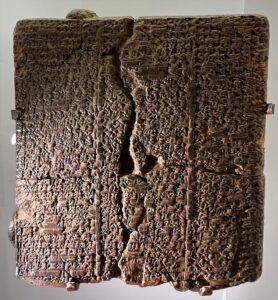
The relationship was used in Babylonian calculations more than a thousand years before Pythagoras. His name therefore cannot establish that he first discovered it. The Old Babylonian tablet MS 3052 contains a geometry problem whose solution uses the relationship now called the Pythagorean theorem.
The claim that Pythagoras supplied the first proof is also disputed. MacTutor allows that he may have done so. The Stanford Encyclopedia of Philosophy argues that early evidence does not support the attribution and considers it unlikely. Discovery and proof are separate questions in this debate.
Euclid’s Elements, compiled around 300 BCE, contains the oldest surviving axiomatic proof of the theorem. The Chinese mathematical text Zhoubi Suanjing also explains the relationship through a 3–4–5 triangle. In China, the relationship is known as Gougu. Its history extends beyond the biography of Pythagoras.
What is a Pythagoras cup?
The Pythagoras cup described by the Kotsanas Museum empties automatically when liquid rises above a specified filling limit. A siphon mechanism drains its contents. The filling threshold is the essential feature: crossing it causes the liquid already inside the cup to flow out.
The cup offers a mechanical detail alongside the mathematical and philosophical subjects associated with the name Pythagoras. The museum’s explanation centres on the siphon and the filling limit. Those features explain what the object does when it is filled too far.
Details you won’t find in guidebooks
Xenophanes portrayed Pythagoras in a satirical poem about a dog being beaten. In the poem, Pythagoras claims to recognise the soul of a dead friend in the animal’s voice. The episode connects an identifiable story with the teaching that souls pass into other bodies.
The admission of both men and women is another detail of the Croton community. Alongside its religious rules and shared living, this feature helps describe who could belong to the school.
Samos also preserves his name in its modern geography. In 1955, the town of Tigani was renamed Pythagoreio in his honour. A modern statue of Pythagoras stands at the town’s harbour. If you visit Pythagoreio, the town name and monument connect the waterfront with the island-born thinker.
How did Pythagoras die?
One account says violence in Croton around 510 BCE forced Pythagoras to flee to Metapontum. He then died there around 490 BCE. The Stanford Encyclopedia of Philosophy regards this explanation as the account based on the most reliable early testimony.
Another tradition says he died in the attacks at Croton. His death’s circumstances remain disputed, and dates also vary. Turkish Wikipedia gives approximately 495 BCE, while MacTutor gives approximately 490 BCE.
Timeline
- Around 570 BCE: Pythagoras was born on Samos.
- Around 530 BCE: He settled in Croton.
- Around 510 BCE: Violence at Croton led to his flight to Metapontum in one account.
- Around 495 or 490 BCE: Turkish Wikipedia and MacTutor give these respective approximate dates for his death. Its location and circumstances remain disputed.
- Around 300 BCE: Euclid’s Elements included the oldest surviving axiomatic proof of the theorem.
- 1955: Tigani on Samos was renamed Pythagoreio in his honour.
FAQ
Where was Pythagoras born?
Pythagoras was born around 570 BCE on Samos, an island in the Aegean Sea.
Where did Pythagoras live?
He lived on Samos before settling in Croton in southern Italy around 530 BCE. One account places his final years in Metapontum.
What is the Pythagorean theorem formula?
For a right triangle with legs a and b and hypotenuse c, the formula is a² + b² = c². The hypotenuse can be calculated as c = √(a² + b²).
Did Pythagoras discover the theorem?
The relationship appeared in Babylonian calculations more than a thousand years before Pythagoras. Whether he supplied its first proof remains disputed.
What does a Pythagoras cup do?
The cup described by the Kotsanas Museum automatically empties through a siphon mechanism when the liquid rises above a specified filling limit.
Sources
- Wikipedia — Pythagoras en.wikipedia.org
- Vikipedi — Pisagor tr.wikipedia.org
- Stanford Encyclopedia of Philosophy — Pythagoras plato.stanford.edu
- University of St Andrews, MacTutor — Pythagoras mathshistory.st-andrews.ac.uk
- Wolfram MathWorld — Pythagorean Theorem mathworld.wolfram.com
- Wikipedia — Pythagorean theorem en.wikipedia.org
- Kotsanas Museum of Ancient Greek Technology — Pythagoras Cup kotsanas.com
- Wikipedia — Pythagoreio en.wikipedia.org
Image: Pythagoras in the Roman Forum, Colosseum.jpg — Unknown authorUnknown author, Public domain