You may know the statue from photographs. Standing in front of it is different. Michelangelo’s David is 517 centimetres tall, base included. It weighs 5,560 kilograms according to the Galleria dell’Accademia in Florence. This article follows how a young sculptor turned one used block of marble into that figure, and what happened to it over the following five centuries.
If you are travelling from Turkey to Italy, or studying the Renaissance, the story is easier to follow in order. It starts with a block that nobody could finish.
A block that other sculptors had already started
David was not carved from a fresh block. The Italian Ministry of Culture’s inventory record says it was cut from a single white Carrara marble block that other sculptors had already begun to work.
The first of them was Agostino di Duccio. In 1464 he was commissioned to carve a giant figure from this block for one of the buttresses of Florence Cathedral. The same record notes that he had started shaping the stone.
That means Michelangelo inherited a problem. The stone had already been cut. He had to find a figure inside a block someone else had begun to shape. The result is still counted as one piece of marble, one figure and one artist’s design.
The commission of 16 August 1501
The Opera di Santa Maria del Fiore, the body that looks after Florence Cathedral, preserves the document that gave Michelangelo the job. It is kept in the cathedral’s archive. The date is 16 August 1501. Michelangelo was 26 years old.
The agreement set two conditions:
- He was to finish the work in two years.
- He was to be paid six gold florins a month.
The record also says where the statue was meant to go. It was designed for one of the outer buttresses in the apse of Florence Cathedral. So David began life as a cathedral figure, placed high on the building.
The inventory record says Michelangelo began cutting the marble on 13 September 1501. That is less than a month after the contract.
What the statue shows
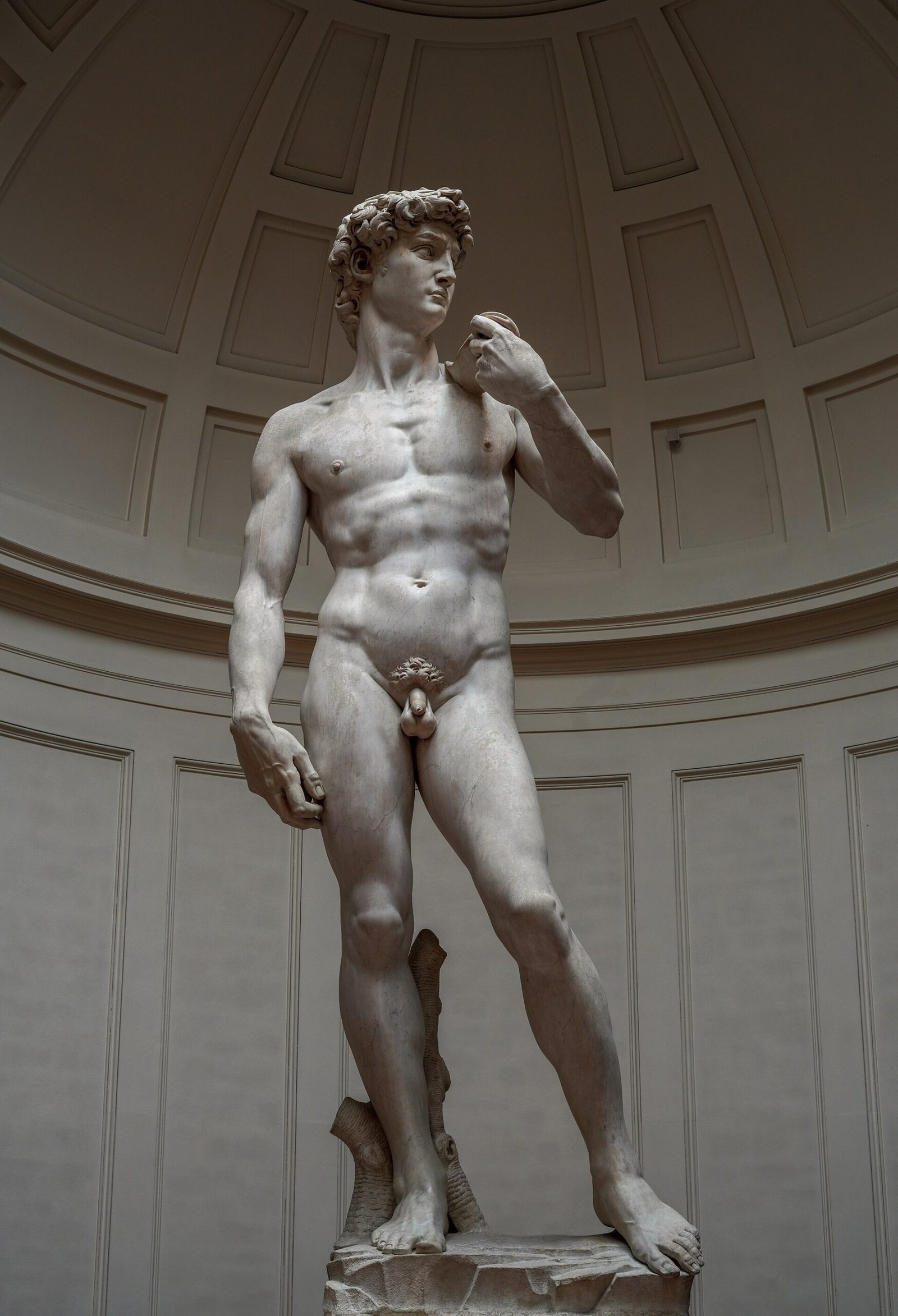
The statue represents David from the biblical story, the young man who defeated the giant Goliath. Michelangelo chose the moment before the fight. According to the Accademia’s material, he shows David as he prepares to attack Goliath.
Look at the hands. The left hand holds the strap of the sling. The right hand holds a stone. Both are details you can check yourself in the museum.
The pose also matters. The left leg is stretched forward, and the arms take opposite positions. This is the arrangement called contrapposto. It makes a standing figure look ready to move rather than frozen.
Why it did not go on the cathedral
The plan changed. The statue was finished in 1504 and a committee met on 25 January 1504 to decide where it should stand. The Accademia’s record names four members:
- Leonardo da Vinci
- Sandro Botticelli
- Filippino Lippi
- Perugino
The result was a different home. David was placed at the entrance of the Palazzo Vecchio, Florence’s seat of government. There it was meant to stand for the strength and independence of the Florentines.
The Accademia says the statue was presented to the people of Florence on 8 September 1504. Count the time from the contract: it is a little over three years. That is longer than the two years the agreement had foreseen.
So a figure ordered for a cathedral buttress ended up outside the city’s civic palace. For Florentines, a young man facing a giant became a picture of their own city.
Timeline
- 1464: Agostino di Duccio is commissioned to carve a giant marble figure for the cathedral.
- 16 August 1501: Michelangelo receives the commission for David.
- 13 September 1501: Michelangelo begins cutting the marble.
- 25 January 1504: The committee meets to decide where the statue should stand.
- 8 September 1504: David is presented to the people of Florence.
- 1527: During an anti-Medici uprising, the statue’s left arm is broken.
- 1873: The statue is moved from Piazza della Signoria to the Galleria dell’Accademia.
- 1882: The Tribuna designed for David is completed.
- 1910: A copy takes the original place in the square.
- Second World War: The statue is protected with sand and a brick enclosure.
- 1991: A hammer attack damages the second toe of the left foot.
- 2003–2004: The marble surface receives a thorough cleaning.
From the square to the museum
For centuries David stood outside. In 1873 the original was moved from Piazza della Signoria to the Galleria dell’Accademia. The Tribuna where you see it today was designed by the architect Emilio De Fabris and finished in 1882.
There is a gap between those two dates, and it is a strange one. The Accademia’s own history page says David was kept for nine years in a wooden crate until the Tribuna made for it was ready. Think of moving house with something fragile. You pack it, seal it and wait for the new room. In David’s case, that waiting lasted nine years.
In 1910 a copy was placed in the square, at the spot the original had occupied. If you walk through Piazza della Signoria today, the figure you see in the open air is that copy. The original is indoors.
Details you won’t find in guidebooks
These facts come from the museum and reference sources listed below. They are less often repeated than the height and the date.
- It once had gold on it. According to the Accademia, the wreath on David’s head, the tree trunk behind his right leg and the sling were originally gilded. The marble you see now is plain white.
- The arm was broken in 1527. During an uprising against the Medici family, the left arm was broken into three pieces.
- It was packed in sand. In the Second World War the statue was protected by packing it with sand and enclosing it in brickwork.
- A hammer attack in 1991. Piero Cannata attacked the statue with a hammer and broke the tip of the second toe on the left foot.
- The marble was cleaned in 2003–2004. The Accademia reports a wide-ranging cleaning of the surface in those years.
Taken together, these details show that David has not simply sat in one place since 1504. It has been moved, protected, damaged, repaired and cleaned.
Visiting the original
The Galleria dell’Accademia is at Via Ricasoli 58/60 in Florence. That is where the original stands, in the Tribuna built for it.
A few things to look for when you are there:
- The sling strap in the left hand and the stone in the right.
- The forward left leg and the opposite positions of the arms.
- The overall height. The 517 centimetres include the base, so the figure itself is a little shorter.
If you only visit the square, remember that you are looking at the 1910 copy. It is still worth seeing, because it stands where the original did for centuries, at the entrance of the Palazzo Vecchio.
FAQ
How tall is Michelangelo’s David?
The statue is 517 centimetres tall, including its carved base. The Galleria dell’Accademia lists its weight as 5,560 kilograms.
When did Michelangelo carve David?
He worked on it in Florence between 1501 and 1504. The commission is dated 16 August 1501, and the statue was presented to the public on 8 September 1504.
Where is the original David today?
The original stands in the Galleria dell’Accademia in Florence, at Via Ricasoli 58/60. A copy has stood in Piazza della Signoria, the original outdoor site, since 1910.
Was David carved from one block of marble?
Yes. It was cut from a single white Carrara marble block that other sculptors, including Agostino di Duccio, had begun to work earlier.
Which moment of the story does the statue show?
Michelangelo shows David as he prepares to attack Goliath. The left hand holds the sling’s strap and the right hand holds a stone.
Sources
- Galleria dell’Accademia di Firenze — David galleriaaccademiafirenze.it
- Italian Ministry of Culture — David inventory record catalogo.cultura.gov.it
- Opera di Santa Maria del Fiore — David commission document duomo.firenze.it
- Galleria dell’Accademia di Firenze — Social History galleriaaccademiafirenze.it
- Galleria dell’Accademia di Firenze — La Galleria galleriaaccademiafirenze.it
- Galleria dell’Accademia di Firenze — Visitor kit galleriaaccademiafirenze.it
- Wikipedia — David (Michelangelo) en.wikipedia.org
- Vikipedi — Davut (Michelangelo) tr.wikipedia.org
Image: Michelangelo’s David – right view 2.jpg — Commonists, CC BY-SA 4.0