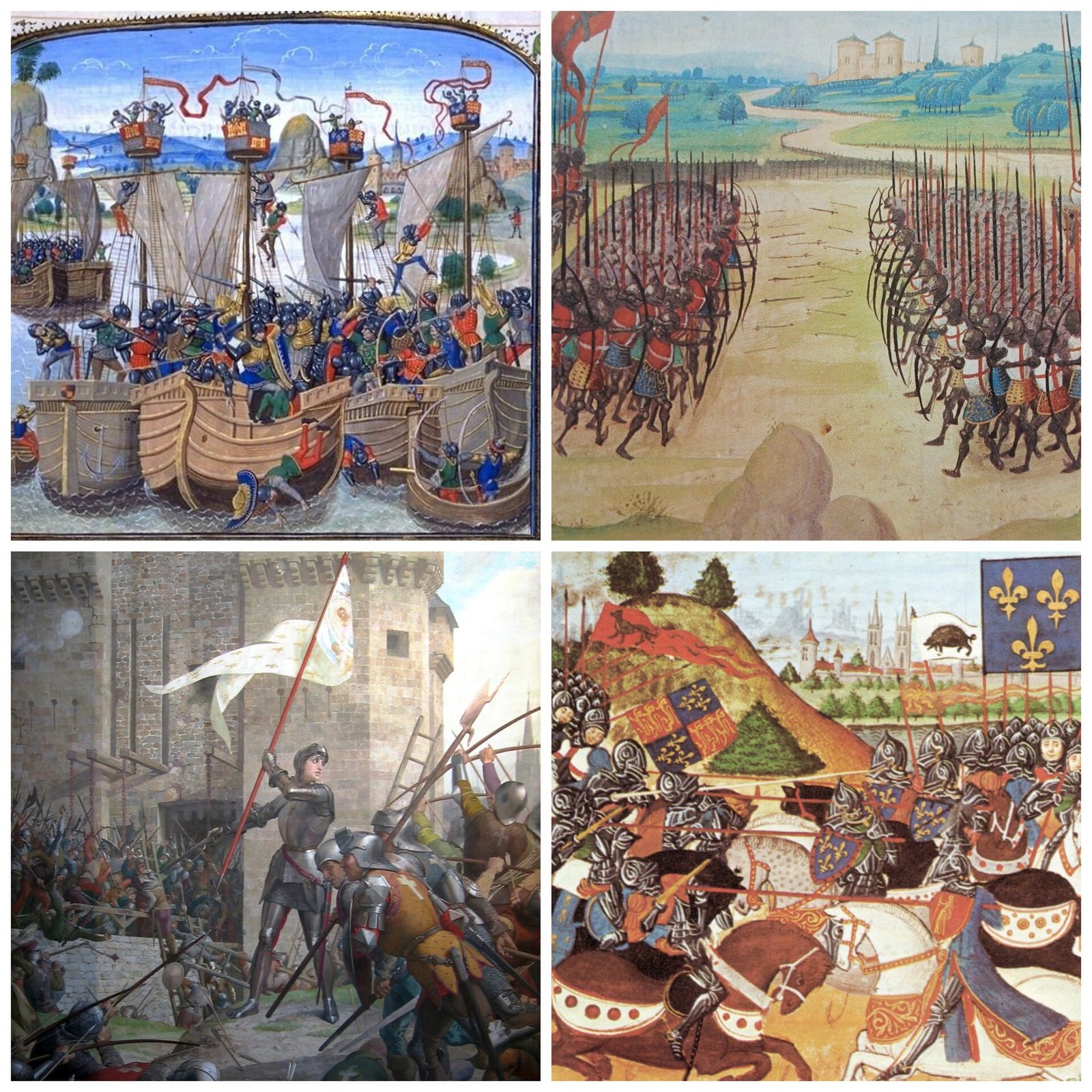
The Hundred Years’ War began because England’s king held land in France under the authority of France’s king. That arrangement created a dispute over sovereignty. A contested French succession made it harder to resolve. In 1337, Philip VI ordered the confiscation of Edward III’s French territories. This decision triggered the war.
If you want to understand the conflict, start with Aquitaine and the disputed crown. Edward III ruled England as king. In Aquitaine, however, he held his lands as a duke subordinate to the French king. The same ruler therefore occupied different positions on either side of the dispute.
Hundred Years’ War summary and definition
The Hundred Years’ War was a series of wars between the kingdoms of England and France from 1337 to 1453. Truces interrupted the fighting. Its accepted beginning and end stand 116 years apart, despite the familiar name.
The conflict combined territorial rights with royal succession. English kings sought to protect their French possessions. Edward III also claimed France’s throne through his mother, Isabella. French nobles instead accepted Philip of Valois as Philip VI in 1328.
France ultimately won. Bordeaux surrendered to the French on 19 October 1453, following the French victory at nearby Castillon. By the end of that year, Calais was the only French territory England retained.
Why did the Hundred Years’ War begin over Aquitaine?
The underlying problem was the English king’s position as a French duke. His authority over Aquitaine existed within a relationship that placed the French king above him. Disputes over those lands could therefore become disputes about who had the final say.
The roots of this tension reached back to 1066. William, Duke of Normandy, became king of England that year. The relationship between the English crown and territories held under French authority formed the background to the later conflict.
An everyday comparison helps you follow the problem. Imagine managing a property while someone above you retains the power to hear complaints about your decisions. In Aquitaine, subjects who disputed the English king’s actions could appeal to his feudal superior, the French king. The arrangement gave sovereignty a practical meaning.
Philip VI’s support for the Scots fighting England increased tensions with Edward III. Then, in 1337, Philip ordered the confiscation of Edward’s French lands. The older disagreement over authority had produced a direct threat to English possessions.
Why was the French crown disputed?
Charles IV of France died in 1328 without a son or a surviving brother. His death created a succession crisis. Edward III advanced a claim through Isabella, his mother and Charles’s sister.
French nobles chose Philip of Valois, Charles IV’s cousin on his father’s side. He became Philip VI. The succession dispute therefore placed Edward’s maternal connection against Philip’s place in the male line of the royal family.
The French response challenged Edward’s route to the throne. Isabella, they argued, could not transmit a right she did not possess herself. The disagreement concerned whether Edward could inherit through his mother, as well as which claimant should rule.
You should separate the succession crisis from the immediate outbreak of war. Philip became king in 1328. His confiscation decision came in 1337. Edward formally adopted the title of king of France in 1340, turning the territorial dispute into an explicit contest between rival claimants.
How did Scotland and Flanders deepen the conflict?
Philip VI supported the Scots who were fighting England. This support worsened his relationship with Edward III. The struggle over French lands was therefore connected to another conflict involving the English king.
Flanders supplied an economic link. Its cloth-producing towns depended on English wool. That dependence helped underpin Edward III’s alliances in the region. Wool and cloth production gave these relationships a material foundation alongside the dispute over kingship.
In 1340, the authorities of Ghent, Ypres and Bruges recognized Edward as king of France. This recognition allowed his allies to support him without presenting themselves as rebels against the French crown. They could claim loyalty to the king they recognized.
Hundred Years’ War map: where was it fought?
To follow the war on a map, begin with England and France, then locate Aquitaine. The English king’s position there explains the original sovereignty dispute. Add Flanders to understand the wool-linked alliances, and Scotland to follow Philip VI’s support for England’s opponents.
The military story includes the naval battle of Sluys and land battles at Crécy, Poitiers, Agincourt and Castillon. Calais and Orléans also matter because of their sieges. These places show why a map of the conflict needs more than the location of a single battlefield.
Bordeaux and nearby Castillon mark the final events of 1453. Calais represents a different outcome. English forces captured it in 1347, and England still held it when its other French territories had been lost by the end of 1453.
Hundred Years’ War timeline: 1337–1453 and its roots
- 1066: William, Duke of Normandy, became king of England, establishing the background to later feudal tensions.
- 1328: Charles IV died. Philip VI succeeded him on the French throne.
- 1337: Philip VI’s decision to confiscate Edward III’s lands in Aquitaine triggered war.
- 1340: Edward adopted the French royal title. England won the naval battle of Sluys on 24 June.
- 1346: Edward III’s army defeated the French at Crécy on 26 August.
- 1347: Calais fell to the English in August after a siege begun in September 1346.
- 1356: The English captured King John II of France at Poitiers.
- 1360: The Treaty of Brétigny provided for extensive French territorial concessions to England.
- 1415: Henry V’s English army won at Agincourt on 25 October.
- 1420: The Treaty of Troyes, dated 21 May, provided for Henry V to succeed Charles VI of France.
- 1429: The English lifted the siege of Orléans on 8 May after a French campaign involving Joan of Arc.
- 1435: The Treaty of Arras reconciled Burgundy with the French king, costing England an important ally.
- 17 July 1453: French forces decisively defeated the English at Castillon near Bordeaux.
- 19 October 1453: Bordeaux surrendered to the French, marking the accepted end of the war.
Which Hundred Years’ War battles mattered?
England achieved major early victories at Sluys, Crécy and Poitiers. These victories involved different kinds of military success. Sluys was a naval battle. Crécy was a victory for Edward III’s army. At Poitiers, the English captured the French king, John II.
Territory remained central after these victories. The English took Calais in 1347. The Treaty of Brétigny in 1360 provided for France to surrender extensive lands to England. Both events belong to a conflict that had begun over the authority governing English possessions in France.
Henry V won at Agincourt in 1415. The Treaty of Troyes followed in 1420 and provided for him to succeed Charles VI. Once again, the war’s course linked military success with the question of who should inherit the French crown.
The later sequence favored France. The English lifted the siege of Orléans in 1429. England lost Burgundy as an ally through the settlement at Arras in 1435. French victory at Castillon and Bordeaux’s surrender completed the accepted closing sequence in 1453.
Details you won’t find in guidebooks
Appeals from Aquitaine made the feudal relationship concrete. A subject in conflict with the English king could seek a judgment from the French king. The disagreement between the rulers therefore reached into the handling of disputes within English-held territory.
The legal explanation for the succession also needs care. According to Craig Taylor, official Valois writers began using Salic Law to explain the succession only around 1413. That is much later than the crisis of 1328, despite its prominence in familiar accounts of Edward’s exclusion.
Truces did not necessarily end soldiers’ military employment. English and French soldiers could join mercenary formations called the Great Companies. These groups served different sides for payment. Their activity is another reason to distinguish a truce from a complete end to armed service.
FAQ
Why did the Hundred Years’ War begin?
The war grew from a sovereignty dispute over the English king’s French lands and a contested royal succession. Philip VI’s decision to confiscate Edward III’s territories in 1337 was the immediate trigger.
What were the Hundred Years’ War dates?
The accepted dates are 1337–1453, a span of 116 years. Truces interrupted the fighting, so this was a series of wars rather than continuous combat.
Where was the Hundred Years’ War fought?
The conflict concerned England and France, with land battles at places including Crécy, Poitiers, Agincourt and Castillon. It also included the naval battle of Sluys and sieges at Calais and Orléans.
Who won the Hundred Years’ War?
France won. French forces defeated the English at Castillon on 17 July 1453, and Bordeaux surrendered on 19 October. By the end of 1453, England retained only Calais among its French territories.
Sources
- Royal Armouries — The Hundred Years’ War, 1337–1453 royalarmouries.org
- Oxford Bibliographies — Hundred Years War, Anne Curry academic.oup.com
- Oxford Bibliographies — The Hundred Years War, Clifford J. Rogers academic.oup.com
- Swansea University — Guto’r Glyn’s Wales: Background gutoswales.swansea.ac.uk
- Craig Taylor — Edward III and the Plantagenet Claim to the French Throne cambridge.org
- English Wikipedia — Hundred Years’ War en.wikipedia.org
- Turkish Wikipedia — Yüz Yıl Savaşı tr.wikipedia.org
Image: Hundred years war collage.jpg — Blaue Max, CC BY-SA 4.0