The Topkapı Dagger was made for a ruler who never received it. Commissioned by the Ottoman sultan Mahmud I for Nader Shah of Iran, it combined emeralds, gold, diamonds, and a concealed watch. The embassy carrying it learned that its intended recipient had been assassinated. The dagger returned to Istanbul and entered the treasury at Topkapı Palace.
If you approach it as a famous emerald ornament, its unfinished journey adds another way to read the object. This was a diplomatic gift with a named recipient and an organized delivery. Its history turns on the gap between the embassy’s departure on 11 May 1747 and Nader Shah’s death on 20 June.
What is the Topkapı Dagger?
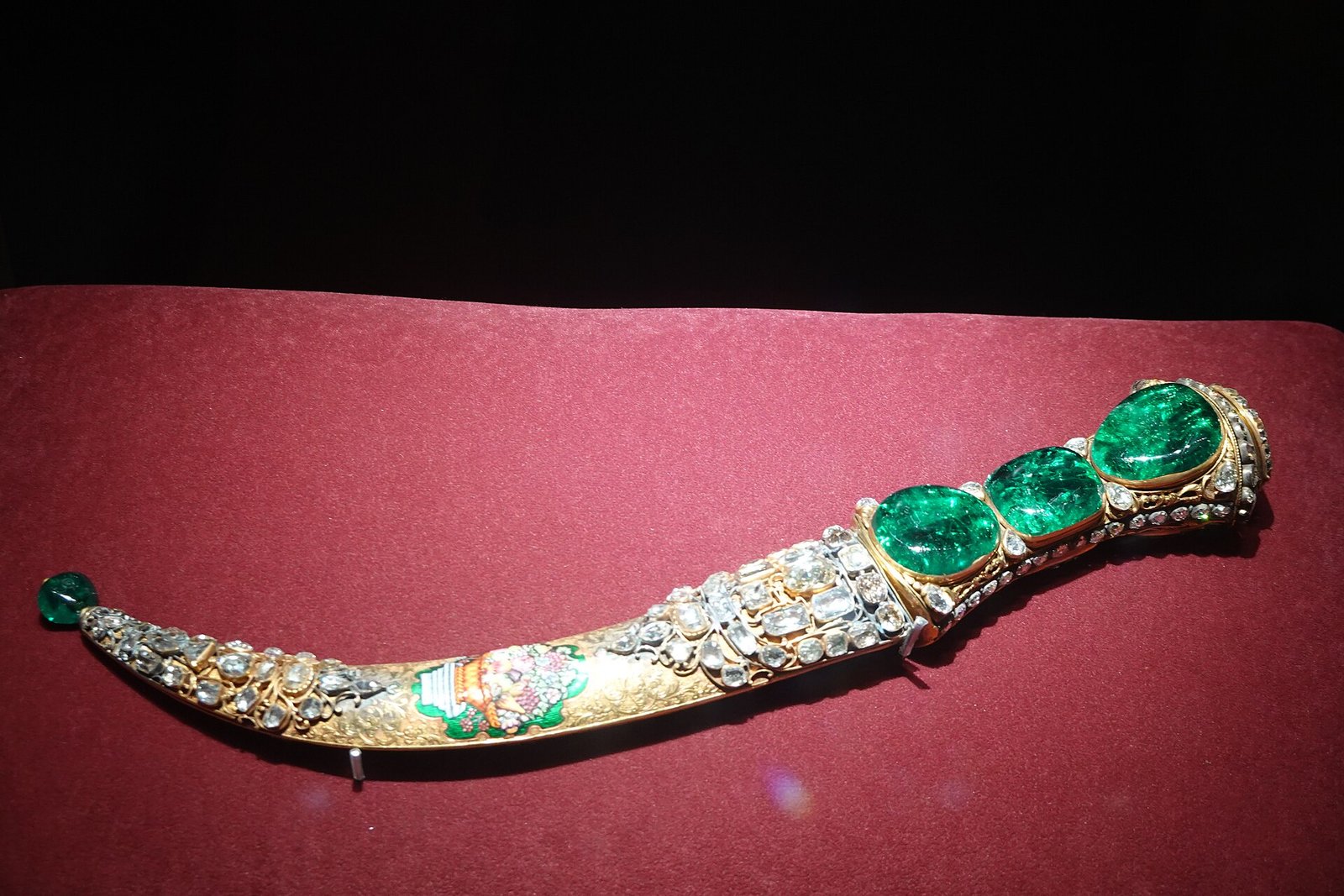
The Topkapı Dagger, known in Turkish as Topkapı Hançeri, is an Ottoman-made dagger of the curved cenbiye type. Its handle and sheath are largely gold. Three large Colombian emeralds occupy one face of the handle, while small rose-cut diamonds decorate the sheath. These materials explain the familiar description, the Topkapı emerald dagger.
The Osaka Museum of History records a length of 35 centimetres and a width of 6 centimetres. Those measurements give you a useful sense of scale before considering the individual stones. The object brings together a curved blade, a richly decorated handle, a fitted sheath, and a small timepiece within those dimensions.
Both the Turkish and English Wikipedia entries date its manufacture to 1746. Mahmud I, who ruled from 1730 to 1754, commissioned it for Nader Shah. The English account describes the commission as a peace gift. Its gold and emeralds therefore belonged to a specific diplomatic purpose, rather than an unnamed treasury commission.
Topkapı Dagger history: a gift for Nader Shah
Mehmet Önder’s account, published on the Bilkent University website, connects the dagger’s materials directly to the Ottoman treasury. The stones came from that treasury, and leading Istanbul jewellers received the commission. The finished work brought treasury gemstones and the city’s jewellery craftsmanship together in an object intended to leave Ottoman possession.
Kesriyeli Ahmed Pasha headed the embassy entrusted with the gifts. Approximately 1,000 people accompanied him. The dagger travelled as part of this larger diplomatic undertaking. Önder dates the delegation’s departure to 11 May 1747, placing the object within a journey whose beginning can be identified precisely.
The everyday comparison is a carefully chosen gift whose delivery matters as much as its contents. Mahmud I had the dagger made for Nader Shah, and an embassy carried it toward him. Its intended meaning depended on reaching that recipient. The assassination prevented that final exchange.
Nader Shah was killed on 20 June 1747. The Ottoman delegation learned of his death while travelling and returned without delivering the dagger. In Önder’s account, Ahmed Pasha turned back to prevent the gifts from being looted after the shah’s death. The decision preserved the dagger among the returning presents.
After its return, the dagger was placed in the Topkapı Palace treasury. That destination completed a very different journey from the one Mahmud I had planned. An object commissioned for the Iranian ruler became part of the Ottoman palace collection, with its unfulfilled purpose remaining central to its history.
Timeline
- 1746: The Wikipedia entries date the dagger’s manufacture to this year, following Mahmud I’s commission for Nader Shah.
- 11 May 1747: According to Mehmet Önder, the gift-bearing embassy led by Kesriyeli Ahmed Pasha departed.
- 20 June 1747: Nader Shah was assassinated. After hearing the news during its journey, the Ottoman delegation returned with the dagger.
- 2000: The dagger appeared in the Palace of Gold & Light exhibition in the United States.
- 9 July 2003: Hürriyet reported that the dagger had been insured for $50 million for an exhibition in Japan.
- 29 June 2024: National Palaces began night visits that included the Treasury Exhibition, naming the dagger among the objects visitors could see.
Details you won’t find in guidebooks
The three large handle emeralds have different shapes. The central stone is rectangular and cushion-cut. The stones on either side are pear-shaped, with their pointed ends facing inward. If you examine their arrangement, the inward-facing points are a specific detail to notice alongside the size and colour of the emeralds.
The opposite face of the handle carries mother-of-pearl and enamel decoration. The three emeralds therefore represent only one side of the handle’s design. Its decoration also includes materials with different surfaces and finishes, making the reverse relevant to understanding the craftsmanship of the whole object.
The sheath has an enamel miniature showing fruit gathered in a basket. It sits in the middle section, alongside the sheath’s precious-metal and diamond decoration. This small pictorial scene gives you something concrete to look for beyond the gemstones: a basket of fruit rendered through enamel work.
The dagger also travelled abroad long after its interrupted diplomatic mission. The Osaka Museum of History records its appearance in the 2000 Palace of Gold & Light exhibition, which included Washington, San Diego, and Florida. That exhibition journey belongs to its later history as a museum object.
The Topkapı Dagger watch: what is inside the handle?
A small London-made winding watch is fitted into the pommel, at the end of the handle. An opening octagonal cover set with emerald conceals it. The watch is thus part of the dagger itself, housed within the same handle whose other decorations include the three large emeralds.
The cover makes the timepiece a detail that requires a closer explanation than the phrase “emerald dagger” provides. The octagonal, emerald-set cover opens, while the three Colombian emeralds occupy a face of the handle. Keeping those positions in mind helps distinguish the watch cover from the main gemstone arrangement.
Topkapı Dagger price and worth: what does $50 million mean?
The $50 million figure comes from exhibition insurance. In a report dated 9 July 2003, Hürriyet stated that NHK and Toei had insured the dagger for that amount for its exhibition in Japan. The report documents a particular insurance arrangement connected to a particular exhibition.
If you are searching for the Topkapı Dagger’s price, the distinction matters. The reported sum was an insurance amount, not a documented sale price. Describing it simply as a dagger “sold for $50 million” would change the meaning of the evidence. The figure belongs to its exhibition history and should retain that context.
The dagger at Topkapı Palace
The dagger belongs to the Imperial Treasury collection in the third courtyard of Topkapı Palace in Istanbul. For a traveller, that collection provides the connection between the object and its palace setting. The dagger returned to the palace treasury after the failed embassy and remains associated with that treasury collection.
National Palaces also named it in an announcement about night visits beginning on 29 June 2024. The announcement included the dagger among works in the Treasury Exhibition. This dated reference connects the historic gift with the palace’s presentation of its treasury objects to visitors.
The 1964 film Topkapi increased the dagger’s international recognition through a fictional robbery plot targeting the emerald dagger in the palace treasury.
FAQ
Why did the Topkapı Dagger never reach Nader Shah?
The Ottoman embassy learned during its journey that Nader Shah had been assassinated on 20 June 1747. It returned to Istanbul with the dagger.
What is the Topkapı Dagger worth?
A report dated 9 July 2003 recorded insurance of $50 million for an exhibition in Japan. That figure was an exhibition insurance amount, not a documented sale price.
Does the Topkapı Dagger contain a watch?
Yes. A small London-made winding watch sits in the pommel beneath an opening cover set with an octagonal emerald.
Where is the Topkapı Dagger?
It belongs to the Imperial Treasury collection in the third courtyard of Topkapı Palace in Istanbul.
Sources
- Vikipedi — Topkapı Hançeri tr.wikipedia.org
- Wikipedia — Topkapı Dagger en.wikipedia.org
- Osaka Museum of History — Topkapi Dagger osakamushis.jp
- Bilkent University — Mehmet Önder, The Emerald Dagger ee.bilkent.edu.tr
- National Palaces — Topkapı Sarayı Artık Gece de Ziyaret Edilebiliyor millisaraylar.gov.tr
- Hürriyet — Topkapı Hançeri’ne 50 milyon dolarlık sigorta hurriyet.com.tr
Image: Topkapı Dagger.jpg — Joseolgon, CC BY 4.0